

Pearson+ LogoPearson+ Logo
Ch. 20 - Population Genetics and Evolution at the Population, Species, and Molecular Levels
Sanders - Genetic Analysis: An Integrated Approach 3rd Edition
Sanders3rd EditionGenetic Analysis: An Integrated ApproachISBN: 9780135564172Not the one you use?Change textbook
Chapter 20, Problem 24a

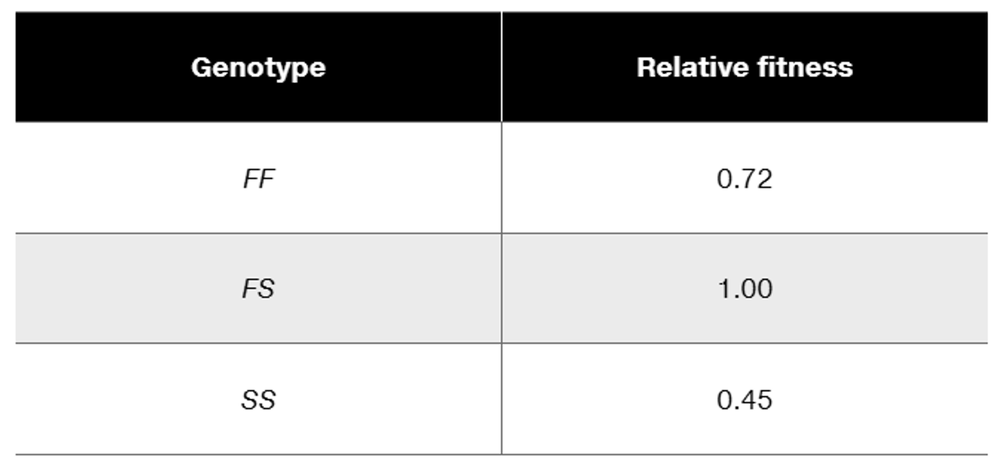
In the mouse, Mus musculus, survival in agricultural fields that are regularly sprayed with a herbicide is determined by the genotype for a detoxification enzyme encoded by a gene with two alleles, F and S. The relative fitness values for the genotypes are
Table showing genotypes FF, FS, SS and their relative fitness values: 0.72, 1.00, and 0.45 respectively.
Why will this pattern of natural selection result in a stable equilibrium of frequencies of F and S?

Verified step by step guidance
1
Understand the concept of relative fitness: Relative fitness measures the reproductive success of a genotype compared to others in the population. In this case, FS has the highest relative fitness (1.00), followed by FF (0.72) and SS (0.45). This indicates that heterozygotes (FS) are favored by natural selection.
Recognize the type of selection: The pattern of relative fitness values suggests heterozygote advantage (also known as overdominance). This occurs when the heterozygous genotype has a higher fitness than either homozygous genotype, leading to a stable equilibrium of allele frequencies.
Explain the equilibrium mechanism: In heterozygote advantage, natural selection maintains both alleles in the population because the heterozygous genotype (FS) is the most fit. If one allele becomes too rare, the likelihood of producing heterozygotes decreases, reducing overall population fitness. Selection then favors the rarer allele to restore balance.
Describe the mathematical basis: The equilibrium frequency of alleles F and S can be calculated using population genetics equations that account for relative fitness values. The equilibrium occurs when the change in allele frequencies due to selection is zero, meaning the population reaches a stable state where both alleles are maintained.
Conclude why equilibrium is stable: The stable equilibrium arises because neither allele can completely replace the other due to the fitness advantage of heterozygotes. This ensures that both alleles persist in the population over time, maintaining genetic diversity.

Verified video answer for a similar problem:

This video solution was recommended by our tutors as helpful for the problem above.
Video duration:
2m
Was this helpful?

Key Concepts

Here are the essential concepts you must grasp in order to answer the question correctly.

Natural Selection

Natural selection is a fundamental mechanism of evolution where individuals with advantageous traits are more likely to survive and reproduce. In this context, the relative fitness values of the genotypes indicate how well each genotype performs in the presence of herbicide. The FS genotype has the highest fitness, suggesting it is favored in the environment, while FF and SS are less fit.
Recommended video:
Guided course
05:54
Natural Selection

Genotype Frequencies

Genotype frequencies refer to the proportion of different genotypes within a population. In this scenario, the frequencies of the F and S alleles will change over time due to natural selection. The stable equilibrium occurs when the rates of increase and decrease of these genotypes balance out, leading to a consistent presence of both alleles in the population.
Recommended video:
Guided course
07:52
Gamete Genotypes

Stable Equilibrium

A stable equilibrium in population genetics occurs when allele frequencies remain constant over time, despite ongoing selection pressures. In this case, the relative fitness values create a balance where the advantageous FS genotype maintains its frequency, while the less fit genotypes do not completely disappear. This dynamic allows for the coexistence of both alleles, F and S, in the population.
Recommended video:
Related Practice
Textbook Question

Tay–Sachs disease is an autosomal recessive neurological disorder that is fatal in infancy. Despite its invariably lethal effect, Tay–Sachs disease occurs at very high frequency in some Central and Eastern European (Ashkenazi) Jewish populations. In certain Ashkenazi populations, 1 in 750 infants has Tay–Sachs disease. Population biologists believe the high frequency is a consequence of genetic bottlenecks caused by pogroms (genocide) that have reduced the population multiple times in the past several hundred years. In the population described, what is the frequency of the recessive allele that produces Tay–Sachs disease?

913
views
1
rank
Textbook Question

Tay–Sachs disease is an autosomal recessive neurological disorder that is fatal in infancy. Despite its invariably lethal effect, Tay–Sachs disease occurs at very high frequency in some Central and Eastern European (Ashkenazi) Jewish populations. In certain Ashkenazi populations, 1 in 750 infants has Tay–Sachs disease. Population biologists believe the high frequency is a consequence of genetic bottlenecks caused by pogroms (genocide) that have reduced the population multiple times in the past several hundred years. Assuming mating occurs at random in this population, what is the probability a couple are both carriers of Tay–Sachs disease?

498
views
Textbook Question
Cystic fibrosis (CF) is the most common autosomal recessive disorder in certain Caucasian populations. In some populations, approximately 1 in 2000 children have CF. Determine the frequency of CF carriers in this population.
796
views
Textbook Question

In the mouse, Mus musculus, survival in agricultural fields that are regularly sprayed with a herbicide is determined by the genotype for a detoxification enzyme encoded by a gene with two alleles, F and S. The relative fitness values for the genotypes are

Calculate the equilibrium frequencies of the alleles.

419
views
Textbook Question

In a population of flowers growing in a meadow, C1 and C2 are autosomal codominant alleles that control flower color. The alleles are polymorphic in the population, with f(C1) = 0.80 and f(C2) = 0.20. Flowers that are C1C1 are yellow, orange flowers are C1C2, and C2C2 flowers are red. A storm blows a new species of hungry insects into the meadow, and they begin to eat yellow and orange flowers but not red flowers. The predation exerts strong natural selection on the flower population, resulting in relative fitness values of C1C1 = 0.30, C1C2 = 0.60, and C2C2 = 1.0.

Assuming the population begins in H-W equilibrium, what are the allele frequencies after one generation of natural selection?

488
views
Textbook Question

In a population of flowers growing in a meadow, C1 and C2 are autosomal codominant alleles that control flower color. The alleles are polymorphic in the population, with f (C1) = 0.80 and f (C2) = 0.20. Flowers that are C1C1 are yellow, orange flowers are C1C2, and C2C2 flowers are red. A storm blows a new species of hungry insects into the meadow, and they begin to eat yellow and orange flowers but not red flowers. The predation exerts strong natural selection on the flower population, resulting in relative fitness values of C1C1 = 0.30, C1C2 = 0.60, and C2C2 = 1.0.

Assuming random mating takes place among survivors, what are the genotype frequencies in the second generation?

502
views