Pearson+ LogoPearson+ Logo
Ch. 20 - Population Genetics and Evolution at the Population, Species, and Molecular Levels
Sanders - Genetic Analysis: An Integrated Approach 3rd Edition
Sanders3rd EditionGenetic Analysis: An Integrated ApproachISBN: 9780135564172Not the one you use?Change textbook
Chapter 20, Problem 21a

The frequency of tasters and nontasters of PTC varies among populations. In population A, 64% of people are tasters (an autosomal dominant trait) and 36% are nontasters. In population B, tasters are 75% and nontasters 25%. In population C, tasters are 91% and nontasters are 9%.
Calculate the frequency of the dominant (T) allele for PTC tasting and the recessive (t) allele for nontasting in each population.

Verified step by step guidance
1
Step 1: Recognize that the problem involves calculating allele frequencies using the Hardy-Weinberg principle. The Hardy-Weinberg equation is p² + 2pq + q² = 1, where p is the frequency of the dominant allele (T), q is the frequency of the recessive allele (t), p² represents the frequency of homozygous dominant individuals, 2pq represents the frequency of heterozygous individuals, and q² represents the frequency of homozygous recessive individuals.
Step 2: Identify the frequency of nontasters (q²) in each population. For population A, q² = 36% (0.36). For population B, q² = 25% (0.25). For population C, q² = 9% (0.09).
Step 3: Calculate the frequency of the recessive allele (q) for each population by taking the square root of q². Use the formula q = √q². For example, for population A, q = √0.36.
Step 4: Calculate the frequency of the dominant allele (p) for each population using the relationship p + q = 1. Rearrange the equation to solve for p: p = 1 - q. For example, for population A, if q is calculated as √0.36, then p = 1 - q.
Step 5: Verify your results by ensuring that the calculated allele frequencies satisfy the Hardy-Weinberg equation (p² + 2pq + q² = 1). For each population, calculate p², 2pq, and q² using the values of p and q, and confirm that their sum equals 1.

Verified video answer for a similar problem:

This video solution was recommended by our tutors as helpful for the problem above.
Video duration:
2m
Was this helpful?

Key Concepts

Here are the essential concepts you must grasp in order to answer the question correctly.

Hardy-Weinberg Principle

The Hardy-Weinberg Principle provides a mathematical framework for understanding allele frequencies in a population. It states that allele and genotype frequencies will remain constant from generation to generation in the absence of evolutionary influences. This principle allows us to calculate the expected frequencies of dominant and recessive alleles based on observed phenotypic ratios.
Recommended video:
Guided course
13:04
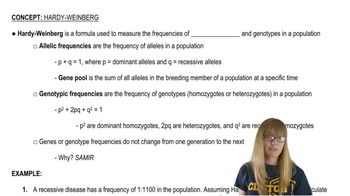
Hardy Weinberg

Allele Frequency Calculation

Allele frequency refers to how often a particular allele appears in a population. For a trait governed by two alleles, such as T (dominant) and t (recessive), the frequencies can be calculated using the formula p + q = 1, where p is the frequency of the dominant allele and q is the frequency of the recessive allele. This calculation is essential for determining the genetic makeup of populations.
Recommended video:
Guided course
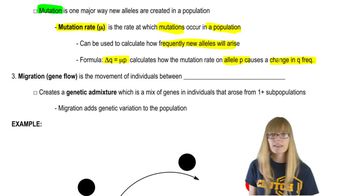
03:03
New Alleles and Migration

Phenotypic Ratio

Phenotypic ratio is the proportion of different phenotypes observed in a population. In this case, the ratio of tasters to nontasters reflects the underlying genotypes influenced by the dominant and recessive alleles. Understanding this ratio is crucial for applying the Hardy-Weinberg Principle to calculate allele frequencies, as it provides the necessary data to derive the frequencies of T and t alleles.
Recommended video:
Guided course
10:48
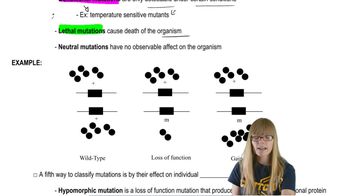
Mutations and Phenotypes
Related Practice
Textbook Question

Sickle cell disease (SCD) is found in numerous populations whose ancestral homes are in the malaria belt of Africa and Asia. SCD is an autosomal recessive disorder that results from homozygosity for a mutant β-globin gene allele. Data on one affected population indicates that approximately 8 in 100 newborn infants have SCD.

What are the frequencies of the wild-type (βᴬ) and mutant (βˢ) alleles in this population?

572
views
Textbook Question

Sickle cell disease (SCD) is found in numerous populations whose ancestral homes are in the malaria belt of Africa and Asia. SCD is an autosomal recessive disorder that results from homozygosity for a mutant β-globin gene allele. Data on one affected population indicates that approximately 8 in 100 newborn infants have SCD.

What is the frequency of carriers of SCD in the population?

681
views
Textbook Question

Epidemiologic data on the population in the previous problem reveal that before the application of modern medical treatment, natural selection played a major role in shaping the frequencies of alleles. Heterozygous individuals have the highest relative fitness, and in comparison with heterozygotes, those who are βᴬβᴬ have a relative fitness of 82%, but only about 32% of those with SCD survived to reproduce. What are the estimated equilibrium frequencies of βᴬ and βˢ in this population?

397
views
Textbook Question

The frequency of tasters and nontasters of PTC varies among populations. In population A, 64% of people are tasters (an autosomal dominant trait) and 36% are nontasters. In population B, tasters are 75% and nontasters 25%. In population C, tasters are 91% and nontasters are 9%.

Assuming that Hardy–Weinberg conditions apply, determine the genotype frequencies in each population.

1286
views
Textbook Question

Tay–Sachs disease is an autosomal recessive neurological disorder that is fatal in infancy. Despite its invariably lethal effect, Tay–Sachs disease occurs at very high frequency in some Central and Eastern European (Ashkenazi) Jewish populations. In certain Ashkenazi populations, 1 in 750 infants has Tay–Sachs disease. Population biologists believe the high frequency is a consequence of genetic bottlenecks caused by pogroms (genocide) that have reduced the population multiple times in the past several hundred years. What is a genetic bottleneck?

800
views
Textbook Question

Tay–Sachs disease is an autosomal recessive neurological disorder that is fatal in infancy. Despite its invariably lethal effect, Tay–Sachs disease occurs at very high frequency in some Central and Eastern European (Ashkenazi) Jewish populations. In certain Ashkenazi populations, 1 in 750 infants has Tay–Sachs disease. Population biologists believe the high frequency is a consequence of genetic bottlenecks caused by pogroms (genocide) that have reduced the population multiple times in the past several hundred years. Explain how a genetic bottleneck and its aftermath could result in a population that carries a lethal allele in high frequency.

552
views