How can ancient DNA provide insight into past migrations that analyses of extant human genomes fail to uncover?

Sanders 3rd Edition
Ch. 20 - Population Genetics and Evolution at the Population, Species, and Molecular Levels
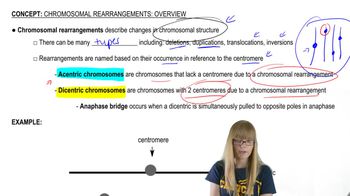
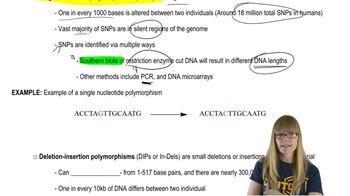
Problem D.13When the human genome is examined, the chromosomes appear to have undergone only minimal rearrangement in the 100 million years since the last common ancestor of eutherian mammals. However, when individual humans are examined or when the human genome is compared with that of chimpanzees, a large number of small indels and SNPs can be detected. How are these observations reconciled?
Verified step by step guidance
Verified video answer for a similar problem:
Key Concepts
Chromosomal Rearrangements and Genome Stability
Small-scale Genetic Variations: SNPs and Indels
Evolutionary Timescales and Mutation Rates
Denisovans are known from bones found in Denisova Cave in the Altai Mountains in Siberia, but traces of their DNA are found in Australians and Melanesians, whose ancestors likely migrated across Asia much farther to the south. How can these geographic differences be reconciled?
In Island Melanesia and Polynesia, most mtDNA haplotypes are of Asian ancestry, whereas Y chromosome haplotypes are predominantly New Guinean. Provide a hypothesis for this sex-biased distribution.
The mtDNA sequence of Neanderthals is more similar to that of modern humans than to that of Denisovans. However, analyses of nuclear DNA clearly indicate that Neandertals and Denisovans share a more recent common ancestor than either of these hominins shares with modern humans. Propose a hypothesis to resolve the discrepancy between the mtDNA and the nuclear genome.
A 9-bp deletion in the mitochondrial genome between the gene for cytochrome oxidase subunit II and the gene for tRNAᴸʸˢ is a common polymorphism among Polynesians and also in a population of Taiwanese natives. The frequency of the polymorphism varies between populations: The highest frequency is seen in the Maoris of New Zealand (98%), lower levels are seen in eastern Polynesia (80%) and western Polynesia (89%), and the lowest level is seen in the Taiwanese population. What do these frequencies tell us about the settlement of the Pacific by the ancestors of the present-day Polynesians?
If you were to compare your genome sequence with that of your parents, how would it differ? If you were to compare your genome sequence with another student's in the class, how would it differ? What additional difference might you see if your genome was compared with that of a sub-Saharan African, or if you are of sub-Saharan African descent, with that of a non-African?