Pearson+ LogoPearson+ Logo
Ch. 3 - Cell Division and Chromosome Heredity
Sanders - Genetic Analysis: An Integrated Approach 3rd Edition
Sanders3rd EditionGenetic Analysis: An Integrated ApproachISBN: 9780135564172Not the one you use?Change textbook
Chapter 3, Problem 9

Alleles A and a are on one pair of autosomes, and alleles B and b are on a separate pair of autosomes. Does crossover between one pair of homologs affect the expected proportions of gamete genotypes? Why or why not? Does crossover between both pairs of chromosomes affect the expected gamete proportions? Why or why not?

Verified step by step guidance
1
Step 1: Understand that alleles A and a are located on one pair of homologous autosomes, and alleles B and b are located on a separate, different pair of homologous autosomes. Each pair segregates independently according to Mendel's law of independent assortment.
Step 2: Recall that crossover (or recombination) occurs between homologous chromosomes during meiosis and can shuffle alleles on the same chromosome, creating new combinations of alleles on that chromosome.
Step 3: Analyze the effect of crossover on one pair of homologs (e.g., the pair carrying A and a). Since the other pair (carrying B and b) is on a different chromosome, crossover on the A/a pair does not affect the allele combinations on the B/b pair. Therefore, crossover on one pair affects only the gamete genotypes related to that pair, but not the overall expected proportions of gametes when considering both pairs together.
Step 4: Consider crossover occurring on both pairs of chromosomes. Since each pair can independently undergo crossover, recombination can generate new allele combinations on both pairs. However, because the pairs assort independently, the overall expected proportions of gamete genotypes are determined by the independent assortment of the two pairs, and crossover on both pairs will not change the expected Mendelian ratios of gametes.
Step 5: Conclude that crossover affects the arrangement of alleles on individual chromosomes but does not alter the expected proportions of gamete genotypes when alleles are on separate chromosome pairs due to independent assortment.

Verified video answer for a similar problem:

This video solution was recommended by our tutors as helpful for the problem above.
Video duration:
1m
Was this helpful?

Key Concepts

Here are the essential concepts you must grasp in order to answer the question correctly.

Independent Assortment of Autosomes

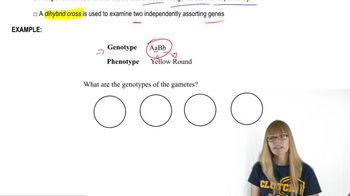
Independent assortment refers to how different pairs of homologous chromosomes segregate independently during meiosis. Since alleles A/a and B/b are on separate autosomes, their segregation into gametes occurs independently, affecting the combination of alleles inherited.
Recommended video:
Guided course
04:58
Gamete Genetics and Independent Assortment

Crossover (Recombination) Within a Chromosome Pair

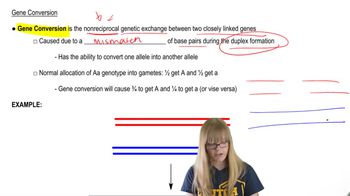
Crossover is the exchange of genetic material between homologous chromosomes during meiosis. It reshuffles alleles on the same chromosome pair, altering gamete genotypes by creating new allele combinations, but it does not affect alleles on different chromosome pairs.
Recommended video:
Guided course
02:36
Gene Conversion

Effect of Crossover on Gamete Genotype Proportions

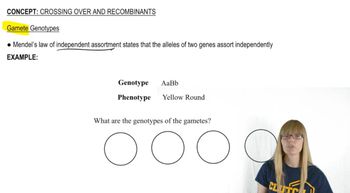
Crossover between one pair of homologs changes the allele combinations on that chromosome but does not affect the independent assortment of other chromosome pairs. Therefore, crossover on one pair alters gamete proportions for that pair only, while crossover on both pairs can change allele combinations on both, influencing overall gamete genotype frequencies.
Recommended video:
Guided course
07:52
Gamete Genotypes