Pearson+ LogoPearson+ Logo
Ch. 3 - Cell Division and Chromosome Heredity
Sanders - Genetic Analysis: An Integrated Approach 3rd Edition
Sanders3rd EditionGenetic Analysis: An Integrated ApproachISBN: 9780135564172Not the one you use?Change textbook
Chapter 3, Problem 13c

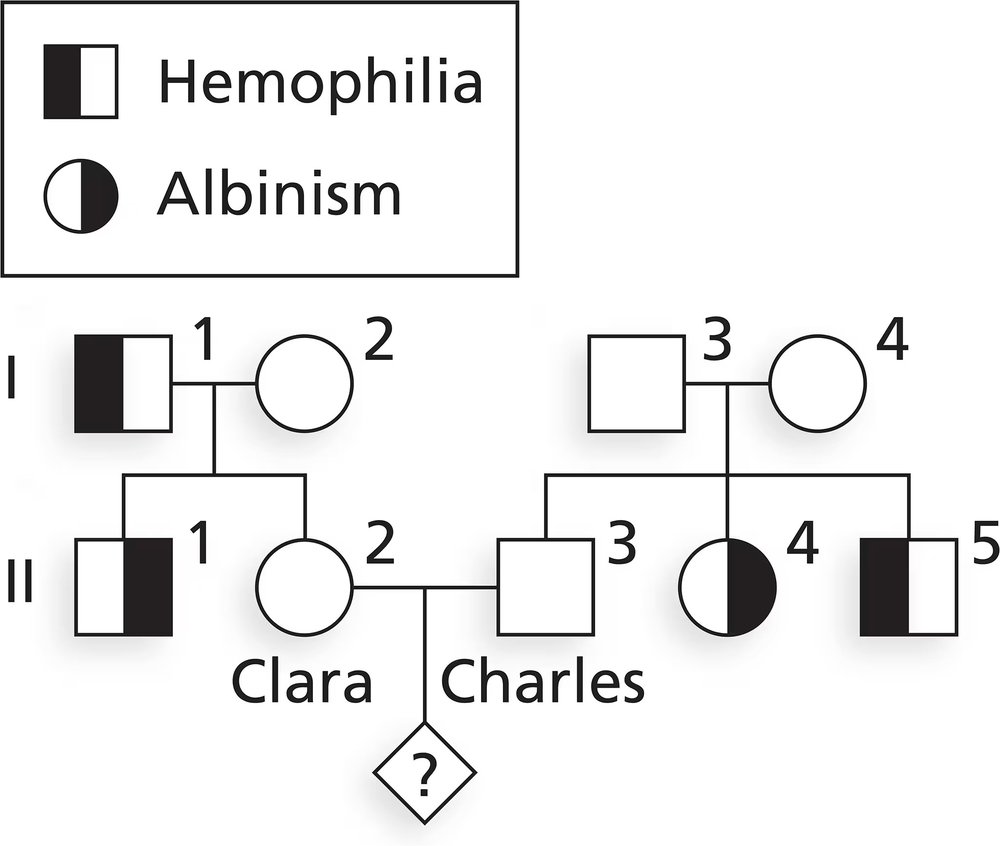
In humans, hemophilia A (OMIM 306700) is an X-linked recessive disorder that affects the gene for factor VIII protein, which is essential for blood clotting. The dominant and recessive alleles for the factor VIII gene are represented by H and h. Albinism is an autosomal recessive condition that results from mutation of the gene producing tyrosinase, an enzyme in the melanin synthesis pathway. A and a represent the tyrosinase alleles. A healthy woman named Clara (II-2), whose father (I-1) has hemophilia and whose brother (II-1) has albinism, is married to a healthy man named Charles (II-3), whose parents are healthy. Charles's brother (II-5) has hemophilia, and his sister (II-4) has albinism. The pedigree is shown below.

If Clara and Charles's first child has albinism, what is the chance the second child has albinism? Explain why this probability is higher than the probability you calculated in part (b).

Verified step by step guidance
1
Step 1: Understand the genetic inheritance patterns. Hemophilia A is X-linked recessive, meaning males (XY) with the recessive allele (h) will express the disorder, while females (XX) must have two copies of the recessive allele (h) to express it. Albinism is autosomal recessive, meaning an individual must inherit two copies of the recessive allele (a) to express the condition.
Step 2: Determine the genotypes of Clara (II-2) and Charles (II-3) based on the pedigree. Clara's father (I-1) has hemophilia, so Clara must be a carrier for hemophilia (XHXh). Clara's brother (II-1) has albinism, so Clara must also be a carrier for albinism (Aa). Charles's brother (II-5) has hemophilia, so Charles must carry the recessive allele for hemophilia on his X chromosome (XhY). Charles's sister (II-4) has albinism, so Charles must also be a carrier for albinism (Aa).
Step 3: Analyze the probability of albinism in the second child. Since albinism is autosomal recessive, the child must inherit one recessive allele (a) from each parent. The probability of Clara passing on the recessive allele (a) is 1/2, and the probability of Charles passing on the recessive allele (a) is also 1/2. Therefore, the probability of the child having albinism is (1/2) × (1/2) = 1/4.
Step 4: Explain why the probability of albinism in the second child is independent of the first child. The inheritance of genetic traits follows Mendel's laws, specifically the law of independent assortment. The genotype of the first child does not influence the genotype of the second child because each child inherits alleles independently from the parents.
Step 5: Address why the probability is higher than in part (b). If part (b) involved a scenario where additional conditions or constraints reduced the probability of albinism (e.g., requiring the child to also inherit a specific X-linked trait), the removal of those constraints in this scenario would increase the probability. Here, the calculation focuses solely on the autosomal recessive inheritance of albinism, which is 1/4 for each child.

Verified video answer for a similar problem:

This video solution was recommended by our tutors as helpful for the problem above.
Video duration:
2m
Was this helpful?

Key Concepts

Here are the essential concepts you must grasp in order to answer the question correctly.

X-linked Recessive Inheritance

X-linked recessive inheritance refers to genetic conditions that are associated with genes located on the X chromosome. In this mode of inheritance, males (XY) are more likely to express the disorder because they have only one X chromosome. Females (XX) can be carriers if they have one affected X chromosome and one normal X chromosome, but they typically do not express the disorder unless both X chromosomes are affected.
Recommended video:
Guided course
09:30
X-Inactivation

Autosomal Recessive Inheritance

Autosomal recessive inheritance involves genes located on non-sex chromosomes (autosomes). For an individual to express an autosomal recessive condition, they must inherit two copies of the recessive allele, one from each parent. Carriers, who have one dominant and one recessive allele, do not show symptoms but can pass the recessive allele to their offspring, making it crucial to consider both parents' genotypes when predicting the likelihood of the condition in children.
Recommended video:
Guided course
09:08
Autosomal Pedigrees

Probability in Genetic Crosses

Probability in genetic crosses is used to predict the likelihood of offspring inheriting specific traits based on parental genotypes. When calculating probabilities, it is essential to consider the genetic makeup of both parents and the inheritance patterns of the traits involved. In this scenario, the probability of the second child having albinism is influenced by the first child's genotype and the parents' carrier status, which can alter the expected ratios due to the presence of recessive alleles.
Recommended video:
Related Practice
Textbook Question

A woman's father has ornithine transcarbamylase deficiency (OTD), an X-linked recessive disorder producing mental deterioration if not properly treated. The woman's mother is homozygous for the wild-type allele.


What proportion of daughters produced by the woman and the man are expected to have OTD? What proportion of sons of the woman and the man are expected to have OTD?

381
views
Textbook Question

In humans, hemophilia A (OMIM 306700) is an X-linked recessive disorder that affects the gene for factor VIII protein, which is essential for blood clotting. The dominant and recessive alleles for the factor VIII gene are represented by H and h. Albinism is an autosomal recessive condition that results from mutation of the gene producing tyrosinase, an enzyme in the melanin synthesis pathway. A and a represent the tyrosinase alleles. A healthy woman named Clara (II-2), whose father (I-1) has hemophilia and whose brother (II-1) has albinism, is married to a healthy man named Charles (II-3), whose parents are healthy. Charles's brother (II-5) has hemophilia, and his sister (II-4) has albinism. The pedigree is shown below.

What are the genotypes of the four parents (I-1 to I-4) in this pedigree?

725
views
Textbook Question

In humans, hemophilia A (OMIM 306700) is an X-linked recessive disorder that affects the gene for factor VIII protein, which is essential for blood clotting. The dominant and recessive alleles for the factor VIII gene are represented by H and h. Albinism is an autosomal recessive condition that results from mutation of the gene producing tyrosinase, an enzyme in the melanin synthesis pathway. A and a represent the tyrosinase alleles. A healthy woman named Clara (II-2), whose father (I-1) has hemophilia and whose brother (II-1) has albinism, is married to a healthy man named Charles (II-3), whose parents are healthy. Charles's brother (II-5) has hemophilia, and his sister (II-4) has albinism. The pedigree is shown below.

Determine the probability that the first child of Clara and Charles will be a


i. boy with hemophilia

ii. girl with albinism

iii. healthy girl

iv. boy with both albinism and hemophilia

v. boy with albinism

vi. girl with hemophilia

940
views
Textbook Question

A wild-type male and a wild-type female Drosophila with red eyes and full wings are crossed. Their progeny are shown below.

Using clearly defined allele symbols of your choice, give the genotype of each parent.

603
views
Textbook Question

A wild-type male and a wild-type female Drosophila with red eyes and full wings are crossed. Their progeny are shown below.

What is/are the genotype(s) of females with purple eye? Of males with purple eye and miniature wing?

1197
views
Textbook Question

A woman with severe discoloration of her tooth enamel has four children with a man who has normal tooth enamel. Two of the children, a boy (B) and a girl (G), have discolored enamel. Each has a mate with normal tooth enamel and produces several children. G has six children—four boys and two girls. Two of her boys and one of her girls have discolored enamel. B has seven children—four girls and three boys. All four of his daughters have discolored enamel, but all his boys have normal enamel. Explain the inheritance of this condition.

390
views