Pearson+ LogoPearson+ Logo
Ch. 3 - Cell Division and Chromosome Heredity
Sanders - Genetic Analysis: An Integrated Approach 3rd Edition
Sanders3rd EditionGenetic Analysis: An Integrated ApproachISBN: 9780135564172Not the one you use?Change textbook
Chapter 3, Problem 12e

A woman's father has ornithine transcarbamylase deficiency (OTD), an X-linked recessive disorder producing mental deterioration if not properly treated. The woman's mother is homozygous for the wild-type allele.


What proportion of daughters produced by the woman and the man are expected to have OTD? What proportion of sons of the woman and the man are expected to have OTD?

Verified step by step guidance
1
Understand the inheritance pattern: Ornithine transcarbamylase deficiency (OTD) is an X-linked recessive disorder. This means the gene responsible for the disorder is located on the X chromosome, and males (XY) are more likely to express the disorder because they have only one X chromosome. Females (XX) would need two copies of the defective allele to express the disorder.
Determine the genotypes of the parents: The woman is a carrier for OTD because her father has the disorder (he passed the defective X chromosome to her) and her mother is homozygous for the wild-type allele. Thus, the woman's genotype is XOTDXWT. The man is unaffected, so his genotype is XWTY.
Predict the offspring's genotypes: Use a Punnett square to determine the possible combinations of X and Y chromosomes from the parents. The woman can pass on either XOTD or XWT, while the man can pass on either XWT or Y. This results in four possible combinations: XOTDXWT (carrier daughter), XWTXWT (wild-type daughter), XOTDY (affected son), and XWTY (wild-type son).
Analyze the daughters' outcomes: Daughters inherit one X chromosome from each parent. Half of the daughters (XOTDXWT) will be carriers, and the other half (XWTXWT) will be wild-type. Since OTD is recessive, none of the daughters will express the disorder because they will always have at least one wild-type allele.
Analyze the sons' outcomes: Sons inherit the X chromosome from their mother and the Y chromosome from their father. Half of the sons (XOTDY) will inherit the defective allele and will have OTD, while the other half (XWTY) will inherit the wild-type allele and will not have OTD.

Verified video answer for a similar problem:

This video solution was recommended by our tutors as helpful for the problem above.
Video duration:
2m
Was this helpful?

Key Concepts

Here are the essential concepts you must grasp in order to answer the question correctly.

X-linked Recessive Inheritance

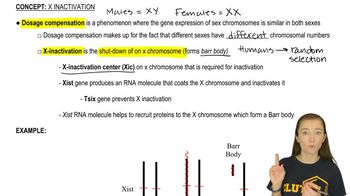
X-linked recessive inheritance refers to genetic conditions that are associated with genes located on the X chromosome. In this mode of inheritance, males (XY) are more likely to express the disorder because they have only one X chromosome. Females (XX) can be carriers if they have one affected X chromosome and one normal X chromosome, but they typically do not express the disorder unless they are homozygous for the recessive allele.
Recommended video:
Guided course
09:30
X-Inactivation

Genotype of Parents

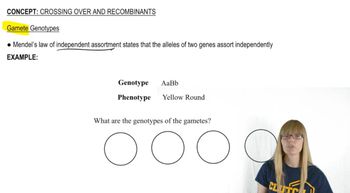
Understanding the genotypes of the parents is crucial for predicting the inheritance of traits. In this case, the woman is a carrier for OTD (X^OX^d) since her father has the disorder and her mother is homozygous for the wild-type allele (X^O X^O). The man’s genotype is assumed to be normal (X^O Y) unless stated otherwise. This information helps determine the potential genotypes of their offspring.
Recommended video:
Guided course
07:52
Gamete Genotypes

Punnett Square Analysis

A Punnett square is a tool used to predict the genetic outcomes of a cross between two parents. By arranging the possible gametes from each parent, one can visualize the probabilities of different genotypes in the offspring. In this scenario, constructing a Punnett square with the woman’s and man’s genotypes will reveal the expected proportions of daughters and sons with OTD, aiding in understanding the inheritance pattern.
Recommended video:
Guided course
02:48
Chi Square Analysis
Related Practice
Textbook Question

A woman's father has ornithine transcarbamylase deficiency (OTD), an X-linked recessive disorder producing mental deterioration if not properly treated. The woman's mother is homozygous for the wild-type allele.


If the woman has a son with a man who does not have OTD, what is the chance the son will have OTD?

387
views
Textbook Question

A woman's father has ornithine transcarbamylase deficiency (OTD), an X-linked recessive disorder producing mental deterioration if not properly treated. The woman's mother is homozygous for the wild-type allele.


If the woman has a daughter with a man who does not have OTD, what is the chance the daughter will be a heterozygous carrier of OTD? What is the chance the daughter will have OTD?

410
views
Textbook Question

A woman's father has ornithine transcarbamylase deficiency (OTD), an X-linked recessive disorder producing mental deterioration if not properly treated. The woman's mother is homozygous for the wild-type allele.


Identify a male with whom the woman could produce a daughter with OTD.

503
views
Textbook Question

In humans, hemophilia A (OMIM 306700) is an X-linked recessive disorder that affects the gene for factor VIII protein, which is essential for blood clotting. The dominant and recessive alleles for the factor VIII gene are represented by H and h. Albinism is an autosomal recessive condition that results from mutation of the gene producing tyrosinase, an enzyme in the melanin synthesis pathway. A and a represent the tyrosinase alleles. A healthy woman named Clara (II-2), whose father (I-1) has hemophilia and whose brother (II-1) has albinism, is married to a healthy man named Charles (II-3), whose parents are healthy. Charles's brother (II-5) has hemophilia, and his sister (II-4) has albinism. The pedigree is shown below.

What are the genotypes of the four parents (I-1 to I-4) in this pedigree?

725
views
Textbook Question

In humans, hemophilia A (OMIM 306700) is an X-linked recessive disorder that affects the gene for factor VIII protein, which is essential for blood clotting. The dominant and recessive alleles for the factor VIII gene are represented by H and h. Albinism is an autosomal recessive condition that results from mutation of the gene producing tyrosinase, an enzyme in the melanin synthesis pathway. A and a represent the tyrosinase alleles. A healthy woman named Clara (II-2), whose father (I-1) has hemophilia and whose brother (II-1) has albinism, is married to a healthy man named Charles (II-3), whose parents are healthy. Charles's brother (II-5) has hemophilia, and his sister (II-4) has albinism. The pedigree is shown below.

Determine the probability that the first child of Clara and Charles will be a


i. boy with hemophilia

ii. girl with albinism

iii. healthy girl

iv. boy with both albinism and hemophilia

v. boy with albinism

vi. girl with hemophilia

940
views
Textbook Question

In humans, hemophilia A (OMIM 306700) is an X-linked recessive disorder that affects the gene for factor VIII protein, which is essential for blood clotting. The dominant and recessive alleles for the factor VIII gene are represented by H and h. Albinism is an autosomal recessive condition that results from mutation of the gene producing tyrosinase, an enzyme in the melanin synthesis pathway. A and a represent the tyrosinase alleles. A healthy woman named Clara (II-2), whose father (I-1) has hemophilia and whose brother (II-1) has albinism, is married to a healthy man named Charles (II-3), whose parents are healthy. Charles's brother (II-5) has hemophilia, and his sister (II-4) has albinism. The pedigree is shown below.

If Clara and Charles's first child has albinism, what is the chance the second child has albinism? Explain why this probability is higher than the probability you calculated in part (b).

454
views