Pearson+ LogoPearson+ Logo
Ch. 3 - Cell Division and Chromosome Heredity
Sanders - Genetic Analysis: An Integrated Approach 3rd Edition
Sanders3rd EditionGenetic Analysis: An Integrated ApproachISBN: 9780135564172Not the one you use?Change textbook
Chapter 3, Problem 5a

The diploid number of the hypothetical animal Geneticus introductus is 2n = 36. Each diploid nucleus contains 3 ng of DNA in G₁.
What amount of DNA is contained in each nucleus at the end of the S phase?

Verified step by step guidance
1
Understand the problem: The diploid number (2n) of the organism is 36, and the DNA content in G₁ phase is 3 ng. The question asks for the DNA content at the end of the S phase, where DNA replication occurs.
Recall that during the S phase of the cell cycle, DNA replication takes place, doubling the amount of DNA in the nucleus. However, the chromosome number (2n = 36) remains the same because no cell division occurs during this phase.
Since the DNA content in G₁ is 3 ng, and the S phase doubles the DNA content, the DNA content at the end of the S phase will be twice the amount present in G₁.
Set up the calculation: Multiply the DNA content in G₁ (3 ng) by 2 to determine the DNA content at the end of the S phase. Use the formula: DNA=2×3ng.
Conclude that the DNA content at the end of the S phase is double the G₁ content, which reflects the completion of DNA replication.

Verified video answer for a similar problem:

This video solution was recommended by our tutors as helpful for the problem above.
Video duration:
2m
Was this helpful?

Key Concepts

Here are the essential concepts you must grasp in order to answer the question correctly.

Diploid Number

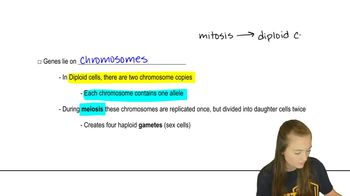
The diploid number (2n) refers to the total number of chromosomes in a somatic cell, which in this case is 36 for the animal Geneticus introductus. This means that there are 18 pairs of homologous chromosomes, with one set inherited from each parent. Understanding the diploid number is crucial for determining the genetic content of the organism.
Recommended video:
Guided course
27:36
Diploid Genetics

DNA Replication

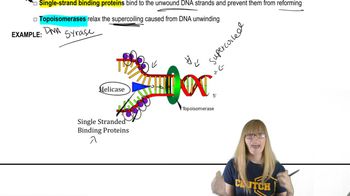
DNA replication is the process by which a cell duplicates its DNA before cell division. During the S phase of the cell cycle, each chromosome is replicated, resulting in two sister chromatids for each chromosome. This means that the total amount of DNA in the nucleus doubles, which is essential for ensuring that each daughter cell receives an identical set of chromosomes.
Recommended video:
Guided course
11:59
Steps to DNA Replication

S Phase

The S phase, or synthesis phase, is a part of the cell cycle where DNA replication occurs. It follows the G₁ phase and precedes the G₂ phase. During this phase, the amount of DNA in the nucleus increases as each chromosome is copied, leading to a temporary state where the amount of DNA is twice that of the G₁ phase, which is critical for proper cell division.
Recommended video:
Guided course
08:34
Cancer Causes
Related Practice
Textbook Question

Our closest primate relative, the chimpanzee, has a diploid number of 2n = 48. For each of the following stages of M phase, identify the number of chromosomes present in each cell.

Early prophase I

403
views
Textbook Question

In a test of his chromosome theory of heredity, Morgan crossed a female Drosophila with red eyes to a male with white eyes. The females were produced from Cross A, shown in the Figure below. Predict the offspring Morgan would have expected under his hypothesis that the gene for eye color is on the X chromosome in fruit flies.

572
views
Textbook Question

Cohesion between sister chromatids, as well as tension created by the pull of kinetochore microtubules, is essential to ensure efficient separation of chromatids at mitotic anaphase or in meiotic anaphase II. Explain why sister chromatid cohesion is important, and discuss the role of the proteins cohesin and separase in sister chromatid separation.

712
views
Textbook Question

The diploid number of the hypothetical animal Geneticus introductus is 2n = 36. Each diploid nucleus contains 3 ng of DNA in G₁.

Explain why a somatic cell of Geneticus introductus has the same number of chromosomes and the same amount of DNA at the beginning of mitotic prophase as one of these cells does at the beginning of prophase I of meiosis.

573
views
Textbook Question

The diploid number of the hypothetical animal Geneticus introductus is 2n = 36. Each diploid nucleus contains 3 ng of DNA in G₁.

Complete the following table by entering the number of chromosomes and amount of DNA present per cell at the end of each stage listed.

375
views
Textbook Question

An organism has alleles R₁ and R₂ on one pair of homologous chromosomes, and it has alleles T₁ and T₂ on another pair. Diagram these pairs of homologs at the end of metaphase I, the end of telophase I, and the end of telophase II, and show how meiosis in this organism produces gametes in expected Mendelian proportions. Assume no crossover between homologous chromosomes.

479
views