Pearson+ LogoPearson+ Logo
Ch. 4 - Gene Interaction
Sanders - Genetic Analysis: An Integrated Approach 3rd Edition
Sanders3rd EditionGenetic Analysis: An Integrated ApproachISBN: 9780135564172Not the one you use?Change textbook
Chapter 4, Problem 17a

The coat color in mink is controlled by two codominant alleles at a single locus. Red coat color is produced by the genotype R₁R₁, silver coat by the genotype R₁R₂, and platinum color by R₂R₂. White spotting of the coat is a recessive trait found with the genotype ss. Solid coat color is found with the S– genotype.


What are the expected progeny phenotypes and proportions for the cross SsR₁R₂ x ssR₂R₂?

Verified step by step guidance
1
Step 1: Identify the genetic traits involved in the problem. The coat color is controlled by codominant alleles R₁ and R₂, where R₁R₁ produces red, R₁R₂ produces silver, and R₂R₂ produces platinum. Additionally, white spotting is a recessive trait controlled by the s allele, while solid coat color is dominant and controlled by the S allele.
Step 2: Determine the genotypes of the parents. The first parent has the genotype SsR₁R₂, meaning it is heterozygous for the spotting trait (S and s alleles) and heterozygous for coat color (R₁ and R₂ alleles). The second parent has the genotype ssR₂R₂, meaning it is homozygous recessive for the spotting trait (ss) and homozygous for platinum coat color (R₂R₂).
Step 3: Set up a Punnett square for the S and s alleles to determine the inheritance of the spotting trait. The first parent (Ss) can pass on either S or s, while the second parent (ss) can only pass on s. This results in two possible combinations: Ss (solid coat) and ss (white spotting).
Step 4: Set up a separate Punnett square for the R₁ and R₂ alleles to determine the inheritance of coat color. The first parent (R₁R₂) can pass on either R₁ or R₂, while the second parent (R₂R₂) can only pass on R₂. This results in two possible combinations: R₁R₂ (silver coat) and R₂R₂ (platinum coat).
Step 5: Combine the results from both Punnett squares to determine the expected progeny phenotypes and proportions. For each combination of spotting trait (Ss or ss) and coat color (R₁R₂ or R₂R₂), calculate the phenotypic ratios by multiplying the probabilities from each Punnett square. This will yield the proportions of progeny with solid silver, solid platinum, spotted silver, and spotted platinum coats.

Verified video answer for a similar problem:

This video solution was recommended by our tutors as helpful for the problem above.
Video duration:
2m
Was this helpful?

Key Concepts

Here are the essential concepts you must grasp in order to answer the question correctly.

Codominance

Codominance occurs when two different alleles at a locus are both expressed in the phenotype of a heterozygote. In the case of mink coat color, the alleles R₁ and R₂ are codominant, resulting in a distinct phenotype (silver coat) when both alleles are present. Understanding codominance is crucial for predicting the phenotypic outcomes of genetic crosses involving these alleles.
Recommended video:
Guided course
04:37
Variations on Dominance

Genotype and Phenotype

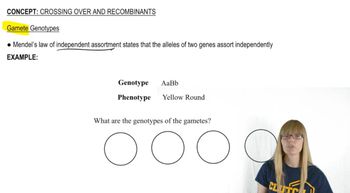
The genotype refers to the genetic makeup of an organism, while the phenotype is the observable physical or biochemical characteristics resulting from the genotype. In the given question, the genotypes (e.g., R₁R₁, R₁R₂, R₂R₂, ss) determine the phenotypes (e.g., red, silver, platinum, white spotting) of the mink. Analyzing the genotypes helps in predicting the expected phenotypes of the progeny.
Recommended video:
Guided course
07:52
Gamete Genotypes

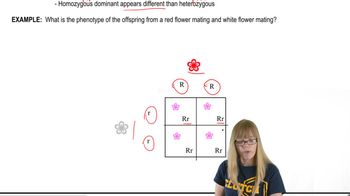
Punnett Square

A Punnett square is a diagram used to predict the genotypes and phenotypes of offspring from a genetic cross. By organizing the alleles of the parents (in this case, SsR₁R₂ and ssR₂R₂) in a grid format, one can easily visualize the potential combinations and calculate the expected proportions of each phenotype in the progeny. This tool is essential for solving genetic problems like the one presented.
Recommended video:
Guided course
18:27
Chi Square Analysis
Related Practice
Textbook Question

A plant line with reduced fertility comes to the attention of a plant breeder who observes that seed pods often contain a mixture of viable seeds that can be planted to produce new plants and withered seeds that cannot be sprouted. The breeder examines numerous seed pods in the reduced fertility line and counts 622 viable seeds and 204 nonviable seeds.

What single-gene mechanism best explains the breeder's observation?

476
views
Textbook Question

A plant line with reduced fertility comes to the attention of a plant breeder who observes that seed pods often contain a mixture of viable seeds that can be planted to produce new plants and withered seeds that cannot be sprouted. The breeder examines numerous seed pods in the reduced fertility line and counts 622 viable seeds and 204 nonviable seeds.

Propose an additional experiment to test the genetic mechanism you propose. If your hypothesis is correct, what experimental outcome do you predict?

477
views
Textbook Question

In cattle, an autosomal mutation called Dexter produces calves with short stature and short limbs. Embryos that are homozygous for the Dexter mutation have severely stunted development and either spontaneously abort or are stillborn. What progeny phenotypes do you expect from the cross of two Dexter cows? What are the expected proportions of the expected phenotypes?

623
views
Textbook Question

The coat color in mink is controlled by two codominant alleles at a single locus. Red coat color is produced by the genotype R₁R₁, silver coat by the genotype R₁R₂, and platinum color by R₂R₂. White spotting of the coat is a recessive trait found with the genotype ss. Solid coat color is found with the S– genotype.


If the cross SsR₁R₂ x SsR₁R₁ is made, what are the progeny phenotypes, and in what proportions are they expected to occur?

418
views
Textbook Question

The coat color in mink is controlled by two codominant alleles at a single locus. Red coat color is produced by the genotype R₁R₁, silver coat by the genotype R₁R₂, and platinum color by R₂R₂. White spotting of the coat is a recessive trait found with the genotype ss. Solid coat color is found with the S– genotype.


Two crosses are made between mink. Cross 1 is the cross of a solid, silver mink to one that is solid, platinum. Cross 2 is between a spotted, silver mink and one that is solid, silver. The progeny are described in the table below. Use these data to determine the genotypes of the parents in each cross. 

632
views
Textbook Question

Strains of petunias come in four pure-breeding colors: white, blue, red, and purple. White petunias are produced when plants synthesize no flower pigment. Blue petunias and red petunias are produced when plants synthesize blue or red pigment only. Purple petunias are produced in plants that synthesize both red and blue pigment (the mixture of red and blue makes purple). Flower-color pigments are synthesized by gene action in two separate pigment-producing biochemical pathways. Pathway I contains gene A that produces an enzyme to catalyze conversion of a colorless pigment designated to blue pigment. In Pathway II, the enzymatic product of gene B converts the colorless pigment designated to red pigment. The two genes assort independently.

What are the possible genotype(s) for pure-breeding red petunias? 

576
views