Pearson+ LogoPearson+ Logo
Ch. 4 - Gene Interaction
Sanders - Genetic Analysis: An Integrated Approach 3rd Edition
Sanders3rd EditionGenetic Analysis: An Integrated ApproachISBN: 9780135564172Not the one you use?Change textbook
Chapter 4, Problem 23c

Three strains of green-seeded lentil plants appear to have the same phenotype. The strains are designated G₁, G₂, and G₃. Each green-seeded strain is crossed to a pure-breeding yellow-seeded strain designated Y. The F₁ of each cross are yellow; however, self-fertilization of F₁ plants produces F₂ with different proportions of yellow- and green-seeded plants as shown below.
Table showing F1 and F2 phenotypes of green-seeded lentil strains G1, G2, G3 crossed with yellow strain Y.
For each set of F₂ progeny, provide a genetic explanation for the yellow : green ratio. What are the genotypes of yellow and green F₂ lentil plants in the G₂ x Y cross? 

Verified step by step guidance
1
Step 1: Understand the parental genotypes and phenotypes. The green-seeded strains G₁, G₂, and G₃ are crossed with a pure-breeding yellow-seeded strain Y. Since all F₁ progeny are yellow, yellow is dominant over green.
Step 2: Analyze the F₂ phenotypic ratios for each cross. For G₂ x Y, the F₂ ratio is 7 green : 9 yellow (or 7/16 green and 9/16 yellow). This ratio suggests that more than one gene is involved in determining seed color, indicating a dihybrid interaction rather than a simple monohybrid.
Step 3: Propose a genetic model for G₂ x Y. Since the F₂ ratio deviates from the classic 3:1, consider two genes with dominant and recessive alleles interacting. The yellow phenotype likely requires at least one dominant allele at both loci, while green appears when recessive alleles are present at either or both loci.
Step 4: Assign genotypes to the parental strains based on the F₂ ratio. The pure-breeding yellow strain Y would be homozygous dominant at both loci (e.g., AABB). The green strain G₂ would be homozygous recessive at one locus and homozygous dominant at the other (e.g., aaBB or AAbb), leading to the observed 9:7 ratio in F₂.
Step 5: Determine the genotypes of yellow and green F₂ plants in the G₂ x Y cross. Yellow F₂ plants have at least one dominant allele at both loci (A_B_), while green F₂ plants are homozygous recessive at one or both loci (aaB_, Aabb, or aabb). This explains the 9:7 phenotypic ratio observed.

Verified video answer for a similar problem:

This video solution was recommended by our tutors as helpful for the problem above.
Video duration:
1m
Was this helpful?

Key Concepts

Here are the essential concepts you must grasp in order to answer the question correctly.

Mendelian Inheritance and Dominance

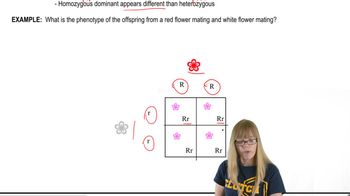
Mendelian inheritance explains how traits are passed from parents to offspring through dominant and recessive alleles. In this question, yellow seed color is dominant over green, as all F1 progeny are yellow. Understanding dominance helps predict phenotypic ratios in F2 generations.
Recommended video:
Guided course
04:37
Variations on Dominance

Genotypic Ratios and Punnett Squares

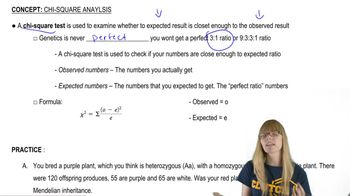
Genotypic ratios describe the distribution of different allele combinations in offspring. Punnett squares are tools to visualize these combinations and predict phenotypic ratios. The varying F2 ratios suggest different genetic mechanisms or allele interactions in each green strain crossed with yellow.
Recommended video:
Guided course
02:48
Chi Square Analysis

Complementation and Multiple Alleles

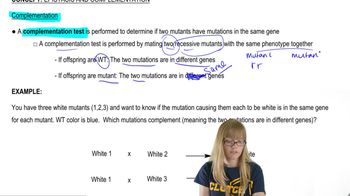
Complementation occurs when mutations in different genes produce the same phenotype but restore normal function when combined. The different F2 ratios imply that green seed color in G1, G2, and G3 may result from mutations in different genes or alleles, affecting segregation patterns and phenotypic ratios.
Recommended video:
Guided course
05:05
Complementation
Related Practice
Textbook Question

Xeroderma pigmentosum (XP) is an autosomal recessive condition characterized by moderate to severe sensitivity to ultraviolet (UV) light. Patients develop multiple skin lesions on UV-exposed skin, and skin cancers often develop as a result. XP is caused by deficient repair of DNA damage from UV exposure.


A series of 10 skin-cell lines was grown from different XP patients. Cells from these lines were fused, and the heterokaryons were tested for genetic complementation by assaying their ability to repair DNA damage caused by a moderate amount of UV exposure. In the table below, '+' indicates that the fusion cell line performs normal DNA damage mutation repair, and '−' indicates defective DNA repair. Use this information to determine how many DNA-repair genes are mutated in the 10 cell lines, and identify which cell lines share the same mutated genes. 

1054
views
Textbook Question

Three strains of green-seeded lentil plants appear to have the same phenotype. The strains are designated G₁, G₂, and G₃. Each green-seeded strain is crossed to a pure-breeding yellow-seeded strain designated Y. The F₁ of each cross are yellow; however, self-fertilization of F₁ plants produces F₂ with different proportions of yellow- and green-seeded plants as shown below.

For what number of genes are variable alleles segregating in the G₁ x Y cross? The G₂ x Y cross? In the G₃ x Y cross? Explain your rationale for each answer. 

691
views
Textbook Question

Three strains of green-seeded lentil plants appear to have the same phenotype. The strains are designated G₁, G₂, and G₃. Each green-seeded strain is crossed to a pure-breeding yellow-seeded strain designated Y. The F₁ of each cross are yellow; however, self-fertilization of F₁ plants produces F₂ with different proportions of yellow- and green-seeded plants as shown below.

Using the allele symbols A and a, B and b, and D and d to represent alleles at segregating genes, give the genotypes of parental and F₁ plants in each cross. 

435
views
Textbook Question

Three strains of green-seeded lentil plants appear to have the same phenotype. The strains are designated G₁, G₂, and G₃. Each green-seeded strain is crossed to a pure-breeding yellow-seeded strain designated Y. The F₁ of each cross are yellow; however, self-fertilization of F₁ plants produces F₂ with different proportions of yellow- and green-seeded plants as shown below.

If green-seeded strains G₁ and G₃ are crossed, what are the phenotype and the genotype of F₁ progeny? 

387
views
Textbook Question

Three strains of green-seeded lentil plants appear to have the same phenotype. The strains are designated G₁, G₂, and G₃. Each green-seeded strain is crossed to a pure-breeding yellow-seeded strain designated Y. The F₁ of each cross are yellow; however, self-fertilization of F₁ plants produces F₂ with different proportions of yellow- and green-seeded plants as shown below.

What proportion of the F₂ are expected to be green? Show your work. 

521
views
Textbook Question

Three strains of green-seeded lentil plants appear to have the same phenotype. The strains are designated G₁, G₂, and G₃. Each green-seeded strain is crossed to a pure-breeding yellow-seeded strain designated Y. The F₁ of each cross are yellow; however, self-fertilization of F₁ plants produces F₂ with different proportions of yellow- and green-seeded plants as shown below.

If strains G₂ and G₃ are crossed, what will be the phenotype of the F₁? 

456
views