Pearson+ LogoPearson+ Logo
Ch. 4 - Gene Interaction
Sanders - Genetic Analysis: An Integrated Approach 3rd Edition
Sanders3rd EditionGenetic Analysis: An Integrated ApproachISBN: 9780135564172Not the one you use?Change textbook
Chapter 4, Problem 13

Total cholesterol in blood is reported as the number of milligrams (mg) of cholesterol per 100 milliliters (mL) of blood. The normal range is 180–220 mg/100 mL. A gene mutation altering the function of cell-surface cholesterol receptors restricts the ability of cells to collect cholesterol from blood and draw it into cells. This defect results in elevated blood cholesterol levels. Individuals who are heterozygous for a mutant allele and a wild-type allele have levels of 300–600 mg/100 mL, and those who are homozygous for the mutation have levels of 800–1000 mg/100 mL. Identify the genetic term that best describes the inheritance of this form of elevated cholesterol level, and justify your choice.

Verified step by step guidance
1
Step 1: Begin by identifying the key genetic terms in the problem. The problem describes individuals with different cholesterol levels based on their genotype: wild-type homozygous individuals have normal cholesterol levels, heterozygous individuals have intermediate levels (300–600 mg/100 mL), and homozygous mutant individuals have the highest levels (800–1000 mg/100 mL).
Step 2: Recognize that the heterozygous individuals exhibit a phenotype that is intermediate between the two homozygous phenotypes. This suggests that the inheritance pattern is not strictly dominant or recessive.
Step 3: Recall the genetic term 'incomplete dominance,' which describes a situation where the heterozygous phenotype is intermediate between the two homozygous phenotypes. This matches the pattern described in the problem.
Step 4: Justify the choice of incomplete dominance by explaining that in this case, the mutant allele does not completely dominate the wild-type allele, nor is it completely recessive. Instead, the heterozygous individuals show a blend of the effects of both alleles.
Step 5: Conclude that the inheritance of elevated cholesterol levels in this scenario is best described as incomplete dominance, based on the intermediate phenotype observed in heterozygous individuals.

Verified video answer for a similar problem:

This video solution was recommended by our tutors as helpful for the problem above.
Video duration:
3m
Was this helpful?

Key Concepts

Here are the essential concepts you must grasp in order to answer the question correctly.

Alleles and Genotypes

Alleles are different versions of a gene that can exist at a specific locus on a chromosome. An individual inherits two alleles for each gene, one from each parent, resulting in a genotype that can be homozygous (two identical alleles) or heterozygous (two different alleles). In the context of cholesterol levels, the presence of a mutant allele can significantly affect the phenotype, or observable traits, such as elevated cholesterol levels.
Recommended video:
Guided course
03:03
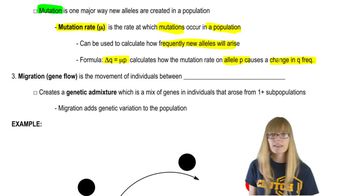
New Alleles and Migration

Dominance and Inheritance Patterns

Dominance refers to the relationship between alleles where one allele can mask the expression of another. In this case, the mutant allele affecting cholesterol receptors is likely dominant, as heterozygous individuals exhibit elevated cholesterol levels. Understanding dominance is crucial for predicting how traits are inherited and expressed in offspring, particularly in conditions like familial hypercholesterolemia.
Recommended video:
Guided course
04:37
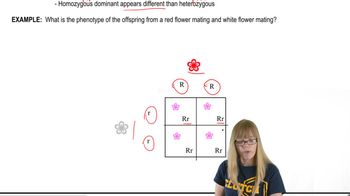
Variations on Dominance

Phenotypic Expression

Phenotypic expression is the observable physical or biochemical characteristics of an organism, determined by both genetic makeup and environmental influences. In this scenario, the phenotypic expression of elevated cholesterol levels varies significantly between heterozygous and homozygous individuals, highlighting the impact of genetic variations on health outcomes. This concept is essential for understanding how genetic mutations can lead to specific health conditions.
Recommended video:
Guided course
02:09
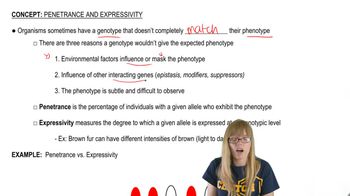
Penetrance and Expressivity
Related Practice
Textbook Question

Using the information provided in Problems 10 and 11, determine the genotype and phenotype of parents that produce the following progeny:

3/8 black : 3/8 cream : 2/8 albino

703
views
Textbook Question

Using the information provided in Problems 10 and 11, determine the genotype and phenotype of parents that produce the following progeny:

27/64 brown : 16/64 albino : 9/64 yellow : 9/64 black : 3/64 cream

490
views
Textbook Question

Using the information provided in Problems 10 and 11, determine the genotype and phenotype of parents that produce the following progeny:

3/4 brown : 1/4 yellow

566
views
Textbook Question

Flower color in snapdragons results from the amount of the pigment anthocyanin in the petals. Red flowers are produced by plants that have full anthocyanin production, and ivory-colored flowers are produced by plants that lack the ability to produce anthocyanin. The allele An1 has full activity in anthocyanin production, and the allele An2 is a null allele. Dr. Ara B. Dopsis, a famous genetic researcher, crosses pure-breeding red snapdragons to pure-breeding ivory snapdragons and produces F₁ progeny plants that have pink flowers. He proposes that this outcome is the result of incomplete dominance, and he crosses the F₁ to test his hypothesis. What phenotypes does Dr. Dopsis predict will be found in the F₂, and in what proportions?

451
views
Textbook Question

A plant line with reduced fertility comes to the attention of a plant breeder who observes that seed pods often contain a mixture of viable seeds that can be planted to produce new plants and withered seeds that cannot be sprouted. The breeder examines numerous seed pods in the reduced fertility line and counts 622 viable seeds and 204 nonviable seeds.

What single-gene mechanism best explains the breeder's observation?

476
views
Textbook Question

A plant line with reduced fertility comes to the attention of a plant breeder who observes that seed pods often contain a mixture of viable seeds that can be planted to produce new plants and withered seeds that cannot be sprouted. The breeder examines numerous seed pods in the reduced fertility line and counts 622 viable seeds and 204 nonviable seeds.

Propose an additional experiment to test the genetic mechanism you propose. If your hypothesis is correct, what experimental outcome do you predict?

477
views