Pearson+ LogoPearson+ Logo
Ch. 5 - Genetic Linkage and Mapping in Eukaryotes
Sanders - Genetic Analysis: An Integrated Approach 3rd Edition
Sanders3rd EditionGenetic Analysis: An Integrated ApproachISBN: 9780135564172Not the one you use?Change textbook
Chapter 5, Problem 36

Divide a clean sheet of paper into four quadrants and draw one pair of homologous chromosomes in each quadrant. Draw the chromosomes with two sister chromatids each. The four sets of homologous pairs are identical. Label one chromosome of each pair with alleles A₁ and A₂ and the other member of each pair with the alleles A₁ and A₂. You are to illustrate a single crossover between the homologs in each quadrant and list the parental and recombinant chromosomes, but you are to illustrate four different ways the crossover can occur by involving different chromatids in each illustration.

Verified step by step guidance
1
Start by dividing your paper into four quadrants. Label each quadrant (e.g., Quadrant 1, Quadrant 2, Quadrant 3, Quadrant 4) to keep track of the different crossover scenarios you will illustrate.
In each quadrant, draw a pair of homologous chromosomes. Each chromosome should consist of two sister chromatids, represented as two parallel lines. Ensure that the homologous chromosomes are paired together, and label one chromosome with alleles A₁ and A₂, and the other homologous chromosome with alleles A₁ and A₂.
Illustrate a single crossover event in each quadrant. For Quadrant 1, show a crossover between one chromatid from each homologous chromosome (e.g., the top chromatid of one homolog and the top chromatid of the other homolog). For Quadrant 2, show a crossover between the top chromatid of one homolog and the bottom chromatid of the other homolog. For Quadrant 3, show a crossover between the bottom chromatid of one homolog and the top chromatid of the other homolog. For Quadrant 4, show a crossover between the bottom chromatid of one homolog and the bottom chromatid of the other homolog.
After illustrating the crossover events, label the resulting chromatids in each quadrant as either parental or recombinant. Parental chromatids will retain the original allele combinations (A₁A₁ or A₂A₂), while recombinant chromatids will have new allele combinations (A₁A₂ or A₂A₁) due to the crossover.
List the parental and recombinant chromatids for each quadrant. For example, in Quadrant 1, identify which chromatids remain parental and which are recombinant after the crossover. Repeat this process for Quadrants 2, 3, and 4, ensuring that you clearly distinguish between the different crossover scenarios.

Verified video answer for a similar problem:

This video solution was recommended by our tutors as helpful for the problem above.
Video duration:
1m
Was this helpful?

Key Concepts

Here are the essential concepts you must grasp in order to answer the question correctly.

Homologous Chromosomes

Homologous chromosomes are pairs of chromosomes in a diploid organism that have the same structure and gene sequence but may carry different alleles. Each parent contributes one chromosome to the pair, resulting in two homologs that are similar but not identical. Understanding homologous chromosomes is crucial for grasping genetic variation and inheritance patterns during meiosis.
Recommended video:
Guided course
07:10
Chromosome Structure

Sister Chromatids

Sister chromatids are identical copies of a single chromosome that are formed during DNA replication. Each chromosome consists of two sister chromatids joined at a region called the centromere. During cell division, these chromatids are separated into daughter cells, ensuring that each new cell receives an identical set of chromosomes, which is essential for maintaining genetic consistency.
Recommended video:

Crossover and Genetic Recombination

Crossover is a process that occurs during meiosis where homologous chromosomes exchange segments of genetic material. This exchange leads to genetic recombination, resulting in new combinations of alleles in the offspring. Understanding crossover is vital for analyzing genetic diversity and the inheritance of traits, as it plays a key role in producing recombinant chromosomes that differ from the parental types.
Recommended video:
Guided course
03:37
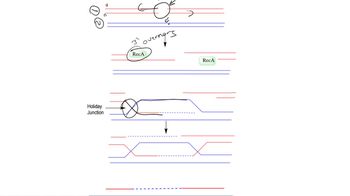
Recombination after Double Strand Breaks
Related Practice
Textbook Question

Based on previous family studies, an autosomal recessive disease with alleles A and a is suspected to be linked to an RFLP marker. The RFLP marker has four alleles, R₁, R₂, R₃, and R₄. The accompanying pedigree shows a three-generation family in which the disease is present. The gel shows the RFLP alleles for each family member directly below the pedigree symbol for that person. After determining the genotypes for the RFLP and disease gene for each family member, answer the following questions.

What is the most likely arrangement of syntenic alleles for the RFLP and the disease gene in I-1 and I-2?

852
views
Textbook Question

Based on previous family studies, an autosomal recessive disease with alleles A and a is suspected to be linked to an RFLP marker. The RFLP marker has four alleles, R₁, R₂, R₃, and R₄. The accompanying pedigree shows a three-generation family in which the disease is present. The gel shows the RFLP alleles for each family member directly below the pedigree symbol for that person. After determining the genotypes for the RFLP and disease gene for each family member, answer the following questions.

Is there any evidence of recombination in this pedigree? If so, identify the recombinant individuals and illustrate the recombination that has occurred.

476
views
Textbook Question

Based on previous family studies, an autosomal recessive disease with alleles A and a is suspected to be linked to an RFLP marker. The RFLP marker has four alleles, R₁, R₂, R₃, and R₄. The accompanying pedigree shows a three-generation family in which the disease is present. The gel shows the RFLP alleles for each family member directly below the pedigree symbol for that person. After determining the genotypes for the RFLP and disease gene for each family member, answer the following questions.

Based on your analysis, what is the recombination frequency in this family? Explain how you obtained your answer.

456
views
Textbook Question

For six genes known to be linked on chromosome 10 of corn (Zea mays), the recombination frequencies between various pairs have been determined in a series of genetic crosses. Use the recombination frequency data in the table below to determine the order of and distance between the genes on a genetic map. The gene lc1 is known to be closest to the telomere of the chromosome.

621
views