Pearson+ LogoPearson+ Logo
Ch. 5 - Genetic Linkage and Mapping in Eukaryotes
Sanders - Genetic Analysis: An Integrated Approach 3rd Edition
Sanders3rd EditionGenetic Analysis: An Integrated ApproachISBN: 9780135564172Not the one you use?Change textbook
Chapter 5, Problem 35a

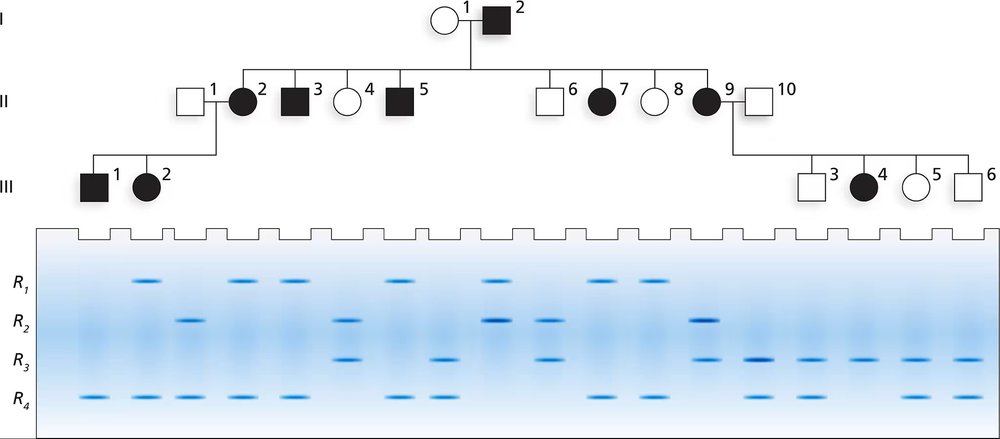
Based on previous family studies, an autosomal recessive disease with alleles A and a is suspected to be linked to an RFLP marker. The RFLP marker has four alleles, R₁, R₂, R₃, and R₄. The accompanying pedigree shows a three-generation family in which the disease is present. The gel shows the RFLP alleles for each family member directly below the pedigree symbol for that person. After determining the genotypes for the RFLP and disease gene for each family member, answer the following questions.
Pedigree chart of a three-generation family with RFLP gel results showing alleles R₁ to R₄ for each member.
What is the most likely arrangement of syntenic alleles for the RFLP and the disease gene in I-1 and I-2?

Verified step by step guidance
1
Step 1: Understand the problem. The question involves determining the arrangement of syntenic alleles (alleles located on the same chromosome) for an autosomal recessive disease gene (A/a) and an RFLP marker with four alleles (R₁, R₂, R₃, R₄). The goal is to analyze the pedigree and gel electrophoresis data to deduce the most likely arrangement of these alleles in individuals I-1 and I-2.
Step 2: Analyze the inheritance pattern of the disease. Since the disease is autosomal recessive, affected individuals must have the genotype 'aa'. Unaffected individuals can be either 'AA' or 'Aa'. Use this information to assign possible genotypes for the disease gene to each family member in the pedigree.
Step 3: Examine the gel electrophoresis data for the RFLP marker. The gel shows the RFLP alleles for each individual. Assign the RFLP genotypes (e.g., R₁R₂, R₃R₄, etc.) to each family member based on the bands visible in the gel.
Step 4: Correlate the disease gene alleles with the RFLP marker alleles. Look for patterns of co-segregation between the disease gene (A/a) and specific RFLP alleles (R₁, R₂, R₃, R₄) across the family. This will help identify which RFLP alleles are most likely linked to the 'a' allele of the disease gene in individuals I-1 and I-2.
Step 5: Deduce the most likely arrangement of syntenic alleles for I-1 and I-2. Based on the co-segregation analysis, determine which RFLP alleles are linked to the 'A' and 'a' alleles in these individuals. For example, if R₁ is consistently inherited with 'a', then the arrangement for I-1 might be A-R₂/a-R₁. Repeat this process for I-2.

Verified video answer for a similar problem:

This video solution was recommended by our tutors as helpful for the problem above.
Video duration:
4m
Was this helpful?

Key Concepts

Here are the essential concepts you must grasp in order to answer the question correctly.

Autosomal Recessive Inheritance

Autosomal recessive inheritance occurs when two copies of a mutated gene are required for an individual to express a trait or disease. In this case, alleles A (normal) and a (mutated) determine the presence of the disease. Individuals with the genotype aa will exhibit the disease, while those with AA or Aa will be unaffected. Understanding this inheritance pattern is crucial for analyzing the pedigree and determining the genotypes of family members.
Recommended video:
Guided course
09:08
Autosomal Pedigrees

Restriction Fragment Length Polymorphism (RFLP)

RFLP is a molecular technique used to analyze the variations in DNA sequences. It involves digesting DNA with specific restriction enzymes, resulting in fragments of different lengths that can be separated by gel electrophoresis. The presence of different alleles (R₁, R₂, R₃, R₄) at the RFLP marker can help establish genetic linkage to the disease gene, providing insights into inheritance patterns and potential carrier status within the family.
Recommended video:
Guided course
07:11
Mapping with Markers

Syntenic Alleles

Syntenic alleles refer to genes or genetic markers that are located on the same chromosome and are inherited together due to their proximity. In the context of the question, determining the arrangement of syntenic alleles for the RFLP and disease gene in individuals I-1 and I-2 involves analyzing their genotypes to see how the alleles are linked. This understanding is essential for predicting inheritance patterns and assessing the likelihood of disease expression in future generations.
Recommended video:
Guided course
03:03
New Alleles and Migration
Related Practice
Textbook Question

The accompanying pedigree below shows a family in which an autosomal recessive disorder is present. Family members I-2 and II-2 are affected by the disorder and have the genotype dd. A pregnancy involving II-4 has just undergone genetic testing for a VNTR that is linked to the disease gene. The VNTR has a recombination frequency of r = 20 with the disease gene. The VNTR has two alleles, V1 and V2. The gel electrophoresis patterns for each family member are shown, including the VNTR genotype for II-4. Based on the information given, answer the following questions about the family.

What is the genotype of each family member, including II-4, for the VNTR?

624
views
Textbook Question

The accompanying pedigree below shows a family in which an autosomal recessive disorder is present. Family members I-2 and II-2 are affected by the disorder and have the genotype dd. A pregnancy involving II-4 has just undergone genetic testing for a VNTR that is linked to the disease gene. The VNTR has a recombination frequency of r = 20 with the disease gene. The VNTR has two alleles, V1 and V2. The gel electrophoresis patterns for each family member are shown, including the VNTR genotype for II-4. Based on the information given, answer the following questions about the family.

What are the syntenic disease gene and VNTR alleles in I-1 and I-2?

654
views
Textbook Question

The accompanying pedigree below shows a family in which an autosomal recessive disorder is present. Family members I-2 and II-2 are affected by the disorder and have the genotype dd. A pregnancy involving II-4 has just undergone genetic testing for a VNTR that is linked to the disease gene. The VNTR has a recombination frequency of r = 20 with the disease gene. The VNTR has two alleles, V1 and V2. The gel electrophoresis patterns for each family member are shown, including the VNTR genotype for II-4. Based on the information given, answer the following questions about the family.

What is the chance II-4 has the disease?

515
views
Textbook Question

Based on previous family studies, an autosomal recessive disease with alleles A and a is suspected to be linked to an RFLP marker. The RFLP marker has four alleles, R₁, R₂, R₃, and R₄. The accompanying pedigree shows a three-generation family in which the disease is present. The gel shows the RFLP alleles for each family member directly below the pedigree symbol for that person. After determining the genotypes for the RFLP and disease gene for each family member, answer the following questions.

Is there any evidence of recombination in this pedigree? If so, identify the recombinant individuals and illustrate the recombination that has occurred.

476
views
Textbook Question

Based on previous family studies, an autosomal recessive disease with alleles A and a is suspected to be linked to an RFLP marker. The RFLP marker has four alleles, R₁, R₂, R₃, and R₄. The accompanying pedigree shows a three-generation family in which the disease is present. The gel shows the RFLP alleles for each family member directly below the pedigree symbol for that person. After determining the genotypes for the RFLP and disease gene for each family member, answer the following questions.

Based on your analysis, what is the recombination frequency in this family? Explain how you obtained your answer.

456
views
Textbook Question

Divide a clean sheet of paper into four quadrants and draw one pair of homologous chromosomes in each quadrant. Draw the chromosomes with two sister chromatids each. The four sets of homologous pairs are identical. Label one chromosome of each pair with alleles A₁ and A₂ and the other member of each pair with the alleles A₁ and A₂. You are to illustrate a single crossover between the homologs in each quadrant and list the parental and recombinant chromosomes, but you are to illustrate four different ways the crossover can occur by involving different chromatids in each illustration.

452
views