Pearson+ LogoPearson+ Logo
Ch. 5 - Genetic Linkage and Mapping in Eukaryotes
Sanders - Genetic Analysis: An Integrated Approach 3rd Edition
Sanders3rd EditionGenetic Analysis: An Integrated ApproachISBN: 9780135564172Not the one you use?Change textbook
Chapter 5, Problem 16b

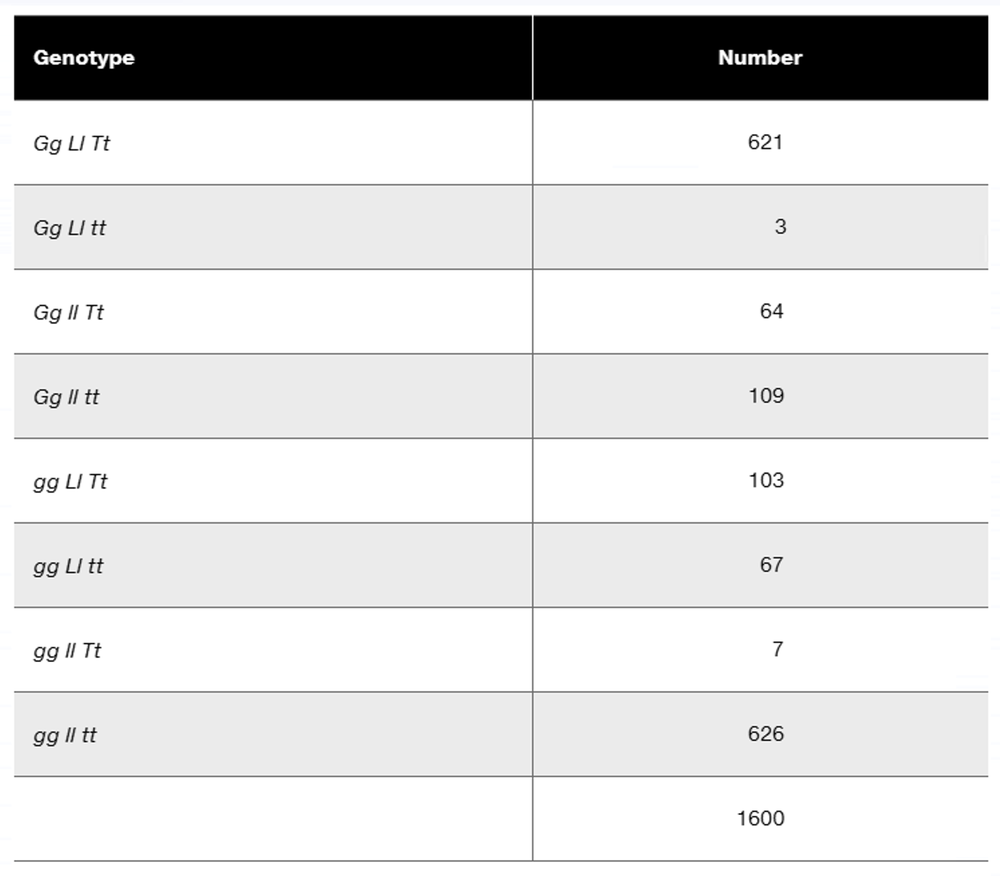
In a diploid plant species, an F₁ with the genotype Gg Ll Tt is test-crossed to a pure-breeding recessive plant with the genotype gg ll tt. The offspring genotypes are as follows:
Table displaying offspring genotypes and their corresponding numbers from a trihybrid cross in a diploid plant species.
Calculate the recombination frequency between each pair of genes.

Verified step by step guidance
1
Step 1: Identify the parental genotypes and offspring genotypes. The parental genotypes are Gg Ll Tt (heterozygous for all three genes) and gg ll tt (homozygous recessive for all three genes). The offspring genotypes and their counts are provided in the table.
Step 2: Determine which offspring genotypes represent parental types and which represent recombinant types. Parental types will have the same combinations of alleles as the parents (Gg Ll Tt and gg ll tt), while recombinant types will have new combinations of alleles due to crossing over.
Step 3: Calculate the total number of recombinant offspring for each pair of genes. For example, to calculate recombination frequency between G and L, sum the counts of offspring with recombinant genotypes for these two genes.
Step 4: Use the formula for recombination frequency: \( \text{Recombination Frequency} = \frac{\text{Number of Recombinant Offspring}}{\text{Total Number of Offspring}} \times 100 \). Apply this formula to each pair of genes (G and L, L and T, G and T).
Step 5: Interpret the recombination frequencies. Frequencies below 50% indicate linkage between the genes, while frequencies close to 50% suggest independent assortment. This helps determine the genetic distance between the genes.

Verified video answer for a similar problem:

This video solution was recommended by our tutors as helpful for the problem above.
Video duration:
4m
Was this helpful?

Key Concepts

Here are the essential concepts you must grasp in order to answer the question correctly.

Test Cross

A test cross is a genetic cross between an individual with an unknown genotype and a homozygous recessive individual. This method helps determine the genotype of the unknown parent by analyzing the phenotypes of the offspring. In the context of the question, the F₁ plant (Gg Ll Tt) is crossed with a pure-breeding recessive plant (gg ll tt) to reveal the genetic contributions of the dominant alleles.
Recommended video:
Guided course
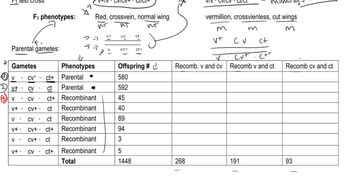
26:08
Trihybrid Cross

Recombination Frequency

Recombination frequency is a measure of the likelihood that two genes will be separated during meiosis due to crossing over. It is calculated by dividing the number of recombinant offspring by the total number of offspring and multiplying by 100 to express it as a percentage. This frequency provides insights into the genetic linkage between genes, with lower frequencies indicating closer linkage.
Recommended video:
Guided course
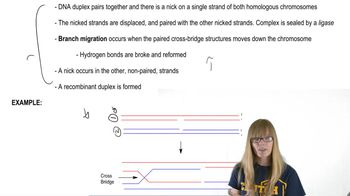
03:51
Recombination after Single Strand Breaks

Linkage and Genetic Mapping

Linkage refers to the tendency of genes located close to each other on a chromosome to be inherited together. Genetic mapping uses recombination frequencies to determine the relative positions of genes on a chromosome. By analyzing the offspring genotypes from the test cross, one can infer the distances between genes G, L, and T, which aids in constructing a genetic map.
Recommended video:
Guided course
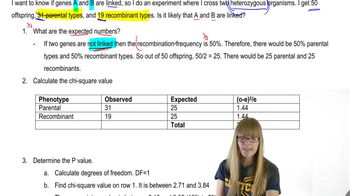
07:33
Chi Square and Linkage
Related Practice
Textbook Question

Three dominant traits of corn seedlings, tunicate seed (T-), glossy appearance (G-), and liguled stem (L-), are studied along with their recessive counterparts, nontunicate (tt), nonglossy (gg), and liguleless (ll). A trihybrid plant with the three dominant traits is crossed to a nontunicate, nonglossy, liguleless plant. Kernels on ears of progeny plants are scored for the traits, with the following results:

If evidence of linkage is present, calculate the recombination frequency or frequencies from the data presented.

632
views
Textbook Question

Three dominant traits of corn seedlings, tunicate seed (T-), glossy appearance (G-), and liguled stem (L-), are studied along with their recessive counterparts, nontunicate (tt), nonglossy (gg), and liguleless (ll). A trihybrid plant with the three dominant traits is crossed to a nontunicate, nonglossy, liguleless plant. Kernels on ears of progeny plants are scored for the traits, with the following results:

Could all three genes be carried on the same chromosome? Discuss why or why not.

853
views
Textbook Question

In a diploid plant species, an F₁ with the genotype Gg Ll Tt is test-crossed to a pure-breeding recessive plant with the genotype gg ll tt. The offspring genotypes are as follows:

What is the order of these three linked genes?

661
views
Textbook Question

In a diploid plant species, an F₁ with the genotype Gg Ll Tt is test-crossed to a pure-breeding recessive plant with the genotype gg ll tt. The offspring genotypes are as follows:

Why is the recombination frequency for the outside pair of genes not equal to the sum of recombination frequencies between the adjacent gene pairs?

738
views
Textbook Question

In a diploid plant species, an F₁ with the genotype Gg Ll Tt is test-crossed to a pure-breeding recessive plant with the genotype gg ll tt. The offspring genotypes are as follows:

What is the interference value for this data set?

622
views
Textbook Question

In a diploid plant species, an F₁ with the genotype Gg Ll Tt is test-crossed to a pure-breeding recessive plant with the genotype gg ll tt. The offspring genotypes are as follows:

Explain the meaning of this I value.

442
views