Pearson+ LogoPearson+ Logo
Ch. 5 - Genetic Linkage and Mapping in Eukaryotes
Sanders - Genetic Analysis: An Integrated Approach 3rd Edition
Sanders3rd EditionGenetic Analysis: An Integrated ApproachISBN: 9780135564172Not the one you use?Change textbook
Chapter 5, Problem 28a

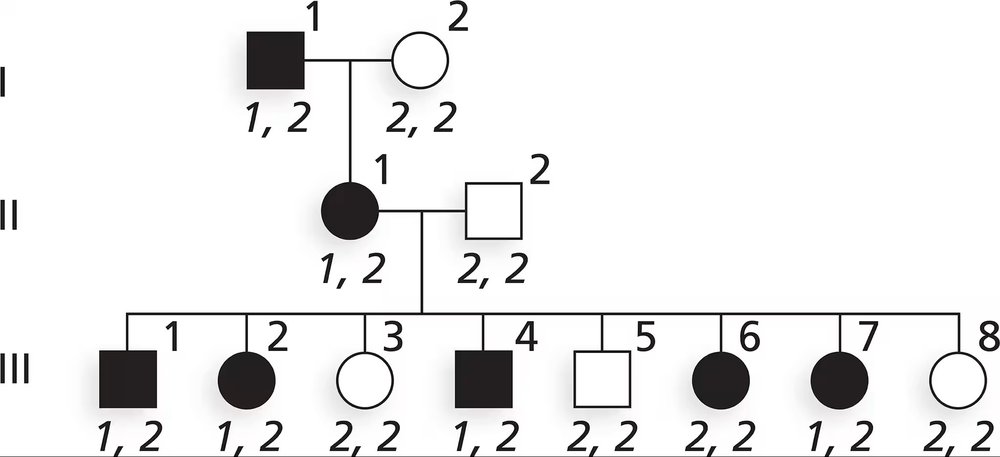
Neurofibromatosis 1 (NF1) is an autosomal dominant disorder inherited on human chromosome 17. Part of the analysis mapping the NF1 gene to chromosome 17 came from genetic linkage studies testing segregation of NF1 and DNA genetic markers on various chromosomes. A DNA marker with two alleles, designated 1 and 2, is linked to NF1. The pedigree below shows segregation of NF1 (darkened symbols) and gives genotypes for the DNA marker for each family member.
Pedigree chart showing NF1 gene segregation with darkened symbols for affected individuals and DNA marker genotypes.
Determine the alleles for the NF1 gene and the DNA marker gene on each chromosome carried by the four family members in generation I and generation II. Use N for the dominant NF1 allele and n for the recessive allele and assume I-1 is heterozygous for the disease allele (Nn).

Verified step by step guidance
1
Step 1: Understand the inheritance pattern. Neurofibromatosis 1 (NF1) is an autosomal dominant disorder, meaning that only one copy of the dominant allele (N) is required for an individual to express the disorder. The recessive allele (n) does not cause the disorder when present in a homozygous state (nn).
Step 2: Analyze the pedigree. Identify the affected individuals (darkened symbols) and their genotypes. Since I-1 is heterozygous (Nn), determine how the dominant allele (N) is passed to the next generation. Use the DNA marker alleles (1 and 2) to track the inheritance of the NF1 gene.
Step 3: Assign alleles to the DNA marker gene for each individual in generation I. For I-1, determine which DNA marker allele (1 or 2) is linked to the dominant NF1 allele (N) and which is linked to the recessive allele (n). For I-2, assign the DNA marker alleles based on the offspring's genotypes.
Step 4: Assign alleles to the NF1 gene and DNA marker gene for each individual in generation II. Use the genotypes provided in the pedigree and the inheritance pattern of the DNA marker alleles to deduce the NF1 alleles (N or n) for each individual. Remember that affected individuals must carry at least one N allele.
Step 5: Verify your assignments. Check that the inheritance of the NF1 gene and the DNA marker alleles is consistent with the pedigree and the autosomal dominant inheritance pattern. Ensure that the genotypes of all individuals align with the given information.

Verified video answer for a similar problem:

This video solution was recommended by our tutors as helpful for the problem above.
Video duration:
6m
Was this helpful?

Key Concepts

Here are the essential concepts you must grasp in order to answer the question correctly.

Autosomal Dominant Inheritance

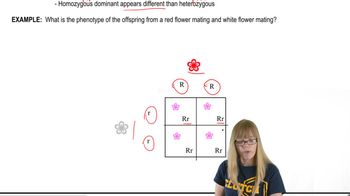
Autosomal dominant inheritance refers to a pattern where only one copy of a mutated gene from an affected parent can cause the disorder in offspring. In the case of Neurofibromatosis 1 (NF1), the presence of the dominant allele (N) leads to the manifestation of the disease, while the recessive allele (n) does not. This means that individuals with at least one N allele will express the NF1 phenotype.
Recommended video:
Guided course
04:37
Variations on Dominance

Genetic Linkage and Markers

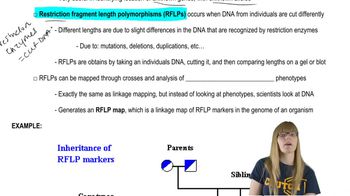
Genetic linkage involves the tendency of genes located close to each other on a chromosome to be inherited together during meiosis. DNA markers, which are specific sequences of DNA with known locations, can be used to track the inheritance of traits. In this scenario, the DNA marker with alleles 1 and 2 is linked to the NF1 gene, allowing researchers to analyze the segregation patterns in the pedigree.
Recommended video:
Guided course
07:11
Mapping with Markers

Pedigree Analysis

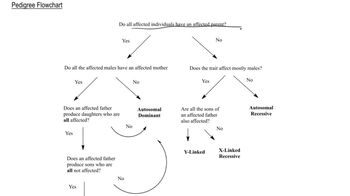
Pedigree analysis is a method used to study the inheritance patterns of traits across generations in a family. By examining the symbols representing affected and unaffected individuals, researchers can infer genotypes and track the transmission of alleles. In this question, the pedigree provides crucial information about the genotypes of family members, which is essential for determining the alleles for both the NF1 gene and the linked DNA marker.
Recommended video:
Guided course
01:59
Pedigree Flowchart
Related Practice
Textbook Question

In tomatoes, the allele T for tall plant height is dominant to dwarf allele t, the P allele for smooth skin is dominant to the p allele for peach fuzz skin, and the allele R for round fruit is dominant to the recessive r allele for oblong fruit. The genes controlling these traits are linked on chromosome 1 in the tomato genome, and the genes are arranged in the order and with the recombination frequencies shown.

What are the genotype and phenotype of the F₁ progeny of this cross?

413
views
Textbook Question

In tomatoes, the allele T for tall plant height is dominant to dwarf allele t, the P allele for smooth skin is dominant to the p allele for peach fuzz skin, and the allele R for round fruit is dominant to the recessive r allele for oblong fruit. The genes controlling these traits are linked on chromosome 1 in the tomato genome, and the genes are arranged in the order and with the recombination frequencies shown.

What are the genotypes of gametes produced by the F₁, and what is the predicted frequency of each gamete?

456
views
Textbook Question

In tomatoes, the allele T for tall plant height is dominant to dwarf allele t, the P allele for smooth skin is dominant to the p allele for peach fuzz skin, and the allele R for round fruit is dominant to the recessive r allele for oblong fruit. The genes controlling these traits are linked on chromosome 1 in the tomato genome, and the genes are arranged in the order and with the recombination frequencies shown.

The F₁ are test-crossed to dwarf, peach fuzz, oblong plants, and 1000 test-cross progeny are produced. What are the phenotypes of test-cross progeny, and what number of progeny is expected in each class?

470
views
Textbook Question

Neurofibromatosis 1 (NF1) is an autosomal dominant disorder inherited on human chromosome 17. Part of the analysis mapping the NF1 gene to chromosome 17 came from genetic linkage studies testing segregation of NF1 and DNA genetic markers on various chromosomes. A DNA marker with two alleles, designated 1 and 2, is linked to NF1. The pedigree below shows segregation of NF1 (darkened symbols) and gives genotypes for the DNA marker for each family member.

Based on the phase of alleles on chromosomes in generation II, is there any evidence of recombination among the eight offspring in generation III? Explain.

552
views
Textbook Question

Neurofibromatosis 1 (NF1) is an autosomal dominant disorder inherited on human chromosome 17. Part of the analysis mapping the NF1 gene to chromosome 17 came from genetic linkage studies testing segregation of NF1 and DNA genetic markers on various chromosomes. A DNA marker with two alleles, designated 1 and 2, is linked to NF1. The pedigree below shows segregation of NF1 (darkened symbols) and gives genotypes for the DNA marker for each family member.

What is the estimated recombination frequency between the NF1 gene and the DNA marker?

831
views
Textbook Question

A 2006 genetic study of a large American family (Ikeda et al., 2006) identified genetic linkage between DNA markers on chromosome 11 and the gene producing the autosomal dominant neuromuscular disorder spinocerebellar ataxia type 5 (SCA5). The following lod score data are taken from the 2006 study:                  

Does either group of lod scores indicate statistically significant odds in favor of genetic linkage? Explain your answer.

522
views