Pearson+ LogoPearson+ Logo
Ch. 5 - Genetic Linkage and Mapping in Eukaryotes
Sanders - Genetic Analysis: An Integrated Approach 3rd Edition
Sanders3rd EditionGenetic Analysis: An Integrated ApproachISBN: 9780135564172Not the one you use?Change textbook
Chapter 5, Problem 27c

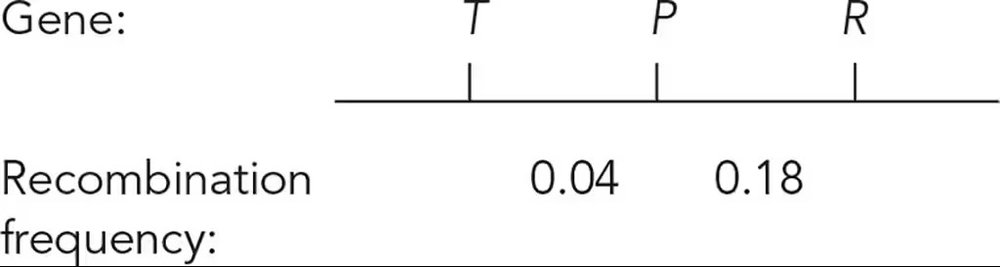
In tomatoes, the allele T for tall plant height is dominant to dwarf allele t, the P allele for smooth skin is dominant to the p allele for peach fuzz skin, and the allele R for round fruit is dominant to the recessive r allele for oblong fruit. The genes controlling these traits are linked on chromosome 1 in the tomato genome, and the genes are arranged in the order and with the recombination frequencies shown.
Genetic linkage diagram showing genes T, P, R with recombination frequencies of 0.04 and 0.18.
What are the genotypes of gametes produced by the F₁, and what is the predicted frequency of each gamete?

Verified step by step guidance
1
Step 1: Understand the genetic linkage and recombination frequencies. The genes T, P, and R are linked on chromosome 1, meaning they are physically close to each other and do not assort independently. Recombination frequencies between the genes indicate the likelihood of crossing over occurring between them during meiosis.
Step 2: Determine the parental and recombinant gametes. Since the genes are linked, the F₁ individual will produce gametes that are either parental (no recombination) or recombinant (resulting from crossing over). Parental gametes retain the original combinations of alleles, while recombinant gametes result from new combinations due to crossing over.
Step 3: Calculate the frequency of parental gametes. Parental gametes are produced at a frequency equal to 1 minus the sum of recombination frequencies between the linked genes. For example, if the recombination frequency between T and P is 0.1 and between P and R is 0.2, the parental gametes will make up the remaining proportion.
Step 4: Calculate the frequency of recombinant gametes. Recombinant gametes are produced at frequencies proportional to the recombination frequencies between the genes. For example, if the recombination frequency between T and P is 0.1, then 10% of the gametes will be recombinant for these genes.
Step 5: List all possible gametes and their frequencies. Combine the parental and recombinant gametes to create a complete list of gametes produced by the F₁ individual. Assign frequencies to each gamete based on the calculations from steps 3 and 4. Ensure that the total frequency sums to 1 (100%).

Verified video answer for a similar problem:

This video solution was recommended by our tutors as helpful for the problem above.
Video duration:
5m
Was this helpful?

Key Concepts

Here are the essential concepts you must grasp in order to answer the question correctly.

Dominant and Recessive Alleles

In genetics, alleles are different forms of a gene that can exist at a specific locus on a chromosome. Dominant alleles, represented by uppercase letters (e.g., T, P, R), mask the expression of recessive alleles, represented by lowercase letters (e.g., t, p, r). This means that if an organism has at least one dominant allele for a trait, that trait will be expressed in the phenotype.
Recommended video:
Guided course
04:37
Variations on Dominance

Linkage and Recombination

Linkage refers to the tendency of genes located close to each other on the same chromosome to be inherited together during meiosis. Recombination occurs when homologous chromosomes exchange genetic material during meiosis, leading to new combinations of alleles. The frequency of recombination between linked genes can provide insights into their relative positions on the chromosome.
Recommended video:
Guided course
07:33
Chi Square and Linkage

Gamete Formation and Genotype Frequencies

Gametes are the reproductive cells (sperm and eggs) that carry half the genetic information of an organism. The genotype of gametes produced by an organism can be determined by the alleles present in its genotype. The predicted frequency of each gamete can be calculated using the principles of Mendelian inheritance, particularly when considering dominant and recessive alleles and the effects of linkage.
Recommended video:
Guided course
04:06
Formation of Plant Gametes
Related Practice
Textbook Question

The following progeny are obtained from a test cross of a trihybrid wild-type plant to a plant with the recessive phenotypes compound leaves (c), intercalary leaflets (i), and green fruits (g). (Traits not listed are wild type.) The test-cross progeny are as follows:

How many double-crossover progeny are expected among the test-cross progeny? Calculate the interference for this cross.

746
views
Textbook Question

In tomatoes, the allele T for tall plant height is dominant to dwarf allele t, the P allele for smooth skin is dominant to the p allele for peach fuzz skin, and the allele R for round fruit is dominant to the recessive r allele for oblong fruit. The genes controlling these traits are linked on chromosome 1 in the tomato genome, and the genes are arranged in the order and with the recombination frequencies shown.

A pure-breeding tall, peach fuzz, round plant is crossed to a pure-breeding plant that is dwarf, smooth, oblong. What are the gamete genotypes produced by each of these plants? 

815
views
Textbook Question

In tomatoes, the allele T for tall plant height is dominant to dwarf allele t, the P allele for smooth skin is dominant to the p allele for peach fuzz skin, and the allele R for round fruit is dominant to the recessive r allele for oblong fruit. The genes controlling these traits are linked on chromosome 1 in the tomato genome, and the genes are arranged in the order and with the recombination frequencies shown.

What are the genotype and phenotype of the F₁ progeny of this cross?

413
views
Textbook Question

In tomatoes, the allele T for tall plant height is dominant to dwarf allele t, the P allele for smooth skin is dominant to the p allele for peach fuzz skin, and the allele R for round fruit is dominant to the recessive r allele for oblong fruit. The genes controlling these traits are linked on chromosome 1 in the tomato genome, and the genes are arranged in the order and with the recombination frequencies shown.

The F₁ are test-crossed to dwarf, peach fuzz, oblong plants, and 1000 test-cross progeny are produced. What are the phenotypes of test-cross progeny, and what number of progeny is expected in each class?

470
views
Textbook Question

Neurofibromatosis 1 (NF1) is an autosomal dominant disorder inherited on human chromosome 17. Part of the analysis mapping the NF1 gene to chromosome 17 came from genetic linkage studies testing segregation of NF1 and DNA genetic markers on various chromosomes. A DNA marker with two alleles, designated 1 and 2, is linked to NF1. The pedigree below shows segregation of NF1 (darkened symbols) and gives genotypes for the DNA marker for each family member.

Determine the alleles for the NF1 gene and the DNA marker gene on each chromosome carried by the four family members in generation I and generation II. Use N for the dominant NF1 allele and n for the recessive allele and assume I-1 is heterozygous for the disease allele (Nn).

924
views
Textbook Question

Neurofibromatosis 1 (NF1) is an autosomal dominant disorder inherited on human chromosome 17. Part of the analysis mapping the NF1 gene to chromosome 17 came from genetic linkage studies testing segregation of NF1 and DNA genetic markers on various chromosomes. A DNA marker with two alleles, designated 1 and 2, is linked to NF1. The pedigree below shows segregation of NF1 (darkened symbols) and gives genotypes for the DNA marker for each family member.

Based on the phase of alleles on chromosomes in generation II, is there any evidence of recombination among the eight offspring in generation III? Explain.

552
views