Pearson+ LogoPearson+ Logo
Ch. 5 - Genetic Linkage and Mapping in Eukaryotes
Sanders - Genetic Analysis: An Integrated Approach 3rd Edition
Sanders3rd EditionGenetic Analysis: An Integrated ApproachISBN: 9780135564172Not the one you use?Change textbook
Chapter 5, Problem 15a

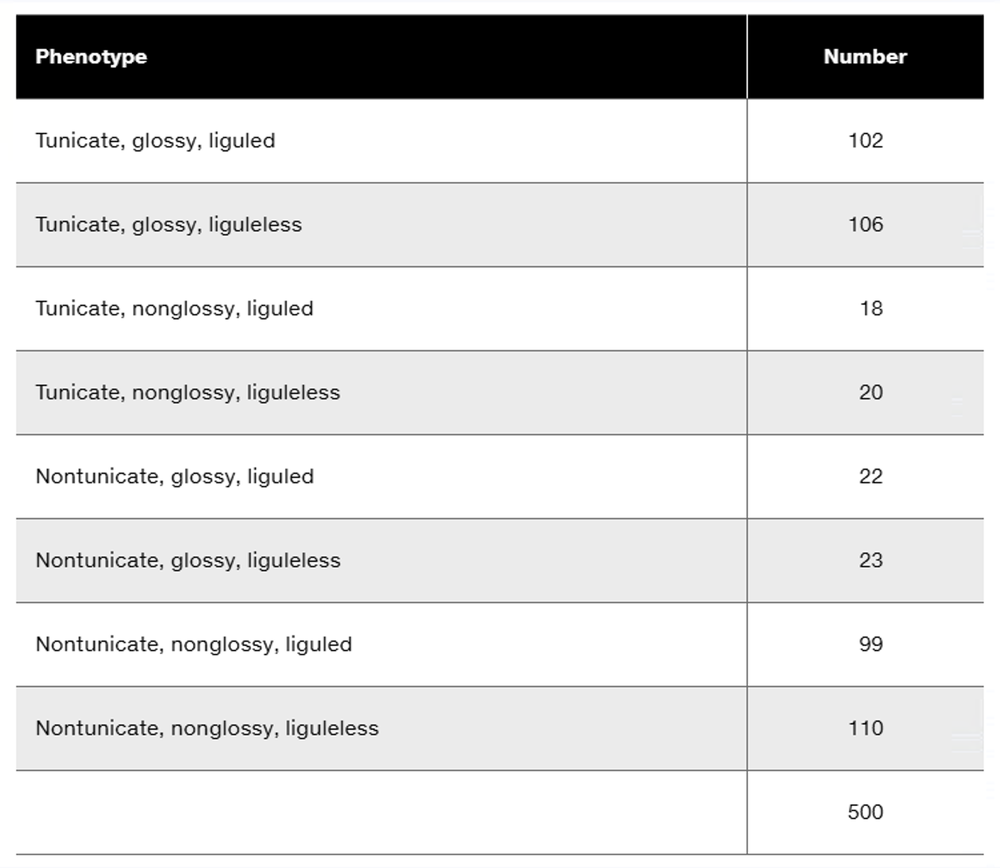
Three dominant traits of corn seedlings, tunicate seed (T-), glossy appearance (G-), and liguled stem (L-), are studied along with their recessive counterparts, nontunicate (tt), nonglossy (gg), and liguleless (ll). A trihybrid plant with the three dominant traits is crossed to a nontunicate, nonglossy, liguleless plant. Kernels on ears of progeny plants are scored for the traits, with the following results:
Table displaying phenotypes and counts of corn seedlings: tunicate, glossy, liguled; nontunicate, nonglossy, liguleless, etc.
Is there evidence of genetic linkage among any of these gene pairs? If so, identify the evidence.

Verified step by step guidance
1
Step 1: Begin by identifying the parental genotypes and phenotypes involved in the cross. The trihybrid plant has dominant traits (T-, G-, L-) and is crossed with a plant homozygous for recessive traits (tt, gg, ll). This setup allows us to analyze the inheritance patterns of the three traits.
Step 2: Examine the phenotypic ratios in the progeny. The observed phenotypes and their counts are provided in the table. These include combinations of dominant and recessive traits for tunicate seed, glossy appearance, and liguled stem. Note the total number of progeny (500).
Step 3: Compare the observed phenotypic ratios to the expected ratios under independent assortment. For three unlinked genes, the expected phenotypic ratio in the progeny would be 1:1:1:1:1:1:1:1, as each gene segregates independently. Calculate the expected counts for each phenotype based on this ratio.
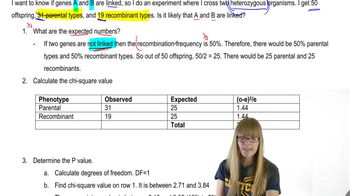
Step 4: Perform a chi-square test to determine if the observed ratios significantly deviate from the expected ratios. Use the formula χ² = Σ((O - E)² / E), where O is the observed count and E is the expected count for each phenotype. This test will help assess whether the genes are independently assorting or linked.
Step 5: Interpret the results of the chi-square test. If the chi-square value is significantly high (p-value < 0.05), it suggests evidence of genetic linkage among the gene pairs. Identify which phenotypes show deviations that indicate linkage and discuss the implications for the genetic map.

Verified video answer for a similar problem:

This video solution was recommended by our tutors as helpful for the problem above.
Video duration:
3m
Was this helpful?

Key Concepts

Here are the essential concepts you must grasp in order to answer the question correctly.

Genetic Linkage

Genetic linkage refers to the tendency of genes located close to each other on a chromosome to be inherited together during meiosis. This phenomenon can affect the expected ratios of phenotypes in offspring, as linked genes do not assort independently. Evidence of genetic linkage can be identified by analyzing the frequency of different phenotypes in progeny and comparing them to expected Mendelian ratios.
Recommended video:
Guided course
07:33
Chi Square and Linkage

Mendelian Inheritance

Mendelian inheritance is the set of principles that govern the transmission of genetic traits from parents to offspring, based on the work of Gregor Mendel. It includes concepts such as dominant and recessive traits, segregation, and independent assortment. Understanding these principles is crucial for predicting the outcomes of genetic crosses and analyzing phenotypic ratios in progeny.
Recommended video:
Guided course
05:13
Organelle Inheritance

Phenotypic Ratios

Phenotypic ratios represent the relative frequencies of different observable traits in the offspring resulting from a genetic cross. These ratios can be used to determine whether the traits assort independently or if there is evidence of linkage. By comparing observed ratios to expected ratios based on Mendelian inheritance, researchers can infer genetic relationships and the presence of linkage among traits.
Recommended video:
Guided course
10:48
Mutations and Phenotypes
Related Practice
Textbook Question

Nail–patella syndrome is an autosomal disorder affecting the shape of nails on fingers and toes as well as the structure of kneecaps. The pedigree below shows the transmission of nail–patella syndrome in a family along with ABO blood type.

Using N and n to represent alleles at the nail–patella locus and Iᴬ, Iᴮ and i to represent ABO alleles, write the genotypes of I-1 and I-2 as well as their five children in generation II.

598
views
Textbook Question

Nail–patella syndrome is an autosomal disorder affecting the shape of nails on fingers and toes as well as the structure of kneecaps. The pedigree below shows the transmission of nail–patella syndrome in a family along with ABO blood type.

Explain why III-6 has nail–patella syndrome and III-8 does not. Give genotypes for these two individuals.

646
views
Textbook Question

Nail–patella syndrome is an autosomal disorder affecting the shape of nails on fingers and toes as well as the structure of kneecaps. The pedigree below shows the transmission of nail–patella syndrome in a family along with ABO blood type.

Explain why III-11 has nail–patella syndrome and III-12 does not. Give genotypes for these two individuals.

440
views
Textbook Question

Three dominant traits of corn seedlings, tunicate seed (T-), glossy appearance (G-), and liguled stem (L-), are studied along with their recessive counterparts, nontunicate (tt), nonglossy (gg), and liguleless (ll). A trihybrid plant with the three dominant traits is crossed to a nontunicate, nonglossy, liguleless plant. Kernels on ears of progeny plants are scored for the traits, with the following results:

Is there evidence of independent assortment among any of these gene pairs? If so, identify the evidence.

448
views
Textbook Question

Three dominant traits of corn seedlings, tunicate seed (T-), glossy appearance (G-), and liguled stem (L-), are studied along with their recessive counterparts, nontunicate (tt), nonglossy (gg), and liguleless (ll). A trihybrid plant with the three dominant traits is crossed to a nontunicate, nonglossy, liguleless plant. Kernels on ears of progeny plants are scored for the traits, with the following results:

Using the gene symbols given above, write the genotypes of F₁ and F₂ plants.

560
views
Textbook Question

Three dominant traits of corn seedlings, tunicate seed (T-), glossy appearance (G-), and liguled stem (L-), are studied along with their recessive counterparts, nontunicate (tt), nonglossy (gg), and liguleless (ll). A trihybrid plant with the three dominant traits is crossed to a nontunicate, nonglossy, liguleless plant. Kernels on ears of progeny plants are scored for the traits, with the following results:

If evidence of linkage is present, calculate the recombination frequency or frequencies from the data presented.

632
views