Pearson+ LogoPearson+ Logo
Ch. 6 - Genetic Analysis and Mapping in Bacteria and Bacteriophages
Sanders - Genetic Analysis: An Integrated Approach 3rd Edition
Sanders3rd EditionGenetic Analysis: An Integrated ApproachISBN: 9780135564172Not the one you use?Change textbook
Chapter 6, Problem 22e

An attribute of growth behavior of eight bacteriophage mutants (1 to 8) is investigated in experiments that establish coinfection by pairs of mutants. The experiments determine whether the mutants complement one another (+) or fail to complement (-). These eight mutants are known to result from point mutation. The results of the complementation tests are shown below.
Table showing complementation results of eight bacteriophage mutants in genetics experiments.
New mutation 10 fails to complement mutants 1, 4, 5, 6, 8, and 9. Mutant 10 forms wild-type recombinants with mutants 1, 5, and 6, but not with mutants 4 and 8. Mutant 9 and mutant 10 form wild-type recombinants. What kind of mutation is mutant 10? Explain your reasoning.

Verified step by step guidance
1
Analyze the complementation table provided. A '+' indicates that the two mutants complement each other, meaning they affect different genes. A '-' indicates no complementation, meaning the mutations are in the same gene.
From the problem, mutant 10 fails to complement mutants 1, 4, 5, 6, 8, and 9. This suggests that mutant 10 shares the same gene as these mutants. Complementation failure indicates that the mutations are in the same functional unit (gene).
Mutant 10 forms wild-type recombinants with mutants 1, 5, and 6. This indicates that the mutations in these mutants are at different locations within the same gene, allowing recombination to restore the wild-type sequence.
Mutant 10 does not form wild-type recombinants with mutants 4 and 8. This suggests that the mutations in these mutants are at the same or overlapping locations within the gene, preventing recombination from restoring the wild-type sequence.
Based on the complementation and recombination data, mutant 10 is likely a point mutation within the same gene as mutants 1, 4, 5, 6, 8, and 9. Its specific behavior in recombination tests indicates that it is at a distinct location within the gene, except for mutants 4 and 8, where it overlaps.

Verified video answer for a similar problem:

This video solution was recommended by our tutors as helpful for the problem above.
Video duration:
2m
Was this helpful?

Key Concepts

Here are the essential concepts you must grasp in order to answer the question correctly.

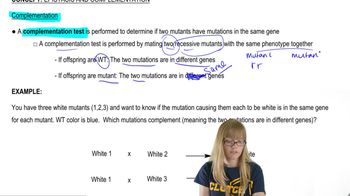
Complementation

Complementation refers to the phenomenon where two different mutations in a gene can restore the wild-type phenotype when present together. In the context of bacteriophage mutants, if two mutants can produce wild-type recombinants, they are said to complement each other, indicating that the mutations affect different genes or different sites within the same gene.
Recommended video:
Guided course
05:05
Complementation

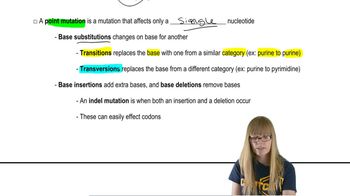
Point Mutation

A point mutation is a change in a single nucleotide base pair in the DNA sequence. This type of mutation can lead to various outcomes, including silent mutations, missense mutations, or nonsense mutations, depending on whether the change affects the amino acid sequence of the resulting protein. In the case of the bacteriophage mutants, the eight mutants are all derived from point mutations, which can influence their ability to complement each other.
Recommended video:
Guided course
09:49
Point Mutations

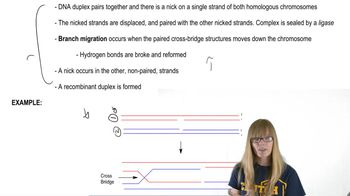
Recombinant Formation

Recombinant formation occurs when genetic material from two different sources combines to create a new genotype. In the context of the experiment, when mutant 10 forms wild-type recombinants with other mutants, it suggests that the mutations in those pairs do not affect the same functional aspect of the bacteriophage, allowing for the restoration of the wild-type phenotype. This is crucial for determining the nature of mutant 10.
Recommended video:
Guided course
03:51
Recombination after Single Strand Breaks
Related Practice
Textbook Question

An attribute of growth behavior of eight bacteriophage mutants (1 to 8) is investigated in experiments that establish coinfection by pairs of mutants. The experiments determine whether the mutants complement one another (+) or fail to complement (-). These eight mutants are known to result from point mutation. The results of the complementation tests are shown below.

Identify the mutants of each gene.

495
views
Textbook Question

An attribute of growth behavior of eight bacteriophage mutants (1 to 8) is investigated in experiments that establish coinfection by pairs of mutants. The experiments determine whether the mutants complement one another (+) or fail to complement (-). These eight mutants are known to result from point mutation. The results of the complementation tests are shown below.

In each coinfection identified as a failure to complement (−) in the table, researchers see evidence of recombination producing wild-type growth. How do the researchers distinguish between wild-type growth resulting from complementation and wild-type growth that is due to recombination?

524
views
Textbook Question

An attribute of growth behavior of eight bacteriophage mutants (1 to 8) is investigated in experiments that establish coinfection by pairs of mutants. The experiments determine whether the mutants complement one another (+) or fail to complement (-). These eight mutants are known to result from point mutation. The results of the complementation tests are shown below.

A new mutation, designated 9, fails to complement mutants 1, 3, 5, 7, and 8. Wild-type recombinants form between mutant 9 and mutations 3, 5, and 8; however, no wild-type recombinants form between mutant 9 and mutations 1 and 7. What kind of mutation is mutant 9? Explain your reasoning.

482
views
Textbook Question

An attribute of growth behavior of eight bacteriophage mutants (1 to 8) is investigated in experiments that establish coinfection by pairs of mutants. The experiments determine whether the mutants complement one another (+) or fail to complement (-). These eight mutants are known to result from point mutation. The results of the complementation tests are shown below.

Gene-mapping information identifies mutations 2 and 3 as the flanking markers in this group of genes. Assuming these mutations are on opposite ends of the gene map, determine the order of mutations in the region of the chromosome.

538
views
Textbook Question

Synthesis of the amino acid histidine is a multistep anabolic pathway that uses the products of 13 genes (hisA to hisM) in E. coli. Two independently isolated his- E. coli mutants, designated his1⁻ and his2⁻ are studied in a conjugation experiment. A his⁺ F' donor strain that carries a copy of the hisJ gene on the plasmid is mated with a his1⁻ recipient strain in Experiment 1 and with a his2⁻ recipient in Experiment 2. The exconjugants are grown on plates lacking histidine. Growth is observed among the exconjugants of Experiment 2 but not among those of Experiment 1.

Why is growth observed in Experiment 2 but not in Experiment 1?

586
views
Textbook Question

Synthesis of the amino acid histidine is a multistep anabolic pathway that uses the products of 13 genes (hisA to hisM) in E. coli. Two independently isolated his- E. coli mutants, designated his1⁻ and his2⁻ are studied in a conjugation experiment. A his⁺ F' donor strain that carries a copy of the hisJ gene on the plasmid is mated with a his1⁻ recipient strain in Experiment 1 and with a his2⁻ recipient in Experiment 2. The exconjugants are grown on plates lacking histidine. Growth is observed among the exconjugants of Experiment 2 but not among those of Experiment 1.

What is the genotype of exconjugants in Experiment 2?

425
views