Pearson+ LogoPearson+ Logo
Ch. 6 - Genetic Analysis and Mapping in Bacteria and Bacteriophages
Sanders - Genetic Analysis: An Integrated Approach 3rd Edition
Sanders3rd EditionGenetic Analysis: An Integrated ApproachISBN: 9780135564172Not the one you use?Change textbook
Chapter 6, Problem 17

Five Hfr strains from the same bacterial species are analyzed for their ability to transfer genes to F⁻ recipient bacteria. The data shown below list the origin of transfer (oriT) for each strain and give the order of genes, with the first gene on the left and the last gene on the right. Use the data to construct a circular map of the bacterium.
Hfr Strain     Genes Transferred
Hfr 1         oriT met ala lac gal
Hfr 2         oriT met leu thr azi
Hfr 3         oriT gal pro trp azi
Hfr 4         oriT leu met ala lac
Hfr 5         oriT trp azi thr leu met

Verified step by step guidance
1
Step 1: Understand the problem. The goal is to construct a circular map of the bacterial genome based on the gene transfer data from five Hfr strains. Each strain starts transferring genes from a specific origin of transfer (oriT) and follows a specific order of genes. The circular map will represent the relative positions of these genes and oriTs.
Step 2: Identify overlapping genes between strains. Look for common genes in the transfer sequences of different Hfr strains to determine how the sequences connect. For example, Hfr 1 transfers 'met ala lac gal', and Hfr 4 transfers 'leu met ala lac'. The overlap 'met ala lac' suggests these sequences are adjacent on the circular map.
Step 3: Determine the orientation of gene transfer. The order of genes transferred by each strain indicates the direction of movement around the circular map. For instance, Hfr 3 transfers 'gal pro trp azi', and Hfr 5 transfers 'trp azi thr leu met'. The overlap 'trp azi' helps establish continuity and directionality.
Step 4: Place oriTs on the map. Each Hfr strain starts transferring genes from a specific oriT. Use the gene order and overlaps to position the oriTs correctly on the circular map. For example, Hfr 1 starts at 'oriT met', and Hfr 2 starts at 'oriT met leu'. This suggests 'met' is near the oriT for both strains.
Step 5: Construct the circular map. Combine all the information from steps 2-4 to create a complete circular representation of the bacterial genome. Ensure that all genes and oriTs are placed in the correct order and orientation, and verify that the map accounts for all overlaps and connections between the Hfr strains.

Verified video answer for a similar problem:

This video solution was recommended by our tutors as helpful for the problem above.
Video duration:
6m
Was this helpful?

Key Concepts

Here are the essential concepts you must grasp in order to answer the question correctly.

Hfr Strains and Gene Transfer

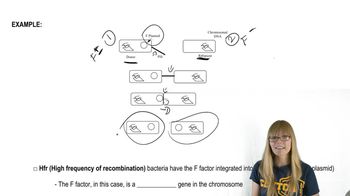
Hfr (high frequency of recombination) strains are a type of bacterial strain that can transfer genetic material to F⁻ recipient bacteria during conjugation. This process involves the transfer of chromosomal genes starting from a specific origin of transfer (oriT). Understanding how Hfr strains operate is crucial for analyzing gene transfer patterns and constructing genetic maps.
Recommended video:
Guided course
08:52
F Factor and Hfr

Gene Mapping

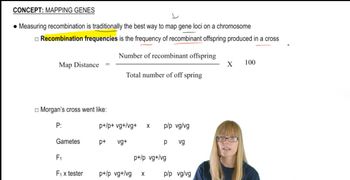
Gene mapping is the process of determining the relative positions of genes on a chromosome. In the context of Hfr strains, the order of genes transferred during conjugation can be used to infer their physical arrangement on the bacterial chromosome. This information is essential for constructing a circular map that represents the genetic layout of the bacterium.
Recommended video:
Guided course
09:09
Mapping Genes

Circular Chromosome Structure in Bacteria

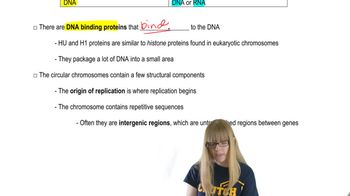
Bacterial chromosomes are typically circular, which influences how genes are organized and transferred. The circular structure allows for continuous replication and gene transfer, making it important to visualize gene order in a circular format when analyzing data from Hfr strains. This understanding aids in accurately mapping the genes based on the transfer data provided.
Recommended video:
Guided course
02:39
Bacteria and Viral Chromosome Structure
Related Practice
Textbook Question

A 2013 CDC report identified the practice of routinely adding antibiotic compounds to animal feed as a major culprit in the rapid increase in the number of antibiotic-resistant strains. Agricultural practice in recent decades has encouraged the addition of antibiotics to animal feed to promote growth rather than to treat disease.

How might the increase in antibiotic-resistant strains of bacteria in cattle be a threat to human health?

504
views
Textbook Question

Hfr strains that differ in integrated F factor orientation and site of integration are used to construct consolidated bacterial chromosome maps. The data below show the order of gene transfer for five strains.

Hfr Strain   Order of Gene Transfer (First → Last)

Hfr A        oriT–thr–leu–azi–ton–pro–lac–ade

Hfr B        oriT–mtl–xyl–mal–str–his

Hfr C        oriT–ile–met–thi–thr–leu–azi–ton

Hfr D        oriT–his–trp–gal–ade–lac–pro–ton

Hfr E        oriT–thi–met–ile–mtl–xyl–mal–str

Identify the overlaps between Hfr strains. Identify the orientations of integrated F factors relative to one another.

1788
views
Textbook Question

Hfr strains that differ in integrated F factor orientation and site of integration are used to construct consolidated bacterial chromosome maps. The data below show the order of gene transfer for five strains.

Hfr Strain   Order of Gene Transfer (First → Last)

Hfr A        oriT–thr–leu–azi–ton–pro–lac–ade

Hfr B        oriT–mtl–xyl–mal–str–his

Hfr C        oriT–ile–met–thi–thr–leu–azi–ton

Hfr D        oriT–his–trp–gal–ade–lac–pro–ton

Hfr E        oriT–thi–met–ile–mtl–xyl–mal–str

Draw a consolidated map of the bacterial chromosome. (Hint: Begin by placing the insertion site for Hfr A at the 2 o'clock position and arranging the genes thr–leu–azi- . . . in clockwise order.)

1689
views
Textbook Question

An interrupted mating study is carried out on Hfr strains 1, 2, and 3 identified in Problem 17. After conjugation is established, a small sample of the mixture is collected every minute for 20 minutes to determine the distance between genes on the chromosome. Results for each of the three Hfr strains are shown below. The total duration of conjugation (in minutes) is given for each transferred gene.

Hfr strain 1     oriT  met  ala  lac  gal

Duration (min)   0     2    8   13   17

Hfr strain 2     oriT  met  leu  thr   azi

Duration (min)   0     2    7   10   17

Hfr strain 3     oriT  gal   pro  trp   azi

Duration (min)   0     3    8   14   19

For each Hfr strain, draw a time-of-entry profile.

1225
views
Textbook Question

An interrupted mating study is carried out on Hfr strains 1, 2, and 3 identified in Problem 17. After conjugation is established, a small sample of the mixture is collected every minute for 20 minutes to determine the distance between genes on the chromosome. Results for each of the three Hfr strains are shown below. The total duration of conjugation (in minutes) is given for each transferred gene.

Hfr strain 1     oriT  met  ala  lac  gal

Duration (min)   0     2    8   13   17

Hfr strain 2     oriT  met  leu  thr   azi

Duration (min)   0     2    7   10   17

Hfr strain 3     oriT  gal   pro  trp   azi

Duration (min)   0     3    8   14   19

Using the chromosome map you prepared in answer to Problem 17, determine the distance in minutes between each gene on the map.

850
views
Textbook Question

An interrupted mating study is carried out on Hfr strains 1, 2, and 3 identified in Problem 17. After conjugation is established, a small sample of the mixture is collected every minute for 20 minutes to determine the distance between genes on the chromosome. Results for each of the three Hfr strains are shown below. The total duration of conjugation (in minutes) is given for each transferred gene.

Hfr strain 1     oriT  met  ala  lac  gal

Duration (min)   0     2    8   13   17

Hfr strain 2     oriT  met  leu  thr   azi

Duration (min)   0     2    7   10   17

Hfr strain 3     oriT  gal   pro  trp   azi

Duration (min)   0     3    8   14   19

Explain why azi is the last gene of strain 2 to transfer in the 20 minutes of conjugation time. How many minutes of conjugation time would be needed to allow the next gene on the map to transfer from Hfr strain 2?

714
views