Pearson+ LogoPearson+ Logo
Ch. 6 - Genetic Analysis and Mapping in Bacteria and Bacteriophages
Sanders - Genetic Analysis: An Integrated Approach 3rd Edition
Sanders3rd EditionGenetic Analysis: An Integrated ApproachISBN: 9780135564172Not the one you use?Change textbook
Chapter 6, Problem 1a

For bacteria that are F⁺, Hfr, F', and F⁻ perform or answer the following.
Describe the state of the F factor.

Verified step by step guidance
1
Understand the F factor: The F factor (fertility factor) is a plasmid that allows bacteria to transfer genetic material through conjugation. It plays a key role in bacterial reproduction and genetic exchange.
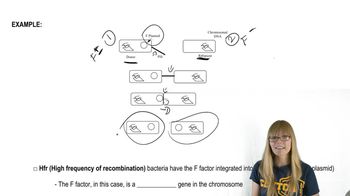
Describe the F⁺ state: In F⁺ bacteria, the F factor exists as an independent plasmid within the cytoplasm. These bacteria can initiate conjugation and transfer the F factor to F⁻ bacteria.
Describe the Hfr state: In Hfr (high frequency of recombination) bacteria, the F factor is integrated into the bacterial chromosome. During conjugation, these bacteria transfer chromosomal genes along with the F factor to recipient cells.
Describe the F' state: In F' bacteria, the F factor exists as a plasmid but carries additional chromosomal genes due to improper excision from the bacterial chromosome. These bacteria can transfer both the F factor and the extra chromosomal genes during conjugation.
Describe the F⁻ state: In F⁻ bacteria, the F factor is absent. These bacteria cannot initiate conjugation but can receive genetic material from F⁺, Hfr, or F' bacteria during conjugation.

Verified video answer for a similar problem:

This video solution was recommended by our tutors as helpful for the problem above.
Video duration:
2m
Was this helpful?

Key Concepts

Here are the essential concepts you must grasp in order to answer the question correctly.

F Factor

The F factor, or fertility factor, is a plasmid in bacteria that contains genes necessary for the formation of sex pili and the process of conjugation. It can exist as a free plasmid (F⁺), integrated into the bacterial chromosome (Hfr), or as a modified plasmid that carries additional genes (F'). The presence and state of the F factor determine the bacterial cell's ability to transfer genetic material to another cell.
Recommended video:
Guided course
08:52
F Factor and Hfr

Conjugation

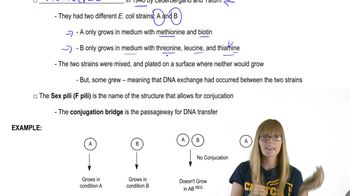
Conjugation is a form of horizontal gene transfer in bacteria where genetic material is transferred from one bacterium to another through direct contact. This process typically involves the formation of a pilus by the donor cell, allowing the transfer of the F factor or chromosomal DNA. Understanding conjugation is essential for grasping how genetic diversity is generated in bacterial populations.
Recommended video:
Guided course
04:06
Conjugation Overview

Hfr Strains

Hfr (high frequency of recombination) strains are bacteria in which the F factor is integrated into the chromosomal DNA. This integration allows for the transfer of chromosomal genes during conjugation, leading to genetic recombination. Hfr strains are important for studying gene mapping and understanding the mechanisms of genetic exchange in bacteria.
Recommended video:
Guided course
08:52
F Factor and Hfr
Related Practice
Textbook Question

Go online to the Online Mendelian Inheritance of Man (OMIM) website. Look up the following genetic conditions and answer the questions posed about them.

Go to the 'Population Genetics' section discussing the TSD gene. In a few sentences, summarize the human population in which TSD is most frequently found and give the approximate frequency of heterozygous carriers for the TSD mutation in North American Jews.

573
views
Textbook Question

Go online to the Online Mendelian Inheritance of Man (OMIM) website. Look up the following genetic conditions and answer the questions posed about them.

Look up cystic fibrosis (CF), OMIM 602421, and give the gene name and abbreviation and the chromosome location of the gene.

728
views
Textbook Question

Go online to the Online Mendelian Inheritance of Man (OMIM) website. Look up the following genetic conditions and answer the questions posed about them.

Go to the 'Molecular Genetics' section and describe the most common mutation of the CF gene.

490
views
Textbook Question

For bacteria that are F⁺, Hfr, F', and F⁻ perform or answer the following.

Which of these cells are donors? Which is the recipient?

488
views
Textbook Question

For bacteria that are F⁺, Hfr, F', and F⁻ perform or answer the following.

Which of these donors can convert exconjugants to a donor state?

771
views
Textbook Question

For bacteria that are F⁺, Hfr, F', and F⁻, perform or answer the following.

Which of these donors can transfer a donor gene to exconjugants?

665
views