
Pearson+ LogoPearson+ Logo
Ch. 6 - Genetic Analysis and Mapping in Bacteria and Bacteriophages
Sanders - Genetic Analysis: An Integrated Approach 3rd Edition
Sanders3rd EditionGenetic Analysis: An Integrated ApproachISBN: 9780135564172Not the one you use?Change textbook
Chapter 6, Problem A.1b

Match each statement (a–e) with the best answer from the following list: consultand, 50%, prior probability, 66.7%, obligate carrier, 100%.
A person who on the basis of family history must be a heterozygous carrier of a recessive mutant allele

Verified step by step guidance
1
Step 1: Understand the term 'obligate carrier'. An obligate carrier is an individual who, based on their family history, must carry a specific genetic mutation. This is often determined by patterns of inheritance in the family, such as autosomal recessive inheritance.
Step 2: Analyze the statement provided in the problem. The statement describes a person who, due to their family history, must be a heterozygous carrier of a recessive mutant allele. This matches the definition of an obligate carrier.
Step 3: Review the list of possible answers provided in the problem: consultand, 50%, prior probability, 66.7%, obligate carrier, 100%. Identify which term aligns with the description in the statement.
Step 4: Match the term 'obligate carrier' to the statement, as it is the best fit based on the definition and the context provided.
Step 5: Confirm your understanding by revisiting the concept of obligate carriers and ensuring that the family history aspect aligns with the genetic inheritance patterns described in the problem.

Verified video answer for a similar problem:

This video solution was recommended by our tutors as helpful for the problem above.
Video duration:
2m
Was this helpful?

Key Concepts

Here are the essential concepts you must grasp in order to answer the question correctly.

Heterozygous Carrier

A heterozygous carrier is an individual who possesses two different alleles for a particular gene, one of which may be a recessive mutant allele. In the context of genetic disorders, this means the person does not express the disorder but can pass the recessive allele to their offspring. Understanding this concept is crucial for interpreting family histories and predicting inheritance patterns.
Recommended video:
Guided course
10:56
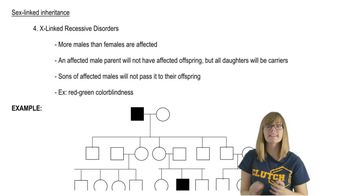
Sex-Linked Pedigrees

Recessive Mutant Allele

A recessive mutant allele is a variant of a gene that does not manifest its effects in the presence of a dominant allele. For an individual to express a trait associated with a recessive allele, they must inherit two copies of that allele, one from each parent. This concept is fundamental in genetics, particularly in understanding how traits are inherited and the likelihood of offspring being affected by genetic conditions.
Recommended video:
Guided course
03:03
New Alleles and Migration

Obligate Carrier

An obligate carrier is an individual who must carry a specific allele due to their family history, even if they do not express the associated trait. In the case of recessive disorders, if both parents are carriers, their child has a 25% chance of being affected, a 50% chance of being a carrier, and a 25% chance of being unaffected. Recognizing obligate carriers is essential for genetic counseling and risk assessment in families.
Recommended video:
Guided course
10:56
Sex-Linked Pedigrees