Pearson+ LogoPearson+ Logo
Ch. 6 - Genetic Analysis and Mapping in Bacteria and Bacteriophages
Sanders - Genetic Analysis: An Integrated Approach 3rd Edition
Sanders3rd EditionGenetic Analysis: An Integrated ApproachISBN: 9780135564172Not the one you use?Change textbook
Chapter 6, Problem A.1c

Match each statement (a–e) with the best answer from the following list: consultand, 50%, prior probability, 66.7%, obligate carrier, 100%.
The probability that the healthy brother of a woman with an autosomal recessive condition is a heterozygous carrier

Verified step by step guidance
1
Step 1: Understand the genetic inheritance pattern. Autosomal recessive conditions require two copies of the recessive allele for an individual to express the condition. A heterozygous carrier has one copy of the recessive allele and one copy of the dominant allele.
Step 2: Identify the relationship between the individuals in the problem. The healthy brother of a woman with an autosomal recessive condition is being analyzed for his carrier status.
Step 3: Consider the genetic information of the parents. If the woman has the autosomal recessive condition, both parents must be carriers of the recessive allele (heterozygous). This means the brother has inherited one allele from each parent.
Step 4: Calculate the probability of the brother being a carrier. Since the brother is healthy, he cannot have two recessive alleles. The possible genotypes for the brother are either homozygous dominant (not a carrier) or heterozygous (carrier). The probability of being a carrier is 50%.
Step 5: Match the statement to the correct answer from the list provided. The probability that the healthy brother is a heterozygous carrier corresponds to '50%'.

Verified video answer for a similar problem:

This video solution was recommended by our tutors as helpful for the problem above.
Video duration:
4m
Was this helpful?

Key Concepts

Here are the essential concepts you must grasp in order to answer the question correctly.

Autosomal Recessive Inheritance

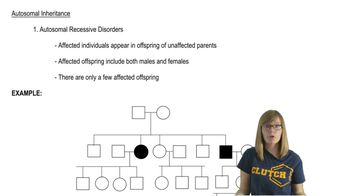
Autosomal recessive inheritance occurs when a trait or condition is expressed only when an individual has two copies of the recessive allele, one from each parent. In this scenario, if a woman has an autosomal recessive condition, she must have two recessive alleles, while her healthy brother may carry one recessive allele and one dominant allele, making him a potential carrier.
Recommended video:
Guided course
09:08
Autosomal Pedigrees

Carrier Probability

The probability of being a carrier for a recessive condition can be calculated using the known genotypes of family members. In this case, since the woman is affected, her brother's probability of being a carrier is influenced by the fact that their parents must each carry at least one recessive allele, leading to a 50% chance that he is a heterozygous carrier.
Recommended video:

Prior Probability

Prior probability refers to the initial estimation of the likelihood of an event before considering additional evidence. In genetics, this concept helps in assessing the probability of an individual being a carrier based on known family history and the inheritance pattern of the condition, which in this case is 50% for the healthy brother of an affected sister.
Recommended video:
Related Practice
Textbook Question

Match each statement (a–e) with the best answer from the following list: consultand, 50%, prior probability, 66.7%, obligate carrier, 100%.

The Mendelian risk that a person is a heterozygous carrier of a recessive condition

449
views
Textbook Question

Match each statement (a–e) with the best answer from the following list: consultand, 50%, prior probability, 66.7%, obligate carrier, 100%.

A person who on the basis of family history must be a heterozygous carrier of a recessive mutant allele

488
views
Textbook Question

Match each statement (a–e) with the best answer from the following list: consultand, 50%, prior probability, 66.7%, obligate carrier, 100%.

The person receiving genetic counseling

440
views
Textbook Question

Match each statement (a–e) with the best answer from the following list: consultand, 50%, prior probability, 66.7%, obligate carrier, 100%.

The probability that the son of a woman with an autosomal recessive condition is a heterozygous carrier

492
views
Textbook Question

A couple comes into your genetic counseling practice with a question about the chance a future child of theirs might have a genetic disease. Three or four men in the woman's family, including her father, had a condition that might be genetic. Although her father is still alive, she has had little contact with him for much of her life and cannot describe or name the condition. Her partner is a healthy man whose family has no history indicating the presence of a genetic condition. To provide more information about this possible genetic condition for the couple, what is the first step you recommend?

472
views