Pearson+ LogoPearson+ Logo
Ch. 7 - DNA Structure and Replication
Sanders - Genetic Analysis: An Integrated Approach 3rd Edition
Sanders3rd EditionGenetic Analysis: An Integrated ApproachISBN: 9780135564172Not the one you use?Change textbook
Chapter 7, Problem 27c

A family consisting of a mother (I-1), a father (I-2), and three children (II-1, II-2, and II-3) are genotyped by PCR for a region of an autosome containing repeats of a 10-bp sequence. The mother carries 16 repeats on one chromosome and 21 on the homologous chromosome. The father carries repeat numbers of 18 and 26.
What genetic term best describes the pattern of inheritance of this DNA marker? Explain your choice.

Verified step by step guidance
1
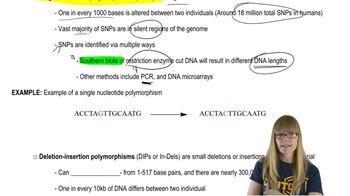
The DNA marker described in the problem is an example of a microsatellite or short tandem repeat (STR), which consists of short, repetitive DNA sequences. These markers are highly polymorphic and are inherited in a Mendelian fashion.
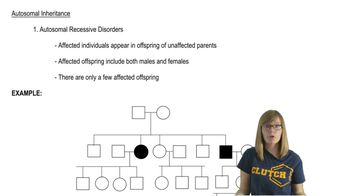
The pattern of inheritance for this DNA marker is autosomal because the marker is located on an autosome (a non-sex chromosome). This means both males and females inherit the marker equally from their parents.
Each parent contributes one allele (one repeat number) to their offspring. For example, the mother can pass on either the allele with 16 repeats or the allele with 21 repeats, while the father can pass on either the allele with 18 repeats or the allele with 26 repeats.
The inheritance of these alleles follows the principle of segregation, where each parent randomly transmits one of their two alleles to their offspring. This is consistent with Mendel's first law of inheritance.
The genetic term that best describes the pattern of inheritance of this DNA marker is 'codominance.' This is because both alleles (repeat numbers) inherited from the parents are expressed in the offspring and can be detected through PCR genotyping. For example, a child inheriting the 16-repeat allele from the mother and the 18-repeat allele from the father will show both alleles in the PCR results.

Verified video answer for a similar problem:

This video solution was recommended by our tutors as helpful for the problem above.
Video duration:
5m
Was this helpful?

Key Concepts

Here are the essential concepts you must grasp in order to answer the question correctly.

Autosomal Inheritance

Autosomal inheritance refers to the transmission of genetic traits that are located on the autosomes, which are the non-sex chromosomes. In this case, the DNA marker is located on an autosome, meaning that both parents contribute to the genetic makeup of their children. Understanding this concept is crucial for analyzing how traits are passed down through generations.
Recommended video:
Guided course
09:08
Autosomal Pedigrees

Allelic Variation

Allelic variation describes the differences in the DNA sequence among individuals, particularly in the number of repeats in a given region. In this scenario, the mother and father have different numbers of repeats (16, 21 for the mother and 18, 26 for the father), which illustrates how allelic variation can influence the genetic traits passed to offspring. This concept is essential for understanding the inheritance pattern of the DNA marker.
Recommended video:
Guided course
09:28
Genomic Variation

Mendelian Inheritance

Mendelian inheritance is based on Gregor Mendel's principles, which describe how traits are inherited through dominant and recessive alleles. In this case, the inheritance of the repeat numbers can be analyzed through Mendelian principles, as the children will inherit one allele from each parent. This framework helps in predicting the possible combinations of repeat numbers in the offspring, thus clarifying the pattern of inheritance for the DNA marker.
Recommended video:
Guided course
05:13
Organelle Inheritance
Related Practice
Textbook Question

Telomeres are found at the ends of eukaryotic chromosomes. Why is telomerase usually active in germ-line cells but not in somatic cells?

859
views
Textbook Question

A family consisting of a mother (I-1), a father (I-2), and three children (II-1, II-2, and II-3) are genotyped by PCR for a region of an autosome containing repeats of a 10-bp sequence. The mother carries 16 repeats on one chromosome and 21 on the homologous chromosome. The father carries repeat numbers of 18 and 26.

Following the layout of the following figure, which aligns members of a pedigree with their DNA fragments in a gel, draw a DNA gel containing the PCR fragments generated by amplification of DNA from the parents (I-1 and I-2). Label the size of each fragment.

676
views
Textbook Question

A family consisting of a mother (I-1), a father (I-2), and three children (II-1, II-2, and II-3) are genotyped by PCR for a region of an autosome containing repeats of a 10-bp sequence. The mother carries 16 repeats on one chromosome and 21 on the homologous chromosome. The father carries repeat numbers of 18 and 26.

Identify all the possible genotypes of children of this couple by specifying PCR fragment lengths in each genotype.

542
views
Textbook Question

In a dideoxy DNA sequencing experiment, four separate reactions are carried out to provide the replicated material for DNA sequencing gels. Reaction products are usually run in gel lanes labeled A, T, C, and G.

Identify the nucleotides used in the dideoxy DNA sequencing reaction that produces molecules for the A lane of the sequencing gel.

725
views
Textbook Question

In a dideoxy DNA sequencing experiment, four separate reactions are carried out to provide the replicated material for DNA sequencing gels. Reaction products are usually run in gel lanes labeled A, T, C, and G.

How does PCR play a role in dideoxy DNA sequencing?

548
views
Textbook Question

In a dideoxy DNA sequencing experiment, four separate reactions are carried out to provide the replicated material for DNA sequencing gels. Reaction products are usually run in gel lanes labeled A, T, C, and G.

Why is incorporation of a dideoxynucleotide during DNA sequencing identified as a 'replication-terminating' event?

542
views