Pearson+ LogoPearson+ Logo
Ch. 7 - DNA Structure and Replication
Sanders - Genetic Analysis: An Integrated Approach 3rd Edition
Sanders3rd EditionGenetic Analysis: An Integrated ApproachISBN: 9780135564172Not the one you use?Change textbook
Chapter 7, Problem 28a

In a dideoxy DNA sequencing experiment, four separate reactions are carried out to provide the replicated material for DNA sequencing gels. Reaction products are usually run in gel lanes labeled A, T, C, and G.
Identify the nucleotides used in the dideoxy DNA sequencing reaction that produces molecules for the A lane of the sequencing gel.

Verified step by step guidance
1
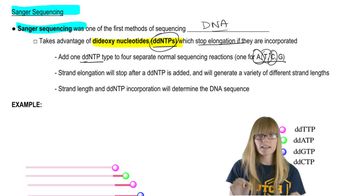
Understand the principle of dideoxy DNA sequencing (Sanger sequencing): This method uses a DNA template, a primer, DNA polymerase, deoxynucleotides (dNTPs), and dideoxynucleotides (ddNTPs). The ddNTPs lack a 3'-OH group, which terminates DNA synthesis when incorporated.
Recognize that the A lane of the sequencing gel corresponds to DNA fragments that terminate at adenine (A) in the template strand. This means the complementary nucleotide (thymine, T) is incorporated in the newly synthesized strand.
Identify the nucleotides required for the A lane reaction: The reaction mixture must include all four deoxynucleotides (dATP, dTTP, dCTP, dGTP) to allow normal DNA synthesis, as well as a small amount of dideoxyadenosine triphosphate (ddATP) to terminate synthesis at positions complementary to adenine in the template strand.
Understand the role of ddATP: When ddATP is incorporated into the growing DNA strand, it prevents further elongation because it lacks the 3'-OH group necessary for forming a phosphodiester bond with the next nucleotide.
Conclude that the A lane reaction contains the following nucleotides: dATP, dTTP, dCTP, dGTP, and ddATP. The ddATP ensures that DNA fragments of varying lengths are generated, each terminating at a position complementary to adenine in the template strand.

Verified video answer for a similar problem:

This video solution was recommended by our tutors as helpful for the problem above.
Video duration:
2m
Was this helpful?

Key Concepts

Here are the essential concepts you must grasp in order to answer the question correctly.

Dideoxy Nucleotide Triphosphates (ddNTPs)

Dideoxy nucleotide triphosphates (ddNTPs) are modified nucleotides used in DNA sequencing. Unlike regular deoxynucleotides, ddNTPs lack a hydroxyl group at the 3' position, preventing further elongation of the DNA strand once incorporated. This property allows for the termination of DNA synthesis at specific bases, which is crucial for determining the sequence of nucleotides in the DNA template.
Recommended video:
Guided course
04:12
Sanger Sequencing

Chain Termination Method

The chain termination method is a technique used in dideoxy DNA sequencing where DNA polymerase synthesizes new DNA strands. In this method, a mixture of regular deoxynucleotides and ddNTPs is used, leading to the production of DNA fragments of varying lengths that terminate at specific nucleotides. These fragments are then separated by size through gel electrophoresis, allowing for the identification of the sequence based on the terminated bases.
Recommended video:
Guided course
07:40
Methods for Analyzing DNA and RNA

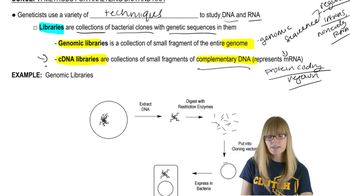
Gel Electrophoresis

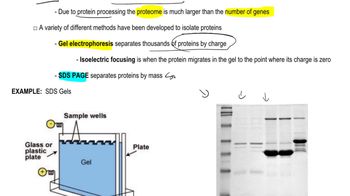
Gel electrophoresis is a laboratory technique used to separate DNA fragments based on their size. In the context of dideoxy sequencing, the terminated DNA fragments are loaded into a gel matrix and subjected to an electric field, causing smaller fragments to migrate faster than larger ones. The resulting pattern of bands corresponds to the different lengths of DNA fragments, which can be visualized and analyzed to determine the nucleotide sequence of the original DNA template.
Recommended video:
Related Practice
Textbook Question

A family consisting of a mother (I-1), a father (I-2), and three children (II-1, II-2, and II-3) are genotyped by PCR for a region of an autosome containing repeats of a 10-bp sequence. The mother carries 16 repeats on one chromosome and 21 on the homologous chromosome. The father carries repeat numbers of 18 and 26.

Following the layout of the following figure, which aligns members of a pedigree with their DNA fragments in a gel, draw a DNA gel containing the PCR fragments generated by amplification of DNA from the parents (I-1 and I-2). Label the size of each fragment.

676
views
Textbook Question

A family consisting of a mother (I-1), a father (I-2), and three children (II-1, II-2, and II-3) are genotyped by PCR for a region of an autosome containing repeats of a 10-bp sequence. The mother carries 16 repeats on one chromosome and 21 on the homologous chromosome. The father carries repeat numbers of 18 and 26.

Identify all the possible genotypes of children of this couple by specifying PCR fragment lengths in each genotype.

542
views
Textbook Question

A family consisting of a mother (I-1), a father (I-2), and three children (II-1, II-2, and II-3) are genotyped by PCR for a region of an autosome containing repeats of a 10-bp sequence. The mother carries 16 repeats on one chromosome and 21 on the homologous chromosome. The father carries repeat numbers of 18 and 26.

What genetic term best describes the pattern of inheritance of this DNA marker? Explain your choice.

594
views
Textbook Question

In a dideoxy DNA sequencing experiment, four separate reactions are carried out to provide the replicated material for DNA sequencing gels. Reaction products are usually run in gel lanes labeled A, T, C, and G.

How does PCR play a role in dideoxy DNA sequencing?

548
views
Textbook Question

In a dideoxy DNA sequencing experiment, four separate reactions are carried out to provide the replicated material for DNA sequencing gels. Reaction products are usually run in gel lanes labeled A, T, C, and G.

Why is incorporation of a dideoxynucleotide during DNA sequencing identified as a 'replication-terminating' event?

542
views
Textbook Question

The following dideoxy DNA sequencing gel is produced in a laboratory.

What is the double-stranded DNA sequence of this molecule? Label the polarity of each strand.

786
views