Pearson+ LogoPearson+ Logo
Ch. 7 - DNA Structure and Replication
Sanders - Genetic Analysis: An Integrated Approach 3rd Edition
Sanders3rd EditionGenetic Analysis: An Integrated ApproachISBN: 9780135564172Not the one you use?Change textbook
Chapter 7, Problem 27a

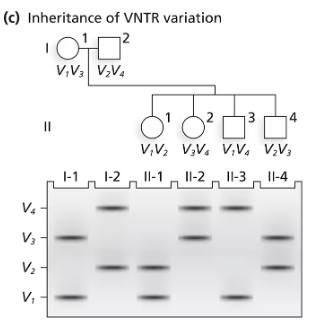
A family consisting of a mother (I-1), a father (I-2), and three children (II-1, II-2, and II-3) are genotyped by PCR for a region of an autosome containing repeats of a 10-bp sequence. The mother carries 16 repeats on one chromosome and 21 on the homologous chromosome. The father carries repeat numbers of 18 and 26.
Following the layout of the following figure, which aligns members of a pedigree with their DNA fragments in a gel, draw a DNA gel containing the PCR fragments generated by amplification of DNA from the parents (I-1 and I-2). Label the size of each fragment.
Pedigree chart showing a family with genotyped PCR fragments labeled V1 to V4 from parents and children.

Verified step by step guidance
1
Understand the problem: The goal is to create a DNA gel representation of PCR fragments for the parents (I-1 and I-2) based on the number of repeats in a specific region of their DNA. Each repeat is 10 base pairs (bp) long, and the total fragment size will depend on the number of repeats plus the flanking regions amplified by PCR.
Calculate the fragment sizes for the mother (I-1): The mother has 16 repeats on one chromosome and 21 repeats on the homologous chromosome. Multiply the number of repeats by 10 bp/repeat to determine the size contributed by the repeats. Add the size of the flanking regions (constant for all fragments, typically provided in the problem or assumed to be a standard value). Represent these two fragment sizes on the gel.
Calculate the fragment sizes for the father (I-2): The father has 18 repeats on one chromosome and 26 repeats on the homologous chromosome. Similarly, multiply the number of repeats by 10 bp/repeat and add the size of the flanking regions. Represent these two fragment sizes on the gel.
Draw the gel layout: On the gel, each lane corresponds to an individual. For the parents, label the lanes as I-1 (mother) and I-2 (father). Place the calculated fragment sizes in their respective lanes, with smaller fragments migrating farther down the gel and larger fragments staying closer to the top. Label the size of each fragment next to the bands.
Ensure proper labeling and alignment: Clearly label the lanes with the individual identifiers (I-1 and I-2) and the fragment sizes. Align the bands vertically to indicate the relative sizes of the fragments. This will allow for easy comparison of the DNA fragments between the parents.

Verified video answer for a similar problem:

This video solution was recommended by our tutors as helpful for the problem above.
Video duration:
2m
Was this helpful?

Key Concepts

Here are the essential concepts you must grasp in order to answer the question correctly.

Polymerase Chain Reaction (PCR)

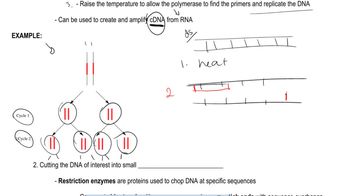
PCR is a molecular biology technique used to amplify specific DNA sequences, making millions of copies of a particular segment. It involves repeated cycles of denaturation, annealing, and extension, allowing researchers to analyze genetic material in detail. Understanding PCR is crucial for interpreting the results of genetic tests, such as those used in this pedigree analysis.
Recommended video:
Guided course
07:39
Genetic Cloning

DNA Fragment Size and Gel Electrophoresis

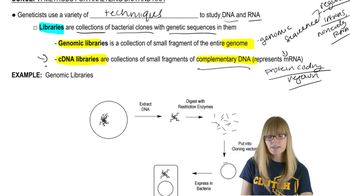
Gel electrophoresis is a method used to separate DNA fragments based on their size. When DNA is subjected to an electric field in a gel matrix, smaller fragments move faster than larger ones, allowing for size estimation. This technique is essential for visualizing PCR products and determining the number of repeats in the DNA sequences from the parents.
Recommended video:
Guided course
07:40
Methods for Analyzing DNA and RNA

Genetic Inheritance Patterns

Genetic inheritance patterns describe how traits and genetic information are passed from parents to offspring. In this case, the number of repeats in the DNA sequences can exhibit co-dominance, where both parental alleles contribute to the phenotype. Understanding these patterns is vital for predicting the potential genotypes of the children based on the parents' genotypes.
Recommended video:
Guided course
27:36
Diploid Genetics
Related Practice
Textbook Question

Telomeres are found at the ends of eukaryotic chromosomes. How does telomerase assemble telomeres?

520
views
Textbook Question

Telomeres are found at the ends of eukaryotic chromosomes. What is the functional role of telomeres?

660
views
Textbook Question

Telomeres are found at the ends of eukaryotic chromosomes. Why is telomerase usually active in germ-line cells but not in somatic cells?

859
views
Textbook Question

A family consisting of a mother (I-1), a father (I-2), and three children (II-1, II-2, and II-3) are genotyped by PCR for a region of an autosome containing repeats of a 10-bp sequence. The mother carries 16 repeats on one chromosome and 21 on the homologous chromosome. The father carries repeat numbers of 18 and 26.

Identify all the possible genotypes of children of this couple by specifying PCR fragment lengths in each genotype.

542
views
Textbook Question

A family consisting of a mother (I-1), a father (I-2), and three children (II-1, II-2, and II-3) are genotyped by PCR for a region of an autosome containing repeats of a 10-bp sequence. The mother carries 16 repeats on one chromosome and 21 on the homologous chromosome. The father carries repeat numbers of 18 and 26.

What genetic term best describes the pattern of inheritance of this DNA marker? Explain your choice.

594
views
Textbook Question

In a dideoxy DNA sequencing experiment, four separate reactions are carried out to provide the replicated material for DNA sequencing gels. Reaction products are usually run in gel lanes labeled A, T, C, and G.

Identify the nucleotides used in the dideoxy DNA sequencing reaction that produces molecules for the A lane of the sequencing gel.

725
views