
Textbook Question
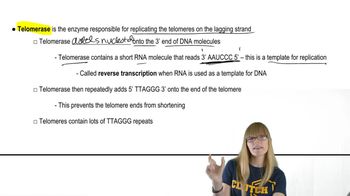
Telomeres are found at the ends of eukaryotic chromosomes. What is the sequence composition of telomeres?
515
views

 Verified step by step guidance
 08:38
08:38 08:38 08:38
Telomeres are found at the ends of eukaryotic chromosomes. What is the sequence composition of telomeres?
How does rolling circle replication differ from bidirectional replication?
Telomeres are found at the ends of eukaryotic chromosomes. Why is telomerase usually active in germ-line cells but not in somatic cells?
A family consisting of a mother (I-1), a father (I-2), and three children (II-1, II-2, and II-3) are genotyped by PCR for a region of an autosome containing repeats of a 10-bp sequence. The mother carries 16 repeats on one chromosome and 21 on the homologous chromosome. The father carries repeat numbers of 18 and 26.
Following the layout of the following figure, which aligns members of a pedigree with their DNA fragments in a gel, draw a DNA gel containing the PCR fragments generated by amplification of DNA from the parents (I-1 and I-2). Label the size of each fragment.
Bloom syndrome (OMIM 210900) is an autosomal recessive disorder caused by mutation of a DNA helicase. Among the principal symptoms of the disease are chromosome instability and a propensity to develop cancer. Explain these symptoms on the basis of the helicase mutation.
Telomeres are found at the ends of eukaryotic chromosomes. What is the functional role of telomeres?