Pearson+ LogoPearson+ Logo
Ch. 7 - DNA Structure and Replication
Sanders - Genetic Analysis: An Integrated Approach 3rd Edition
Sanders3rd EditionGenetic Analysis: An Integrated ApproachISBN: 9780135564172Not the one you use?Change textbook
Chapter 7, Problem 26a

Telomeres are found at the ends of eukaryotic chromosomes. What is the sequence composition of telomeres?

Verified step by step guidance
1
Understand that telomeres are repetitive DNA sequences located at the ends of eukaryotic chromosomes, serving to protect the chromosome from degradation and fusion with other chromosomes.
Learn that the sequence composition of telomeres is highly conserved across many eukaryotic organisms. In humans and other vertebrates, the telomeric sequence is typically a repeated hexanucleotide motif.
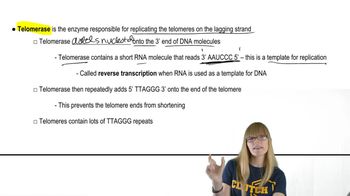
Recognize that the specific sequence in humans is represented as TTAGGGn, where 'n' indicates the number of repeats.
Understand that telomerase, an enzyme, is responsible for adding these repetitive sequences to the ends of chromosomes, ensuring their maintenance and stability during cell division.
Explore how telomeres play a critical role in cellular aging and genome stability, as their shortening over time is associated with aging and certain diseases.

Verified video answer for a similar problem:

This video solution was recommended by our tutors as helpful for the problem above.
Video duration:
2m
Was this helpful?

Key Concepts

Here are the essential concepts you must grasp in order to answer the question correctly.

Telomere Structure

Telomeres are repetitive nucleotide sequences located at the ends of eukaryotic chromosomes. They consist primarily of tandem repeats of a specific DNA sequence, typically rich in guanine (G) and cytosine (C), which helps protect the chromosome from degradation and prevents the loss of essential genetic information during DNA replication.
Recommended video:
Guided course
08:38
Telomeres and Telomerase

Function of Telomeres

The primary function of telomeres is to maintain chromosomal stability by preventing the ends of chromosomes from fusing with each other or being recognized as damaged DNA. As cells divide, telomeres shorten, which is associated with cellular aging and limits the number of times a cell can divide, a phenomenon known as the Hayflick limit.
Recommended video:
Guided course
08:38
Telomeres and Telomerase

Telomerase Enzyme

Telomerase is an enzyme that adds nucleotide sequences to the ends of telomeres, counteracting their shortening during cell division. This enzyme is particularly active in stem cells and cancer cells, allowing them to maintain telomere length and proliferate indefinitely, which is a key factor in tumorigenesis.
Recommended video:
Guided course
08:38
Telomeres and Telomerase