Pearson+ LogoPearson+ Logo
Ch. 8 - Molecular Biology of Transcription and RNA Processing
Sanders - Genetic Analysis: An Integrated Approach 3rd Edition
Sanders3rd EditionGenetic Analysis: An Integrated ApproachISBN: 9780135564172Not the one you use?Change textbook
Chapter 8, Problem 18b

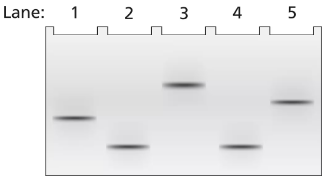
A 3.5-kb segment of DNA containing the complete sequence of a mouse gene is available. The DNA segment contains the promoter sequence and extends beyond the polyadenylation site of the gene. The DNA is studied by band shift assay, and the following gel bands are observed.
Gel electrophoresis image showing five lanes with distinct DNA band patterns for a 3.5-kb mouse gene segment.
Match these conditions to a specific lane of the gel.
3.5-kb fragment plus TFIIB, TFIID, TFIIF, and RNA polymerase II

Verified step by step guidance
1
Examine the gel image provided. Each lane represents a different experimental condition, and the bands indicate the presence of DNA-protein complexes or free DNA.
Understand the band shift assay principle: DNA bound to proteins migrates slower in the gel compared to free DNA, resulting in shifted bands. The more proteins bound, the slower the migration.
Identify the experimental condition described in the problem: the 3.5-kb DNA fragment is combined with TFIIB, TFIID, TFIIF, and RNA polymerase II. This combination should result in a significant shift due to the binding of multiple transcription factors and RNA polymerase II.
Compare the lanes in the gel image. Look for the lane with the most shifted band, indicating the presence of the largest DNA-protein complex. This lane corresponds to the condition described in the problem.
Match the condition to the specific lane number based on the observed band shift. The lane with the most shifted band represents the DNA fragment bound to TFIIB, TFIID, TFIIF, and RNA polymerase II.

Verified video answer for a similar problem:

This video solution was recommended by our tutors as helpful for the problem above.
Video duration:
3m
Was this helpful?

Key Concepts

Here are the essential concepts you must grasp in order to answer the question correctly.

Transcription Factors

Transcription factors are proteins that bind to specific DNA sequences to regulate the transcription of genes. They play crucial roles in initiating and controlling the transcription process by recruiting RNA polymerase and other necessary proteins to the promoter region of a gene. In this context, TFIIB, TFIID, and TFIIF are specific transcription factors that assist RNA polymerase II in forming the transcription initiation complex.
Recommended video:
Guided course
09:16
Eukaryotic Transcription

Gel Electrophoresis

Gel electrophoresis is a laboratory technique used to separate DNA, RNA, or proteins based on their size and charge. In this method, samples are loaded into a gel matrix and subjected to an electric field, causing the molecules to migrate through the gel. Smaller fragments move faster and farther than larger ones, allowing for the visualization of different bands corresponding to various sizes of DNA or protein complexes, as seen in the provided gel image.
Recommended video:

Polyadenylation Site

The polyadenylation site is a specific sequence in a gene where the addition of a poly(A) tail occurs during RNA processing. This tail is crucial for the stability, export, and translation of mRNA. In the context of the question, the DNA segment extends beyond this site, indicating that the entire gene, including regulatory elements, is being analyzed, which is important for understanding the transcriptional regulation of the gene.
Recommended video:
Guided course
08:39
mRNA Processing
Related Practice
Textbook Question

A 2-kb fragment of E. coli DNA contains the complete sequence of a gene for which transcription is terminated by the rho protein. The fragment contains the complete promoter sequence as well as the terminator region of the gene. The cloned fragment is examined by band shift assay. Each lane of a single electrophoresis gel contains the 2-kb cloned fragment under the following conditions:

Lane 1: 2-kb fragment alone

Lane 2: 2-kb fragment plus the core enzyme

Lane 3: 2-kb fragment plus the RNA polymerase holoenzyme

Lane 4: 2-kb fragment plus rho protein

Explain the relative positions of bands in lanes 1 and 3.

563
views
Textbook Question

A 2-kb fragment of E. coli DNA contains the complete sequence of a gene for which transcription is terminated by the rho protein. The fragment contains the complete promoter sequence as well as the terminator region of the gene. The cloned fragment is examined by band shift assay. Each lane of a single electrophoresis gel contains the 2-kb cloned fragment under the following conditions:

Lane 1: 2-kb fragment alone

Lane 2: 2-kb fragment plus the core enzyme

Lane 3: 2-kb fragment plus the RNA polymerase holoenzyme

Lane 4: 2-kb fragment plus rho protein

Explain the relative positions of bands in lanes 1 and 4.

504
views
Textbook Question

A 3.5-kb segment of DNA containing the complete sequence of a mouse gene is available. The DNA segment contains the promoter sequence and extends beyond the polyadenylation site of the gene. The DNA is studied by band shift assay, and the following gel bands are observed.

Match these conditions to a specific lane of the gel.

3.5-kb fragment plus TFIIB and TFIID

372
views
Textbook Question

A 3.5-kb segment of DNA containing the complete sequence of a mouse gene is available. The DNA segment contains the promoter sequence and extends beyond the polyadenylation site of the gene. The DNA is studied by band shift assay, and the following gel bands are observed.

Match these conditions to a specific lane of the gel.

3.5-kb fragment alone

366
views
Textbook Question

A 3.5-kb segment of DNA containing the complete sequence of a mouse gene is available. The DNA segment contains the promoter sequence and extends beyond the polyadenylation site of the gene. The DNA is studied by band shift assay, and the following gel bands are observed.

Match these conditions to a specific lane of the gel.

3.5-kb fragment plus RNA polymerase II

354
views
Textbook Question

A 3.5-kb segment of DNA containing the complete sequence of a mouse gene is available. The DNA segment contains the promoter sequence and extends beyond the polyadenylation site of the gene. The DNA is studied by band shift assay, and the following gel bands are observed.

Match these conditions to a specific lane of the gel.

3.5-kb fragment plus TFIIB

473
views