Pearson+ LogoPearson+ Logo
Ch. 8 - Molecular Biology of Transcription and RNA Processing
Sanders - Genetic Analysis: An Integrated Approach 3rd Edition
Sanders3rd EditionGenetic Analysis: An Integrated ApproachISBN: 9780135564172Not the one you use?Change textbook
Chapter 8, Problem 18e

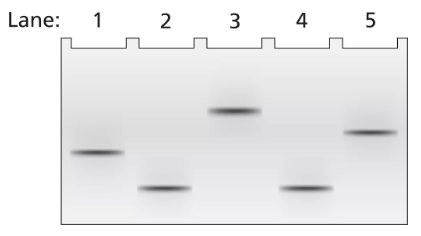
A 3.5-kb segment of DNA containing the complete sequence of a mouse gene is available. The DNA segment contains the promoter sequence and extends beyond the polyadenylation site of the gene. The DNA is studied by band shift assay, and the following gel bands are observed.
Gel electrophoresis image showing five lanes with distinct DNA band patterns from a 3.5-kb mouse gene segment.
Match these conditions to a specific lane of the gel.
3.5-kb fragment plus TFIIB

Verified step by step guidance
1
Step 1: Understand the experimental setup. A band shift assay is used to study protein-DNA interactions. In this case, the 3.5-kb DNA fragment is mixed with TFIIB, a transcription factor, and the gel electrophoresis is used to observe the resulting bands.
Step 2: Analyze the gel image. Each lane represents a different condition. Lane 1 likely contains the DNA fragment alone, as it shows a single band corresponding to the unbound DNA. Lanes 2-5 show additional bands, indicating interactions between the DNA and TFIIB.
Step 3: Match the conditions to the lanes. The presence of shifted bands in lanes 2-5 suggests that TFIIB is binding to the DNA fragment. The degree of shift and the number of bands can indicate the strength and specificity of the interaction.
Step 4: Interpret the results. The shifted bands in lanes 2-5 represent DNA-TFIIB complexes. The position of the bands can be used to infer the binding affinity and the number of binding sites for TFIIB on the DNA fragment.
Step 5: Conclude the analysis. Based on the gel image, the interaction between the 3.5-kb DNA fragment and TFIIB is confirmed. The specific lane assignments depend on the experimental conditions, such as varying concentrations of TFIIB or additional factors influencing the binding.

Verified video answer for a similar problem:

This video solution was recommended by our tutors as helpful for the problem above.
Video duration:
5m
Was this helpful?

Key Concepts

Here are the essential concepts you must grasp in order to answer the question correctly.

Promoter Sequence

The promoter sequence is a region of DNA located upstream of a gene that initiates transcription. It contains specific binding sites for transcription factors and RNA polymerase, which are essential for the regulation of gene expression. Understanding the promoter's role is crucial for interpreting how genes are activated or repressed in response to various signals.
Recommended video:
Guided course
08:41
Sequencing Difficulties

Band Shift Assay

A band shift assay, also known as an electrophoretic mobility shift assay (EMSA), is a technique used to study protein-DNA interactions. In this assay, DNA fragments bound to proteins migrate more slowly through a gel than unbound DNA, resulting in distinct bands. This method helps identify specific proteins that interact with DNA sequences, such as transcription factors.
Recommended video:
Guided course
03:44
Plaques and Experiments

TFIIB

TFIIB is a general transcription factor that plays a critical role in the initiation of transcription by RNA polymerase II. It helps recruit RNA polymerase to the promoter and is involved in the formation of the transcription pre-initiation complex. Understanding TFIIB's function is essential for analyzing how transcription is regulated and how specific genes are expressed.
Related Practice
Textbook Question

A 3.5-kb segment of DNA containing the complete sequence of a mouse gene is available. The DNA segment contains the promoter sequence and extends beyond the polyadenylation site of the gene. The DNA is studied by band shift assay, and the following gel bands are observed.

Match these conditions to a specific lane of the gel.

3.5-kb fragment plus TFIIB, TFIID, TFIIF, and RNA polymerase II

374
views
Textbook Question

A 3.5-kb segment of DNA containing the complete sequence of a mouse gene is available. The DNA segment contains the promoter sequence and extends beyond the polyadenylation site of the gene. The DNA is studied by band shift assay, and the following gel bands are observed.

Match these conditions to a specific lane of the gel.

3.5-kb fragment alone

366
views
Textbook Question

A 3.5-kb segment of DNA containing the complete sequence of a mouse gene is available. The DNA segment contains the promoter sequence and extends beyond the polyadenylation site of the gene. The DNA is studied by band shift assay, and the following gel bands are observed.

Match these conditions to a specific lane of the gel.

3.5-kb fragment plus RNA polymerase II

354
views
Textbook Question

A 1.0-kb DNA fragment from the end of the mouse gene described in the previous problem is examined by DNA footprint protection analysis. Two samples are end-labeled with ³²P and one of the two is mixed with TFIIB, TFIID, and RNA polymerase II. The DNA exposed to these proteins is run in the right-hand lane of the gel shown below and the control DNA is run in the left-hand. Both DNA samples are treated with DNase I before running the samples on the electrophoresis gel.

What length of DNA is bound by the transcriptional proteins? Explain how the gel results support this interpretation.

559
views
Textbook Question

A 1.0-kb DNA fragment from the end of the mouse gene described in the previous problem is examined by DNA footprint protection analysis. Two samples are end-labeled with ³²P, and one of the two is mixed with TFIIB, TFIID, and RNA polymerase II. The DNA exposed to these proteins is run in the right-hand lane of the gel shown below and the control DNA is run in the left-hand. Both DNA samples are treated with DNase I before running the samples on the electrophoresis gel.

Draw a diagram of this DNA fragment bound by the transcriptional proteins, showing the approximate position of proteins along the fragment.

471
views
Textbook Question

A 1.0-kb DNA fragment from the end of the mouse gene described in the previous problem is examined by DNA footprint protection analysis. Two samples are end-labeled with ³²P and one of the two is mixed with TFIIB, TFIID, and RNA polymerase II. The DNA exposed to these proteins is run in the right-hand lane of the gel shown below and the control DNA is run in the left-hand. Both DNA samples are treated with DNase I before running the samples on the electrophoresis gel.

Explain the role of DNase I.

467
views