Pearson+ LogoPearson+ Logo
Ch. 8 - Molecular Biology of Transcription and RNA Processing
Sanders - Genetic Analysis: An Integrated Approach 3rd Edition
Sanders3rd EditionGenetic Analysis: An Integrated ApproachISBN: 9780135564172Not the one you use?Change textbook
Chapter 8, Problem 28c

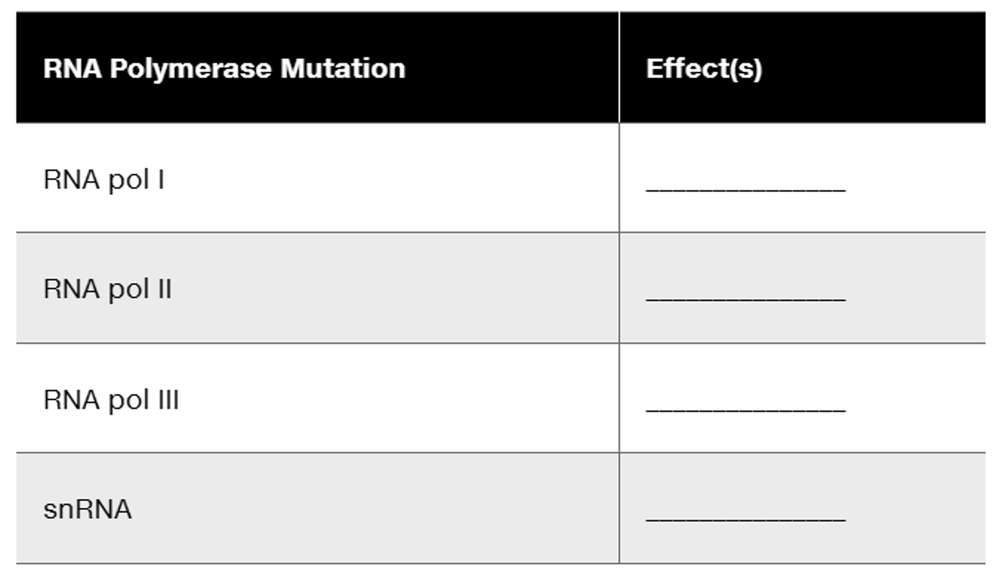
Assume that a mutation affects the gene for each of the following eukaryotic RNA polymerases. Match each mutation with the possible effects from the list provided. More than one effect is possible for each mutation.
Table displaying RNA polymerase mutations and their potential effects, with blank spaces for user input.
Some rRNA is not synthesized.

Verified step by step guidance
1
Understand the roles of the three eukaryotic RNA polymerases: RNA polymerase I synthesizes most rRNA (ribosomal RNA), RNA polymerase II synthesizes mRNA (messenger RNA) and some snRNA (small nuclear RNA), and RNA polymerase III synthesizes tRNA (transfer RNA), 5S rRNA, and some snRNA.
Analyze the mutation effects: If some rRNA is not synthesized, this suggests a mutation in RNA polymerase I, as it is responsible for producing the majority of rRNA.
Match RNA polymerase II with its effects: A mutation in RNA polymerase II would affect the synthesis of mRNA and some snRNA, potentially disrupting protein-coding gene expression and RNA splicing.
Match RNA polymerase III with its effects: A mutation in RNA polymerase III would affect the synthesis of tRNA, 5S rRNA, and some snRNA, potentially disrupting translation and ribosome assembly.
Determine the effect on snRNA synthesis: Since snRNA is synthesized by both RNA polymerase II and RNA polymerase III, a mutation in either of these polymerases could lead to a reduction in snRNA production, affecting RNA splicing.

Verified video answer for a similar problem:

This video solution was recommended by our tutors as helpful for the problem above.
Video duration:
2m
Was this helpful?

Key Concepts

Here are the essential concepts you must grasp in order to answer the question correctly.

Eukaryotic RNA Polymerases

Eukaryotic cells contain three main types of RNA polymerases: RNA polymerase I (RNA pol I), RNA polymerase II (RNA pol II), and RNA polymerase III (RNA pol III). Each polymerase is responsible for synthesizing different types of RNA; RNA pol I primarily synthesizes ribosomal RNA (rRNA), RNA pol II synthesizes messenger RNA (mRNA) and some small nuclear RNAs (snRNA), and RNA pol III synthesizes transfer RNA (tRNA) and other small RNAs. Understanding the specific functions of these polymerases is crucial for predicting the effects of mutations.
Recommended video:

Mutations and Their Effects

Mutations are changes in the DNA sequence that can affect gene function. Depending on the type and location of the mutation, effects can range from benign to detrimental, potentially leading to the loss of function of the encoded protein or altered gene expression. In the context of RNA polymerases, mutations can disrupt the synthesis of specific RNA types, impacting cellular processes such as protein synthesis and gene regulation.
Recommended video:
Guided course
03:38
Maternal Effect

snRNA and Its Role

Small nuclear RNA (snRNA) is a class of RNA molecules that play a critical role in the splicing of pre-mRNA in eukaryotic cells. They are components of the spliceosome, a complex responsible for removing introns from pre-mRNA transcripts. Mutations affecting snRNA can lead to improper splicing, resulting in the production of nonfunctional or dysfunctional proteins, which can have significant consequences for cellular function and organismal health.
Recommended video:
Related Practice
Textbook Question

Suppose you have a 1-kb segment of cloned DNA that is suspected to contain a eukaryotic promoter, including a TATA box, a CAAT box, and an upstream GC-rich sequence. The clone also contains a gene whose transcript is readily detectable. Your laboratory supervisor asks you to outline an experiment that will (1) determine if eukaryotic transcription factors (TF) bind to the fragment and, if so, (2) identify where on the fragment the transcription factors bind. All necessary reagents, equipment, and experimental know-how are available in the laboratory. Your assignment is to propose techniques to be used to address the two items your supervisor has listed and to describe the kind of results that would indicate binding of TF to the DNA and the location of the binding.

463
views
Textbook Question

Assume that a mutation affects the gene for each of the following eukaryotic RNA polymerases. Match each mutation with the possible effects from the list provided. More than one effect is possible for each mutation.

Pre-mRNA does not have introns removed.

432
views
Textbook Question

Assume that a mutation affects the gene for each of the following eukaryotic RNA polymerases. Match each mutation with the possible effects from the list provided. More than one effect is possible for each mutation.

Some pre-mRNA is not synthesized.

476
views
Textbook Question

Assume that a mutation affects the gene for each of the following eukaryotic RNA polymerases. Match each mutation with the possible effects from the list provided. More than one effect is possible for each mutation.

Some tRNA is not synthesized.

535
views
Textbook Question

Assume that a mutation affects the gene for each of the following eukaryotic RNA polymerases. Match each mutation with the possible effects from the list provided. More than one effect is possible for each mutation.

Ribosomal RNA is not processed.

462
views
Textbook Question

The DNA sequence below gives the first 12 base pairs of the transcribed region of a gene, and the template and nontemplate strands of DNA are identified. The transcription start is the thymine nucleotide at the end of the sequence given. Use the diagram to answer the list of questions. Make a copy of the diagram before you begin answering the questions, or have one group member diagram the answers for bacteria and another group member diagram the answers for eukaryotes.

Nontemplate strand ___________ TTGCTACGGTCA___________

Template strand    ___________ AACGATGCCAGT___________

Write the polarity of the two DNA strands shown.

505
views