Pearson+ LogoPearson+ Logo
Ch. 8 - Molecular Biology of Transcription and RNA Processing
Sanders - Genetic Analysis: An Integrated Approach 3rd Edition
Sanders3rd EditionGenetic Analysis: An Integrated ApproachISBN: 9780135564172Not the one you use?Change textbook
Chapter 8, Problem 1a

What is a gene?

Verified step by step guidance
1
A gene is a fundamental unit of heredity in living organisms, responsible for encoding the information necessary to produce proteins or functional RNA molecules.
Genes are composed of DNA (deoxyribonucleic acid) sequences, which are organized into specific regions on chromosomes.
Each gene contains regulatory regions (such as promoters and enhancers) that control its expression, as well as coding regions (exons) and non-coding regions (introns).
The information in a gene is transcribed into messenger RNA (mRNA) through the process of transcription, and this mRNA is then translated into a protein during translation.
Genes play a critical role in determining the traits and functions of an organism, and variations in genes can lead to differences in phenotypes or genetic disorders.

Verified video answer for a similar problem:

This video solution was recommended by our tutors as helpful for the problem above.
Video duration:
2m
Was this helpful?

Key Concepts

Here are the essential concepts you must grasp in order to answer the question correctly.

Definition of a Gene

A gene is a fundamental unit of heredity in living organisms, composed of DNA. It serves as a blueprint for the synthesis of proteins, which perform various functions in the body. Genes are located on chromosomes and can influence traits and characteristics passed from parents to offspring.
Recommended video:
Guided course
09:09
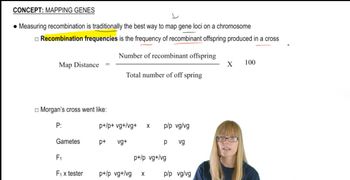
Mapping Genes

Structure of DNA

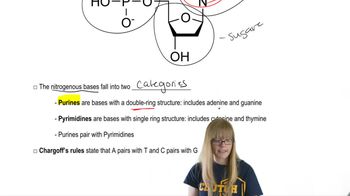
DNA, or deoxyribonucleic acid, is the molecule that carries genetic information. It consists of two strands forming a double helix, with nucleotides as its building blocks. Each nucleotide contains a sugar, a phosphate group, and a nitrogenous base, which sequences determine the genetic code and the function of genes.
Recommended video:
Guided course
06:25
DNA Structure

Gene Expression

Gene expression is the process by which information from a gene is used to synthesize functional gene products, typically proteins. This process involves two main steps: transcription, where the DNA sequence is copied into messenger RNA (mRNA), and translation, where the mRNA is used to assemble amino acids into proteins. Regulation of gene expression is crucial for cellular function and adaptation.
Recommended video:
Guided course
02:09
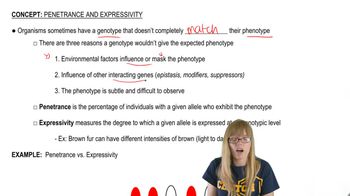
Penetrance and Expressivity