Pearson+ LogoPearson+ Logo
Ch. 8 - Molecular Biology of Transcription and RNA Processing
Sanders - Genetic Analysis: An Integrated Approach 3rd Edition
Sanders3rd EditionGenetic Analysis: An Integrated ApproachISBN: 9780135564172Not the one you use?Change textbook
Chapter 8, Problem 1b

Why are genes for rRNA and tRNA considered to be genes even though they do not produce polypeptides?

Verified step by step guidance
1
Understand the definition of a gene: A gene is a segment of DNA that contains the information necessary to produce a functional product. This product can be a polypeptide (protein) or a functional RNA molecule.
Recognize that not all genes code for proteins. Some genes are transcribed into RNA molecules that perform essential cellular functions without being translated into proteins.
Explain the role of rRNA (ribosomal RNA): rRNA is a structural and functional component of ribosomes, which are the molecular machines responsible for protein synthesis. It plays a critical role in catalyzing peptide bond formation and ensuring proper alignment of mRNA and tRNA during translation.
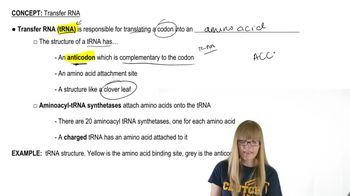
Explain the role of tRNA (transfer RNA): tRNA is responsible for delivering specific amino acids to the ribosome during translation, based on the codon sequence of the mRNA. It acts as an adaptor molecule, linking the genetic code to the amino acid sequence of proteins.
Conclude that rRNA and tRNA genes are considered genes because they produce functional RNA molecules that are essential for cellular processes, even though they do not produce polypeptides. Their products are directly involved in the machinery of gene expression and protein synthesis.

Verified video answer for a similar problem:

This video solution was recommended by our tutors as helpful for the problem above.
Video duration:
3m
Was this helpful?

Key Concepts

Here are the essential concepts you must grasp in order to answer the question correctly.

Non-coding RNA

Non-coding RNAs (ncRNAs) are RNA molecules that are not translated into proteins. They play crucial roles in various cellular processes, including gene regulation and protein synthesis. rRNA (ribosomal RNA) and tRNA (transfer RNA) are types of ncRNAs essential for the translation process, facilitating the assembly of amino acids into polypeptides.
Recommended video:

Gene Definition

A gene is traditionally defined as a segment of DNA that encodes a functional product. This product can be a protein or a functional RNA molecule. Therefore, genes for rRNA and tRNA are still considered genes because they encode functional RNA products that are vital for cellular functions, despite not coding for polypeptides.
Recommended video:
Guided course
09:09
Mapping Genes

Role of rRNA and tRNA

rRNA and tRNA are integral components of the ribosome, the cellular machinery responsible for protein synthesis. rRNA forms the structural and functional core of the ribosome, while tRNA serves as an adaptor that brings amino acids to the ribosome during translation. Their roles are essential for the accurate and efficient synthesis of proteins, highlighting their importance as gene products.
Recommended video: