Pearson+ LogoPearson+ Logo
Ch. 8 - Molecular Biology of Transcription and RNA Processing
Sanders - Genetic Analysis: An Integrated Approach 3rd Edition
Sanders3rd EditionGenetic Analysis: An Integrated ApproachISBN: 9780135564172Not the one you use?Change textbook
Chapter 8, Problem 3b

Answer these questions concerning promoters.
What is the common structure of a bacterial promoter with respect to consensus sequences?

Verified step by step guidance
1
Understand that a bacterial promoter is a DNA sequence that facilitates the binding of RNA polymerase to initiate transcription. Promoters are located upstream of the transcription start site.
Recognize that bacterial promoters typically contain two key consensus sequences: the -10 region (Pribnow box) and the -35 region. These sequences are named based on their approximate distance in base pairs upstream from the transcription start site (+1).
The -10 region consensus sequence is typically TATAAT. This sequence is important for the unwinding of DNA, as it is rich in adenine (A) and thymine (T), which are easier to separate due to having only two hydrogen bonds.
The -35 region consensus sequence is typically TTGACA. This sequence is recognized by the sigma factor of RNA polymerase, which helps the enzyme bind to the promoter.
Note that the spacing between the -10 and -35 regions is also important, usually around 16-18 base pairs. This spacing allows proper alignment of RNA polymerase for efficient transcription initiation.

Verified video answer for a similar problem:

This video solution was recommended by our tutors as helpful for the problem above.
Video duration:
2m
Was this helpful?

Key Concepts

Here are the essential concepts you must grasp in order to answer the question correctly.

Bacterial Promoter Structure

Bacterial promoters are specific DNA sequences located upstream of a gene that facilitate the binding of RNA polymerase for transcription initiation. They typically contain two key regions: the -10 region (Pribnow box) and the -35 region, which are recognized by sigma factors. The spacing between these regions is crucial for effective transcription initiation.
Recommended video:
Guided course
02:39
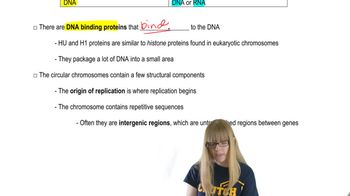
Bacteria and Viral Chromosome Structure

Consensus Sequences

Consensus sequences are short, recurring patterns in DNA that are recognized by proteins, such as transcription factors. In bacterial promoters, the consensus sequences at the -10 and -35 regions represent the most common nucleotides found in these positions across different genes, providing a template for RNA polymerase binding and transcription regulation.
Recommended video:
Guided course
08:55
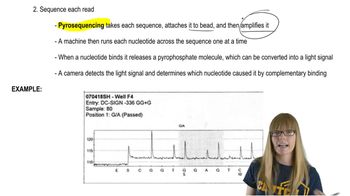
Sequencing Overview

Transcription Initiation

Transcription initiation is the process by which RNA polymerase binds to a promoter and begins synthesizing RNA from a DNA template. In bacteria, this process is highly regulated and relies on the interaction between the RNA polymerase, sigma factors, and the consensus sequences of the promoter, ensuring that genes are expressed at the right time and in the right amounts.
Recommended video:
Guided course
09:16
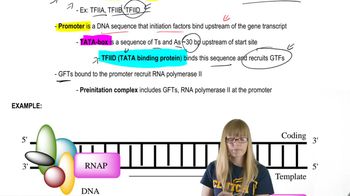
Eukaryotic Transcription