Pearson+ LogoPearson+ Logo
Ch. 8 - Molecular Biology of Transcription and RNA Processing
Sanders - Genetic Analysis: An Integrated Approach 3rd Edition
Sanders3rd EditionGenetic Analysis: An Integrated ApproachISBN: 9780135564172Not the one you use?Change textbook
Chapter 8, Problem 29g

The DNA sequence below gives the first 12 base pairs of the transcribed region of a gene, and the template and nontemplate strands of DNA are identified. The transcription start is the thymine nucleotide at the end of the sequence given. Use the diagram to answer the list of questions. Make a copy of the diagram before you begin answering the questions, or have one group member diagram the answers for bacteria and another group member diagram the answers for eukaryotes.
Nontemplate strand ___________ TTGCTACGGTCA___________
Template strand    ___________ AACGATGCCAGT___________
Write the anticipated eukaryotic consensus sequence(s) in the approximate position(s) on the diagram.

Verified step by step guidance
1
Identify the transcription start site in the given DNA sequence. The problem states that the transcription starts at the thymine nucleotide at the end of the sequence provided. This will help you orient the sequence for further analysis.
Determine the direction of transcription. Transcription proceeds in the 5' to 3' direction of the RNA strand, which corresponds to the 3' to 5' direction of the template strand. This means the RNA polymerase will read the template strand (AACGATGCCAGT) from 3' to 5'.
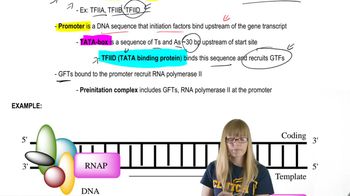
Locate the approximate positions of the eukaryotic consensus sequences. In eukaryotes, the most common consensus sequences are the TATA box (TATAAA) located approximately 25-30 base pairs upstream of the transcription start site and the CAAT box (GGCCAATCT) located approximately 75-80 base pairs upstream.
Mark the positions of the TATA box and CAAT box on the nontemplate strand. Since the nontemplate strand is complementary to the template strand, you will need to count upstream from the transcription start site (thymine) to place these sequences in their approximate positions.
Diagram the anticipated eukaryotic consensus sequences on the nontemplate strand. For example, place the TATA box approximately 25-30 base pairs upstream and the CAAT box approximately 75-80 base pairs upstream, ensuring the sequences are written in the 5' to 3' direction of the nontemplate strand.

Verified video answer for a similar problem:

This video solution was recommended by our tutors as helpful for the problem above.
Video duration:
2m
Was this helpful?

Key Concepts

Here are the essential concepts you must grasp in order to answer the question correctly.

Transcription

Transcription is the process by which the genetic information encoded in DNA is copied into messenger RNA (mRNA). This occurs in the nucleus of eukaryotic cells, where RNA polymerase binds to the template strand of DNA and synthesizes a complementary RNA strand. Understanding transcription is crucial for analyzing gene expression and the role of various sequences in regulating this process.
Recommended video:
Guided course
09:16
Eukaryotic Transcription

Consensus Sequence

A consensus sequence is a sequence of DNA that is highly conserved across different genes and species, indicating its importance in biological functions. In the context of transcription, consensus sequences often represent binding sites for transcription factors and RNA polymerase, which are essential for initiating transcription. Identifying these sequences helps in understanding gene regulation and expression patterns.
Recommended video:
Guided course
08:55
Sequencing Overview

Eukaryotic Gene Structure

Eukaryotic genes typically consist of exons (coding regions) and introns (non-coding regions), with regulatory elements such as promoters and enhancers. The transcription process in eukaryotes involves additional complexities, including the need for RNA processing (capping, polyadenylation, and splicing) before the mRNA is translated into protein. Familiarity with eukaryotic gene structure is vital for accurately predicting transcription outcomes and understanding gene regulation.
Recommended video:
Guided course
07:10
Chromosome Structure
Related Practice
Textbook Question

The DNA sequence below gives the first 12 base pairs of the transcribed region of a gene, and the template and nontemplate strands of DNA are identified. The transcription start is the thymine nucleotide at the end of the sequence given. Use the diagram to answer the list of questions. Make a copy of the diagram before you begin answering the questions, or have one group member diagram the answers for bacteria and another group member diagram the answers for eukaryotes. Nontemplate strand ___________TTGCTACGGTCA___________

Template strand ___________ AACGATGCCAGT___________

Assuming the sequence shown is part of a bacterial gene, what consensus sequence(s) would you expect to identify in the promoter?

552
views
Textbook Question

The DNA sequence below gives the first 12 base pairs of the transcribed region of a gene, and the template and nontemplate strands of DNA are identified. The transcription start is the thymine nucleotide at the end of the sequence given. Use the diagram to answer the list of questions. Make a copy of the diagram before you begin answering the questions, or have one group member diagram the answers for bacteria and another group member diagram the answers for eukaryotes. Nontemplate strand ___________TTGCTACGGTCA___________

Template strand ___________AACGATGCCAGT___________

Write the anticipated bacterial consensus sequence(s) in the approximate position(s) on the diagram.

514
views
Textbook Question

The DNA sequence below gives the first 12 base pairs of the transcribed region of a gene, and the template and nontemplate strands of DNA are identified. The transcription start is the thymine nucleotide at the end of the sequence given. Use the diagram to answer the list of questions. Make a copy of the diagram before you begin answering the questions, or have one group member diagram the answers for bacteria and another group member diagram the answers for eukaryotes.

Nontemplate strand ___________ TTGCTACGGTCA___________

Template strand    ___________ AACGATGCCAGT___________

Assuming the sequence shown is part of a eukaryotic gene, what consensus sequence(s) would you expect to identify within about 100 base pairs of the start of transcription?

506
views
Textbook Question

Genomic DNA from a mouse is isolated, fragmented, and denatured into single strands. It is then mixed with mRNA isolated from the cytoplasm of mouse cells. The image represents an electron micrograph result showing the hybridization of single-stranded DNA and mRNA.

Which nucleic acid is indicated by the 'a' pointer? Justify your answer. 

738
views
Textbook Question

Genomic DNA from a mouse is isolated, fragmented, and denatured into single strands. It is then mixed with mRNA isolated from the cytoplasm of mouse cells. The image represents an electron micrograph result showing the hybridization of single-stranded DNA and mRNA.

Which nucleic acid is indicated by the 'b' pointer? Justify your answer. 

558
views
Textbook Question

Genomic DNA from a mouse is isolated, fragmented, and denatured into single strands. It is then mixed with mRNA isolated from the cytoplasm of mouse cells. The image represents an electron micrograph result showing the hybridization of single-stranded DNA and mRNA.

What term best identifies the nucleic acid region indicated by the 'c' pointer?

578
views