Pearson+ LogoPearson+ Logo
Ch. 8 - Molecular Biology of Transcription and RNA Processing
Sanders - Genetic Analysis: An Integrated Approach 3rd Edition
Sanders3rd EditionGenetic Analysis: An Integrated ApproachISBN: 9780135564172Not the one you use?Change textbook
Chapter 8, Problem 29d

The DNA sequence below gives the first 12 base pairs of the transcribed region of a gene, and the template and nontemplate strands of DNA are identified. The transcription start is the thymine nucleotide at the end of the sequence given. Use the diagram to answer the list of questions. Make a copy of the diagram before you begin answering the questions, or have one group member diagram the answers for bacteria and another group member diagram the answers for eukaryotes. Nontemplate strand ___________TTGCTACGGTCA___________
Template strand ___________ AACGATGCCAGT___________
Assuming the sequence shown is part of a bacterial gene, what consensus sequence(s) would you expect to identify in the promoter?

Verified step by step guidance
1
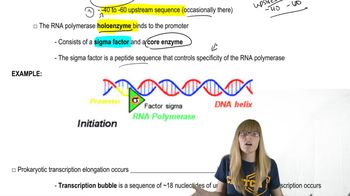
Understand the context: In bacterial genes, the promoter region contains specific consensus sequences that are recognized by RNA polymerase and associated sigma factors to initiate transcription. These sequences are typically located upstream of the transcription start site.
Identify the key consensus sequences: In bacteria, the two most common consensus sequences in the promoter region are the -10 sequence (Pribnow box) and the -35 sequence. The -10 sequence is typically 'TATAAT,' and the -35 sequence is typically 'TTGACA.' These sequences are named based on their approximate distance from the transcription start site.
Determine the location of the transcription start site: The problem states that the transcription start site is the thymine nucleotide at the end of the given sequence. This means the sequence provided is downstream of the promoter region, and the promoter sequences would be located upstream of the given sequence.
Analyze the upstream region: To identify the consensus sequences, you would need to examine the DNA sequence upstream of the transcription start site. Since the upstream sequence is not provided in the problem, you would infer that the promoter region contains sequences similar to the -10 and -35 consensus sequences mentioned earlier.
Conclude the expected consensus sequences: Based on the information provided, you would expect to find the -10 sequence ('TATAAT') approximately 10 base pairs upstream of the transcription start site and the -35 sequence ('TTGACA') approximately 35 base pairs upstream of the transcription start site in the bacterial promoter region.

Verified video answer for a similar problem:

This video solution was recommended by our tutors as helpful for the problem above.
Video duration:
3m
Was this helpful?

Key Concepts

Here are the essential concepts you must grasp in order to answer the question correctly.

Transcription and Promoter Regions

Transcription is the process by which RNA is synthesized from a DNA template. In bacteria, transcription begins at a promoter region, which is a specific sequence of DNA that signals the start of a gene. The consensus sequence is a common pattern found in the promoter region that is recognized by RNA polymerase and transcription factors, facilitating the initiation of transcription.
Recommended video:
Guided course
10:14
Prokaryotic Transcription

Consensus Sequences

Consensus sequences are short, recurring patterns in DNA that are crucial for the binding of proteins involved in transcription. In bacterial promoters, the most well-known consensus sequences are the -10 (Pribnow box) and -35 regions, which are typically located upstream of the transcription start site. These sequences help ensure that RNA polymerase binds efficiently to initiate transcription.
Recommended video:
Guided course
08:55
Sequencing Overview

Differences Between Bacterial and Eukaryotic Transcription

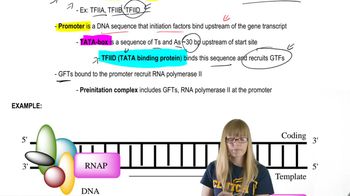
Bacterial transcription is simpler than eukaryotic transcription, as bacteria typically have a single RNA polymerase and lack introns in their genes. In contrast, eukaryotic transcription involves multiple RNA polymerases, extensive processing of pre-mRNA, and the presence of complex promoter elements. Understanding these differences is essential for analyzing transcription in different organisms.
Recommended video:
Guided course
09:16
Eukaryotic Transcription
Related Practice
Textbook Question

The DNA sequence below gives the first 12 base pairs of the transcribed region of a gene, and the template and nontemplate strands of DNA are identified. The transcription start is the thymine nucleotide at the end of the sequence given. Use the diagram to answer the list of questions. Make a copy of the diagram before you begin answering the questions, or have one group member diagram the answers for bacteria and another group member diagram the answers for eukaryotes.

Nontemplate strand ___________ TTGCTACGGTCA___________

Template strand    ___________ AACGATGCCAGT___________

Write the polarity of the two DNA strands shown.

505
views
Textbook Question

The DNA sequence below gives the first 12 base pairs of the transcribed region of a gene, and the template and nontemplate strands of DNA are identified. The transcription start is the thymine nucleotide at the end of the sequence given. Use the diagram to answer the list of questions. Make a copy of the diagram before you begin answering the questions, or have one group member diagram the answers for bacteria and another group member diagram the answers for eukaryotes.

Nontemplate strand ___________ TTGCTACGGTCA___________

Template strand    ___________ AACGATGCCAGT___________

Give the mRNA transcript sequence and the polarity of the transcript.

419
views
Textbook Question

The DNA sequence below gives the first 12 base pairs of the transcribed region of a gene, and the template and nontemplate strands of DNA are identified. The transcription start is the thymine nucleotide at the end of the sequence given. Use the diagram to answer the list of questions. Make a copy of the diagram before you begin answering the questions, or have one group member diagram the answers for bacteria and another group member diagram the answers for eukaryotes. Nontemplate strand ___________TTGCTACGGTCA___________

Template strand ___________ AACGATGCCAGT___________

Assuming the sequence shown is part of a bacterial gene, draw the approximate positions of the promoter sequence and the termination sequence.

575
views
Textbook Question

The DNA sequence below gives the first 12 base pairs of the transcribed region of a gene, and the template and nontemplate strands of DNA are identified. The transcription start is the thymine nucleotide at the end of the sequence given. Use the diagram to answer the list of questions. Make a copy of the diagram before you begin answering the questions, or have one group member diagram the answers for bacteria and another group member diagram the answers for eukaryotes. Nontemplate strand ___________TTGCTACGGTCA___________

Template strand ___________AACGATGCCAGT___________

Write the anticipated bacterial consensus sequence(s) in the approximate position(s) on the diagram.

514
views
Textbook Question

The DNA sequence below gives the first 12 base pairs of the transcribed region of a gene, and the template and nontemplate strands of DNA are identified. The transcription start is the thymine nucleotide at the end of the sequence given. Use the diagram to answer the list of questions. Make a copy of the diagram before you begin answering the questions, or have one group member diagram the answers for bacteria and another group member diagram the answers for eukaryotes.

Nontemplate strand ___________ TTGCTACGGTCA___________

Template strand    ___________ AACGATGCCAGT___________

Assuming the sequence shown is part of a eukaryotic gene, what consensus sequence(s) would you expect to identify within about 100 base pairs of the start of transcription?

506
views
Textbook Question

The DNA sequence below gives the first 12 base pairs of the transcribed region of a gene, and the template and nontemplate strands of DNA are identified. The transcription start is the thymine nucleotide at the end of the sequence given. Use the diagram to answer the list of questions. Make a copy of the diagram before you begin answering the questions, or have one group member diagram the answers for bacteria and another group member diagram the answers for eukaryotes.

Nontemplate strand ___________ TTGCTACGGTCA___________

Template strand    ___________ AACGATGCCAGT___________

Write the anticipated eukaryotic consensus sequence(s) in the approximate position(s) on the diagram.

455
views