Pearson+ LogoPearson+ Logo
Ch. 8 - Molecular Biology of Transcription and RNA Processing
Sanders - Genetic Analysis: An Integrated Approach 3rd Edition
Sanders3rd EditionGenetic Analysis: An Integrated ApproachISBN: 9780135564172Not the one you use?Change textbook
Chapter 8, Problem 22b

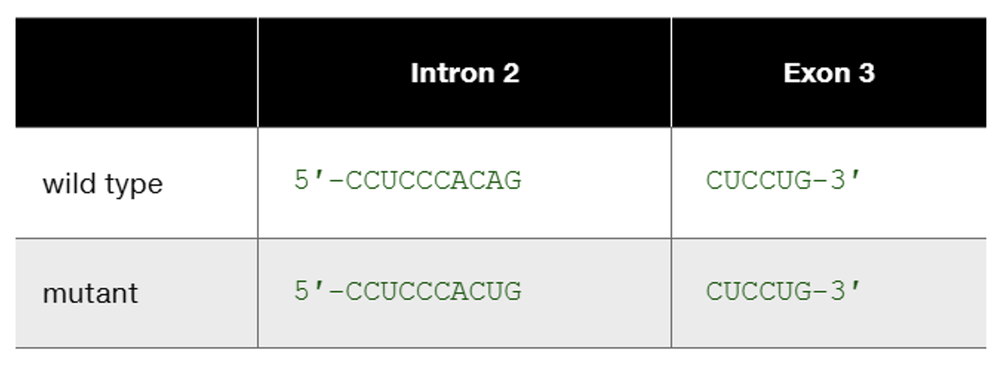
The human β-globin wild-type allele and a certain mutant allele are identical in sequence except for a single base-pair substitution that changes one nucleotide at the end of intron 2. The wild-type and mutant sequences of the affected portion of pre-mRNA are
Comparison of wild-type and mutant β-globin pre-mRNA sequences highlighting a single base-pair substitution in intron 2.
This is one example of how DNA sequence change occurring somewhere other than in an exon can produce mutation. List other kinds of DNA sequence changes occurring outside exons that can produce mutation. In each case, characterize the kind of change you would expect to see in mutant mRNA or mutant protein.

Verified step by step guidance
1
Understand the problem: The question asks for examples of DNA sequence changes outside exons that can lead to mutations, and how these changes affect mutant mRNA or protein. This involves understanding regulatory and structural elements of genes beyond coding regions.
Step 1: Splice site mutations - Explain that mutations in splice donor or acceptor sites (e.g., GT at the 5' end of an intron or AG at the 3' end) can disrupt splicing. This may result in intron retention, exon skipping, or the use of cryptic splice sites, leading to altered mRNA and potentially truncated or nonfunctional proteins.
Step 2: Promoter mutations - Discuss how mutations in the promoter region can affect transcription initiation. For example, a mutation in the TATA box or other regulatory elements can reduce or abolish transcription, leading to decreased or absent mRNA and protein production.
Step 3: Enhancer or silencer mutations - Highlight that mutations in enhancer or silencer regions can alter the binding of transcription factors, leading to changes in gene expression levels. This can result in overexpression, underexpression, or misexpression of the gene, affecting protein levels or function.
Step 4: Polyadenylation signal mutations - Explain that mutations in the polyadenylation signal (e.g., AAUAAA) can disrupt proper 3' end processing of mRNA. This can lead to unstable mRNA or altered protein products due to improper translation termination.

Verified video answer for a similar problem:

This video solution was recommended by our tutors as helpful for the problem above.
Video duration:
1m
Was this helpful?

Key Concepts

Here are the essential concepts you must grasp in order to answer the question correctly.

Introns and Exons

Introns are non-coding sequences in a gene that are transcribed into pre-mRNA but are removed during RNA splicing, while exons are the coding sequences that remain in the mature mRNA. Understanding the roles of introns and exons is crucial because mutations in introns can affect splicing, potentially leading to altered protein products even if the coding sequence remains unchanged.
Recommended video:
Guided course
08:39
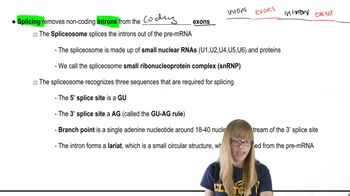
mRNA Processing

Splice Site Mutations

Splice site mutations occur at the boundaries of introns and exons, affecting the recognition of these sites by the splicing machinery. Such mutations can lead to the inclusion of intronic sequences in the mRNA or the exclusion of exonic sequences, resulting in frameshift mutations or truncated proteins, which can have significant functional consequences.
Recommended video:
Guided course
10:48
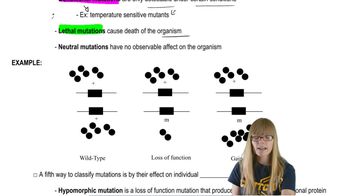
Mutations and Phenotypes

Regulatory Element Mutations

Regulatory elements, such as enhancers and silencers, are DNA sequences that control the expression of genes. Mutations in these regions can alter the binding of transcription factors, leading to changes in gene expression levels. This can result in either overexpression or underexpression of the corresponding protein, potentially causing various phenotypic effects.
Recommended video:
Guided course
05:30
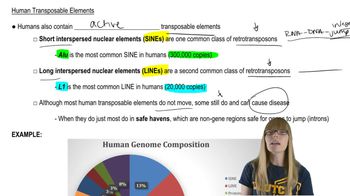
Human Transposable Elements
Related Practice
Textbook Question

A mutant strain of Salmonella bacteria carries a mutation of the rho protein that has full activity at 37°C but is completely inactivated when the mutant strain is grown at 40°C. Speculate about the kind of differences you would expect to see if you compared a broad spectrum of mRNAs from the mutant strain grown at 37°C and the same spectrum of mRNAs from the strain when grown at 40°C.

551
views
Textbook Question

A mutant strain of Salmonella bacteria carries a mutation of the rho protein that has full activity at 37°C but is completely inactivated when the mutant strain is grown at 40°C. Are all mRNAs affected by the rho protein mutation in the same way? Why or why not?

503
views
Textbook Question

The human β-globin wild-type allele and a certain mutant allele are identical in sequence except for a single base-pair substitution that changes one nucleotide at the end of intron 2. The wild-type and mutant sequences of the affected portion of pre-mRNA are

Speculate about the way in which this base substitution causes mutation of β-globin protein.

500
views
Textbook Question

Microbiologists describe the processes of transcription and translation as 'coupled' in bacteria. This term indicates that a bacterial mRNA can be undergoing transcription at the same moment it is also undergoing translation.

How is coupling of transcription and translation possible in bacteria?

821
views
Textbook Question

A full-length eukaryotic gene is inserted into a bacterial chromosome. The gene contains a complete promoter sequence and a functional polyadenylation sequence, and it has wild-type nucleotides throughout the transcribed region. However, the gene fails to produce a functional protein. List at least three possible reasons why this eukaryotic gene is not expressed in bacteria.

497
views
Textbook Question

A full-length eukaryotic gene is inserted into a bacterial chromosome. The gene contains a complete promoter sequence and a functional polyadenylation sequence, and it has wild-type nucleotides throughout the transcribed region. However, the gene fails to produce a functional protein. What changes would you recommend to permit expression of this eukaryotic gene in a bacterial cell?

379
views