Pearson+ LogoPearson+ Logo
Ch. 8 - Molecular Biology of Transcription and RNA Processing
Sanders - Genetic Analysis: An Integrated Approach 3rd Edition
Sanders3rd EditionGenetic Analysis: An Integrated ApproachISBN: 9780135564172Not the one you use?Change textbook
Chapter 8, Problem 24b

A full-length eukaryotic gene is inserted into a bacterial chromosome. The gene contains a complete promoter sequence and a functional polyadenylation sequence, and it has wild-type nucleotides throughout the transcribed region. However, the gene fails to produce a functional protein. What changes would you recommend to permit expression of this eukaryotic gene in a bacterial cell?

Verified step by step guidance
1
Understand the problem: Eukaryotic genes contain introns and exons, while bacterial cells lack the machinery to process introns (splicing). This means the eukaryotic gene cannot be properly expressed in bacteria without modifications.
Step 1: Remove introns from the eukaryotic gene. Use reverse transcription to create complementary DNA (cDNA) from the fully processed mRNA of the eukaryotic gene. cDNA lacks introns and can be directly translated in bacteria.
Step 2: Ensure the bacterial transcription machinery can recognize the promoter. Replace the eukaryotic promoter with a bacterial promoter sequence that is compatible with bacterial RNA polymerase.
Step 3: Modify the polyadenylation sequence. Bacteria do not use polyadenylation for mRNA stability. Remove the polyadenylation sequence and ensure the mRNA has a bacterial-compatible ribosome binding site (Shine-Dalgarno sequence) for translation.
Step 4: Confirm codon compatibility. While the genetic code is largely universal, some codon usage preferences differ between eukaryotes and bacteria. Optimize the codon usage of the gene to match the bacterial host for efficient translation.

Verified video answer for a similar problem:

This video solution was recommended by our tutors as helpful for the problem above.
Video duration:
3m
Was this helpful?

Key Concepts

Here are the essential concepts you must grasp in order to answer the question correctly.

Promoter Compatibility

In prokaryotes, the promoter region must be recognized by bacterial RNA polymerase for transcription to occur. Eukaryotic promoters often contain specific elements that may not be compatible with bacterial transcription machinery. Therefore, using a bacterial promoter or modifying the eukaryotic promoter to include elements recognized by bacteria is essential for successful gene expression.
Recommended video:
Guided course
05:34
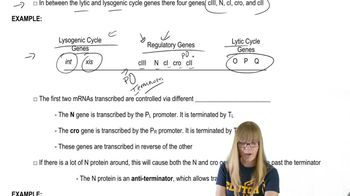
Bacteriophage Regulation

Transcription and Translation Differences

Eukaryotic genes typically undergo post-transcriptional modifications, such as splicing and polyadenylation, which are not present in prokaryotes. Bacteria lack the machinery for splicing introns, so inserting a eukaryotic gene directly may lead to non-functional transcripts. To express a eukaryotic gene in bacteria, it is crucial to use a cDNA version of the gene that excludes introns.
Recommended video:
Guided course
07:58
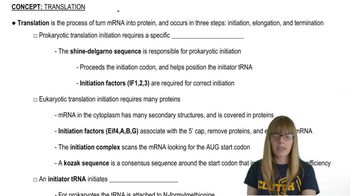
Translation initiation

Codon Usage Bias

Different organisms have varying preferences for specific codons, known as codon usage bias. Eukaryotic genes may contain codons that are rarely used in bacteria, leading to inefficient translation. To enhance protein production in bacterial cells, it may be necessary to optimize the gene's coding sequence to match the codon preferences of the bacterial host.
Recommended video:
Guided course
08:28
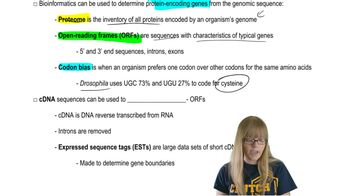
Bioinformatics
Related Practice
Textbook Question

The human β-globin wild-type allele and a certain mutant allele are identical in sequence except for a single base-pair substitution that changes one nucleotide at the end of intron 2. The wild-type and mutant sequences of the affected portion of pre-mRNA are

This is one example of how DNA sequence change occurring somewhere other than in an exon can produce mutation. List other kinds of DNA sequence changes occurring outside exons that can produce mutation. In each case, characterize the kind of change you would expect to see in mutant mRNA or mutant protein.

491
views
Textbook Question

Microbiologists describe the processes of transcription and translation as 'coupled' in bacteria. This term indicates that a bacterial mRNA can be undergoing transcription at the same moment it is also undergoing translation.

How is coupling of transcription and translation possible in bacteria?

821
views
Textbook Question

A full-length eukaryotic gene is inserted into a bacterial chromosome. The gene contains a complete promoter sequence and a functional polyadenylation sequence, and it has wild-type nucleotides throughout the transcribed region. However, the gene fails to produce a functional protein. List at least three possible reasons why this eukaryotic gene is not expressed in bacteria.

497
views
Textbook Question

The accompanying illustration shows a portion of a gene undergoing transcription. The template and coding strands for the gene are labeled, and a segment of DNA sequence is given.

For this gene segment, superimpose a drawing of RNA polymerase as it nears the end of transcription of the DNA sequence.

734
views
Textbook Question

The accompanying illustration shows a portion of a gene undergoing transcription. The template and coding strands for the gene are labeled, and a segment of DNA sequence is given.

For this gene segment indicate the direction in which RNA polymerase moves as it transcribes this gene.

579
views
Textbook Question

The accompanying illustration shows a portion of a gene undergoing transcription. The template and coding strands for the gene are labeled, and a segment of DNA sequence is given.

For this gene segment, write the polarity and sequence [TIP 1] of the RNA transcript from the DNA sequence given.

578
views