Pearson+ LogoPearson+ Logo
Ch. 9 - The Molecular Biology of Translation
Sanders - Genetic Analysis: An Integrated Approach 3rd Edition
Sanders3rd EditionGenetic Analysis: An Integrated ApproachISBN: 9780135564172Not the one you use?Change textbook
Chapter 9, Problem 32b

A eukaryotic mRNA has the following sequence. The 5' cap is indicated in italics (CAP), and the 3' poly(A) tail is indicated by italicized adenines.
5′-CAPCCAAGCGUUACAUGUAUGGAGAGAAUGAAACUGAGGCUUGCCACGUUUGUUAAGCACCUAUGCUACCGAAAAAAAAAAAAAAAAAAAAAAAA-3′
Determine the amino acid sequence of the polypeptide produced from this mRNA. Write the sequence using the three-letter and one-letter abbreviations for amino acids.

Verified step by step guidance
1
Identify the start codon (AUG) in the mRNA sequence. This is the codon where translation begins, and it codes for the amino acid Methionine (Met).
Divide the mRNA sequence into codons (groups of three nucleotides) starting from the start codon (AUG). For example, AUG, UAU, GGA, etc.
Use the genetic code table to translate each codon into its corresponding amino acid. For example, AUG codes for Methionine (Met), UAU codes for Tyrosine (Tyr), and so on.
Continue translating codons until you encounter a stop codon (UAA, UAG, or UGA). Stop codons do not code for an amino acid and signal the end of translation.
Write the resulting amino acid sequence in both three-letter and one-letter abbreviations, ensuring the sequence starts with Methionine (Met) and ends before the stop codon.

Verified video answer for a similar problem:

This video solution was recommended by our tutors as helpful for the problem above.
Video duration:
2m
Was this helpful?

Key Concepts

Here are the essential concepts you must grasp in order to answer the question correctly.

Transcription and mRNA Structure

Transcription is the process by which DNA is converted into mRNA. Eukaryotic mRNA undergoes several modifications, including the addition of a 5' cap and a 3' poly(A) tail, which protect the mRNA from degradation and assist in translation. Understanding the structure of mRNA is crucial for determining how it is read during protein synthesis.
Recommended video:
Guided course
10:14
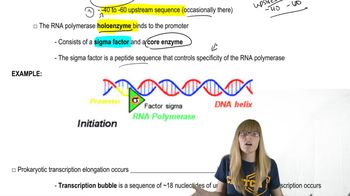
Prokaryotic Transcription

Translation and Codons

Translation is the process where ribosomes synthesize proteins by decoding mRNA. The mRNA sequence is read in sets of three nucleotides called codons, each corresponding to a specific amino acid. Familiarity with the genetic code, which maps codons to amino acids, is essential for translating the mRNA sequence into a polypeptide.
Recommended video:
Guided course
07:58
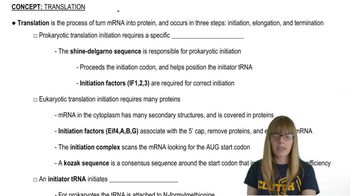
Translation initiation

Amino Acid Abbreviations

Amino acids are the building blocks of proteins, and each has a unique three-letter and one-letter abbreviation. For example, alanine is represented as 'Ala' (three-letter) and 'A' (one-letter). Knowing these abbreviations is important for accurately writing and interpreting the amino acid sequence derived from the mRNA.
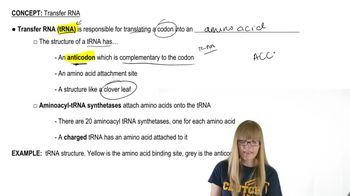
Recommended video:
Related Practice
Textbook Question

A portion of the coding strand of DNA for a gene has the sequence

5′-...GGAGAGAATGAATCT...-3′

Write out the template DNA strand sequence and polarity as well as the mRNA sequence and polarity for this gene segment.

924
views
Textbook Question

A portion of the coding strand of DNA for a gene has the sequence

5′-...GGAGAGAATGAATCT...-3′

Assuming the mRNA is in the correct reading frame, write the amino acid sequence of the polypeptide using three-letter abbreviations and, separately, the amino acid sequence using one-letter abbreviations.

1312
views
Textbook Question

A eukaryotic mRNA has the following sequence. The 5' cap is indicated in italics (CAP), and the 3' poly(A) tail is indicated by italicized adenines.

5′-CAPCCAAGCGUUACAUGUAUGGAGAGAAUGAAACUGAGGCUUGCCACGUUUGUUAAGCACCUAUGCUACCGAAAAAAAAAAAAAAAAAAAAAAAA-3′

Locate the start codon and stop codon in this sequence.

792
views
Textbook Question

Diagram a eukaryotic gene containing three exons and two introns, the pre-mRNA and mature mRNA transcript of the gene, and a partial polypeptide that contains the following sequences and features. Carefully align the nucleic acids, and locate each sequence or feature on the appropriate molecule.

a. The AG and GU dinucleotides corresponding to intron-exon junctions
b. The +1 nucleotide
c. The 5' UTR and the 3' UTR
d. The start codon sequence
e. A stop codon sequence
f. A codon sequence for the amino acids Gly-His-Arg at the end of exon 1 and a codon sequence for the amino acids Leu-Trp-Ala at the beginning of exon 2

911
views
Textbook Question

Table C contains DNA-sequence information compiled by Marilyn Kozak (1987). The data consist of the percentage of A, C, G, and T at each position among the 12 nucleotides preceding the start codon in 699 genes from various vertebrate species and at the first nucleotide after the start codon. (The start codon occupies positions +1 to +3 and the first nucleotide immediately after the start codon occupies position +4) Use the data to determine the consensus sequence for the 13 nucleotides ( -12 to -1 and +4) surrounding the start codon in vertebrate genes.

642
views
Textbook Question

Table D lists α-globin and β-globin gene sequences for the 11 or 12 nucleotides preceding the start codon and the first nucleotide following the start codon (see Problem 34). The data are for 16 vertebrate globin genes reported by Kozak (1987). The sequences are written from -12 to +4 with the start codon sequence in capital letters. Use the data in this table to:

Determine the consensus sequence for the 16 selected α-globin and β-globin genes.

547
views