Pearson+ LogoPearson+ Logo
Ch. 9 - The Molecular Biology of Translation
Sanders - Genetic Analysis: An Integrated Approach 3rd Edition
Sanders3rd EditionGenetic Analysis: An Integrated ApproachISBN: 9780135564172Not the one you use?Change textbook
Chapter 9, Problem 34

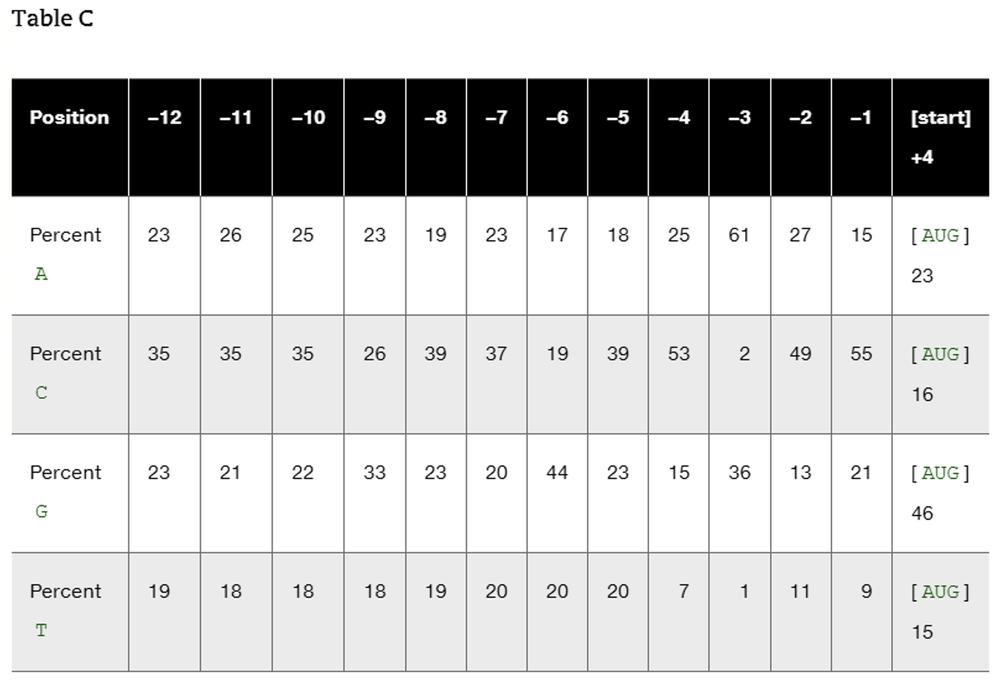
Table C contains DNA-sequence information compiled by Marilyn Kozak (1987). The data consist of the percentage of A, C, G, and T at each position among the 12 nucleotides preceding the start codon in 699 genes from various vertebrate species and at the first nucleotide after the start codon. (The start codon occupies positions +1 to +3 and the first nucleotide immediately after the start codon occupies position +4) Use the data to determine the consensus sequence for the 13 nucleotides ( -12 to -1 and +4) surrounding the start codon in vertebrate genes.
Table C displays the percentage of nucleotides A, C, G, and T at positions surrounding the start codon in vertebrate genes.

Verified step by step guidance
1
Step 1: Understand the problem. The goal is to determine the consensus sequence for the 13 nucleotides surrounding the start codon in vertebrate genes using the provided data. A consensus sequence represents the most common nucleotide at each position across multiple sequences.
Step 2: Analyze the data in Table C. For each position (from -12 to +1 relative to the start codon), calculate the frequency of each nucleotide (A, C, G, T). Identify the nucleotide with the highest percentage at each position.
Step 3: Construct the consensus sequence. For each position, select the nucleotide with the highest frequency from the data. Combine these nucleotides sequentially to form the consensus sequence spanning positions -12 to +1.
Step 4: Verify the sequence. Ensure that the selected nucleotides accurately reflect the highest frequency at each position and confirm that the sequence aligns with the start codon (positions -3 to -1 should correspond to the start codon, typically AUG in mRNA).
Step 5: Interpret the results. Discuss the biological significance of the consensus sequence, such as its role in translation initiation and how it may vary across vertebrate species.

Verified video answer for a similar problem:

This video solution was recommended by our tutors as helpful for the problem above.
Video duration:
3m
Was this helpful?

Key Concepts

Here are the essential concepts you must grasp in order to answer the question correctly.

Consensus Sequence

A consensus sequence is a sequence of DNA that represents the most common nucleotide at each position across a set of sequences. It is derived from multiple sequences and highlights the nucleotides that are most frequently observed, providing insights into functional elements such as promoters or start codons. In this context, the consensus sequence will help identify the typical nucleotides surrounding the start codon in vertebrate genes.
Recommended video:
Guided course
08:55
Sequencing Overview

Start Codon

The start codon is a specific nucleotide triplet in mRNA that signals the beginning of translation, typically AUG, which codes for the amino acid methionine. It is crucial for the proper initiation of protein synthesis. Understanding its position and the surrounding nucleotides is essential for analyzing gene expression and the translation process in vertebrates.
Recommended video:
Guided course
07:58
Translation initiation

Nucleotide Composition

Nucleotide composition refers to the relative abundance of the four nucleotides (adenine, cytosine, guanine, and thymine) in a given DNA sequence. Analyzing the nucleotide composition at specific positions can reveal patterns that are important for gene regulation and function. In this case, it helps in determining the consensus sequence by examining the frequency of each nucleotide around the start codon.
Recommended video:
Guided course
06:51
Human Genome Composition
Related Practice
Textbook Question

A eukaryotic mRNA has the following sequence. The 5' cap is indicated in italics (CAP), and the 3' poly(A) tail is indicated by italicized adenines.

5′-CAPCCAAGCGUUACAUGUAUGGAGAGAAUGAAACUGAGGCUUGCCACGUUUGUUAAGCACCUAUGCUACCGAAAAAAAAAAAAAAAAAAAAAAAA-3′

Locate the start codon and stop codon in this sequence.

792
views
Textbook Question

A eukaryotic mRNA has the following sequence. The 5' cap is indicated in italics (CAP), and the 3' poly(A) tail is indicated by italicized adenines.

5′-CAPCCAAGCGUUACAUGUAUGGAGAGAAUGAAACUGAGGCUUGCCACGUUUGUUAAGCACCUAUGCUACCGAAAAAAAAAAAAAAAAAAAAAAAA-3′

Determine the amino acid sequence of the polypeptide produced from this mRNA. Write the sequence using the three-letter and one-letter abbreviations for amino acids.

758
views
Textbook Question

Diagram a eukaryotic gene containing three exons and two introns, the pre-mRNA and mature mRNA transcript of the gene, and a partial polypeptide that contains the following sequences and features. Carefully align the nucleic acids, and locate each sequence or feature on the appropriate molecule.

a. The AG and GU dinucleotides corresponding to intron-exon junctions
b. The +1 nucleotide
c. The 5' UTR and the 3' UTR
d. The start codon sequence
e. A stop codon sequence
f. A codon sequence for the amino acids Gly-His-Arg at the end of exon 1 and a codon sequence for the amino acids Leu-Trp-Ala at the beginning of exon 2

911
views
Textbook Question

Table D lists α-globin and β-globin gene sequences for the 11 or 12 nucleotides preceding the start codon and the first nucleotide following the start codon (see Problem 34). The data are for 16 vertebrate globin genes reported by Kozak (1987). The sequences are written from -12 to +4 with the start codon sequence in capital letters. Use the data in this table to:

Determine the consensus sequence for the 16 selected α-globin and β-globin genes.

547
views
Textbook Question

Table D lists α-globin and β-globin gene sequences for the 11 or 12 nucleotides preceding the start codon and the first nucleotide following the start codon (see Problem 34). The data are for 16 vertebrate globin genes reported by Kozak (1987). The sequences are written from -12 to +4 with the start codon sequence in capital letters. Use the data in this table to:

Compare the consensus sequence for these globin genes to the consensus sequence derived from the larger study of 699 vertebrate genes in Problem 34. 

551
views
Textbook Question

The six nucleotides preceding the start codon and the first nucleotide after the start codon in eukaryotes exhibit strong sequence conservation as determined by the percentages of nucleotides in the  to  positions and the  position (see Problem 34). Use the data given in the table for Problem 35 to determine the seven nucleotides that most commonly surround the start in vertebrates.

432
views