
Textbook Question
Consider translation of the following mRNA sequence:
5′-...AUGCAGAUCCAUGCCUAUUGA...-3′
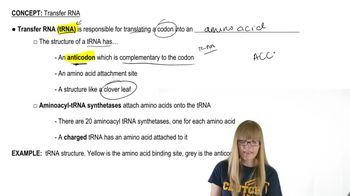
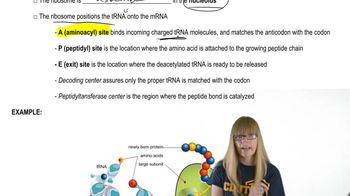
What is the anticodon triplet sequence of the next tRNA to interact with mRNA?
571
views

 Verified step by step guidance
 08:39
08:39
 03:49
03:49Consider translation of the following mRNA sequence:
5′-...AUGCAGAUCCAUGCCUAUUGA...-3′
What is the anticodon triplet sequence of the next tRNA to interact with mRNA?
If you were to look up Gaucher disease on the OMIM website, you would see that there are three major types, designated Type I (OMIM 230800), Type II (OMIM 230900), and Type III (OMIM 231000). All three types are mutations of the gene for acid-β-glucosidase, encoded on chromosome 1. Different mutations of this gene produce the three types of Gaucher disease that differ somewhat in their symptoms and disease severity.
For each mutation, speculate about whether the acid-β-glucosidase enzyme is merely reduced in function or whether its production is eliminated, and explain why.
Consider translation of the following mRNA sequence:
5′-...AUGCAGAUCCAUGCCUAUUGA...-3′
What events occur to permit the next tRNA to interact with mRNA?
If a man and a woman are each heterozygous carriers of a mutation causing a disease on the RUSP list, what do you think are the three or four most important factors they should consider in their decision making about having children?
Suppose a man and a woman are each heterozygous carriers of a mutation causing a fatal hereditary disease not on the RUSP list. Prenatal genetic testing can identify the genotype of a fetus with regard to this disease and can identify fetuses with the disease. What do you think are the three or four most important factors this couple should consider in their decision making about having children?
Compare and contrast the composition and structure of bacterial and eukaryotic ribosomes, identifying at least three features that are the same and three features that are unique to each type of ribosome.