Pearson+ LogoPearson+ Logo
Ch. 9 - The Molecular Biology of Translation
Sanders - Genetic Analysis: An Integrated Approach 3rd Edition
Sanders3rd EditionGenetic Analysis: An Integrated ApproachISBN: 9780135564172Not the one you use?Change textbook
Chapter 9, Problem 25c

An experiment by Khorana and his colleagues translated a synthetic mRNA containing repeats of the trinucelotide UUG.
How does the result of this experiment help confirm the triplet nature of the genetic code?

Verified step by step guidance
1
Understand the context: The genetic code is composed of codons, which are sequences of three nucleotides that correspond to specific amino acids. The experiment by Khorana used a synthetic mRNA with repeating trinucleotide sequences (UUG) to investigate how these codons are translated into amino acids.
Recognize the significance of repeating trinucleotides: When the mRNA contains repeating sequences like UUG, the ribosome reads the sequence in sets of three nucleotides (triplets). This ensures that the genetic code is interpreted in a consistent manner during translation.
Analyze the experimental outcome: The translation of the synthetic mRNA would produce a polypeptide with a repeating pattern of amino acids. For example, UUG could code for one amino acid, and the next UUG triplet would code for the same or a different amino acid, depending on the genetic code.
Connect the results to the triplet nature of the genetic code: The experiment confirms that the genetic code operates in triplets because the repeating trinucleotide sequence (UUG) leads to a predictable and repeating pattern of amino acids in the resulting polypeptide. If the code were not triplet-based, the translation would not produce such a regular pattern.
Conclude the importance of the experiment: This experiment provides strong evidence that the genetic code is read in sets of three nucleotides (triplets), reinforcing the understanding of codon-based translation and the triplet nature of the genetic code.

Verified video answer for a similar problem:

This video solution was recommended by our tutors as helpful for the problem above.
Video duration:
3m
Was this helpful?

Key Concepts

Here are the essential concepts you must grasp in order to answer the question correctly.

Triplet Nature of the Genetic Code

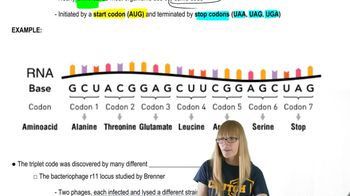
The genetic code is composed of nucleotide sequences that are read in groups of three, known as codons. Each codon corresponds to a specific amino acid or a stop signal during protein synthesis. This triplet nature is fundamental to how genetic information is translated into proteins, as it allows for 64 possible combinations from the four nucleotides, accommodating the 20 standard amino acids.
Recommended video:
Guided course
11:43
The Genetic Code

Synthetic mRNA and Translation

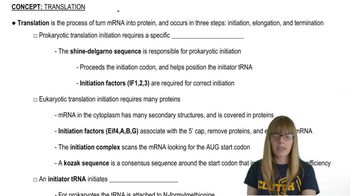
Synthetic mRNA is artificially created RNA that can be designed to contain specific sequences of nucleotides. In the experiment by Khorana, the synthetic mRNA with repeated UUG codons was used to study how ribosomes translate these sequences into proteins. This process demonstrates how the sequence of nucleotides in mRNA dictates the sequence of amino acids in a protein, thereby confirming the triplet nature of the genetic code.
Recommended video:
Guided course
07:58
Translation initiation

Experimental Confirmation in Genetics

Experimental confirmation in genetics involves conducting controlled experiments to validate hypotheses about genetic mechanisms. Khorana's experiment provided empirical evidence for the triplet nature of the genetic code by showing that specific sequences of mRNA lead to predictable and consistent protein synthesis. This type of experimental approach is crucial for establishing the principles of molecular biology and genetics.
Recommended video:
Guided course
03:45
Descriptive Genetics