Pearson+ LogoPearson+ Logo
Ch.4 Introduction to Organic Compounds
Frost - General, Organic and Biological Chemistry 4th Edition
Frost4th EditionGeneral, Organic and Biological ChemistryISBN: 9780134988696Not the one you use?Change textbook
Chapter 1, Problem 58b

Draw skeletal structures for each of the following molecules:
(b) cis-1-chloro-3-methylcyclohexane

Verified step by step guidance
1
Start by drawing the basic structure of cyclohexane, which is a six-membered ring of carbon atoms connected by single bonds. Represent the ring as a hexagon.
Identify the substituents: 'cis-1-chloro-3-methyl' indicates that there is a chlorine atom attached to carbon 1 and a methyl group attached to carbon 3. Both substituents are on the same side of the ring (cis configuration).
Label the carbon atoms in the cyclohexane ring from 1 to 6 in a clockwise or counterclockwise direction. Ensure that carbon 1 is where the chlorine atom will be attached.
Attach the chlorine atom to carbon 1 and the methyl group to carbon 3. Since the configuration is cis, both substituents should be drawn either both as wedges (pointing out of the plane) or both as dashes (pointing into the plane).
Double-check the structure to ensure that the substituents are correctly placed and that the cis configuration is properly represented. The skeletal structure should now be complete.

Verified video answer for a similar problem:

This video solution was recommended by our tutors as helpful for the problem above.
Video duration:
2m
Was this helpful?

Key Concepts

Here are the essential concepts you must grasp in order to answer the question correctly.

Skeletal Structures

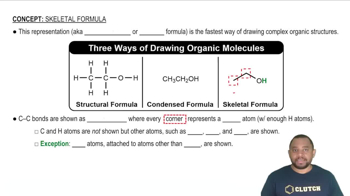
Skeletal structures are simplified representations of organic molecules that depict the arrangement of atoms without showing all the hydrogen atoms explicitly. In these diagrams, carbon atoms are represented by vertices or ends of lines, while functional groups and other atoms are shown as symbols. This method allows chemists to visualize complex molecules more easily and focus on the connectivity and geometry of the structure.
Recommended video:
Guided course
2:26
Skeletal Formula Concept 1

Cis-Trans Isomerism

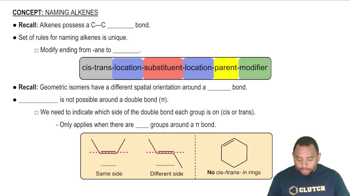
Cis-trans isomerism is a form of stereoisomerism where the spatial arrangement of groups around a double bond or a ring structure differs. In cis isomers, similar groups are on the same side, while in trans isomers, they are on opposite sides. Understanding this concept is crucial for accurately drawing and interpreting the structure of molecules like cis-1-chloro-3-methylcyclohexane, where the positioning of substituents affects the molecule's properties.
Recommended video:
Guided course
2:47
Rules for Naming Alkenes Concept 1

Cyclohexane Conformation

Cyclohexane can adopt various conformations, primarily the chair and boat forms, which influence the stability and reactivity of substituents on the ring. The chair conformation is the most stable due to minimized steric strain, while substituents can occupy axial or equatorial positions. Recognizing these conformations is essential for accurately representing the structure of cyclohexane derivatives, such as cis-1-chloro-3-methylcyclohexane, and understanding their chemical behavior.
Recommended video:
Guided course
03:25
Periodic Table: Phases (Simplified) Concept 1