Pearson+ LogoPearson+ Logo
Ch.17 Carboxylic Acids and Their Derivatives
McMurry - Fundamentals of GOB 8th Edition
McMurry8th EditionFundamentals of GOBISBN: 9780134015187Not the one you use?Change textbook
Chapter 17, Problem 59b

Give systematic names for the following structures and structures for the names:
b. N-Phenylacetamide

Verified step by step guidance
1
Step 1: Break down the name 'N-Phenylacetamide' into its components. The prefix 'N-' indicates that a substituent is attached to the nitrogen atom of the amide group. 'Phenyl' refers to a benzene ring (C₆H₅) as a substituent. 'Acetamide' is the parent compound, which consists of an amide group (-CONH₂) attached to a methyl group (CH₃).
Step 2: Identify the parent structure. The parent compound is 'acetamide,' which has the structure CH₃CONH₂. This is the simplest amide, with a methyl group attached to the carbonyl carbon.
Step 3: Attach the phenyl group to the nitrogen atom. The 'N-' prefix specifies that the phenyl group (C₆H₅) is bonded directly to the nitrogen atom of the amide group, replacing one of the hydrogen atoms on the nitrogen.
Step 4: Combine the components to construct the full structure. The final structure will have a benzene ring (C₆H₅) attached to the nitrogen atom of the amide group, and the carbonyl carbon will still be bonded to a methyl group (CH₃).
Step 5: Verify the systematic name. Ensure that the name 'N-Phenylacetamide' correctly describes the structure, with the phenyl group on the nitrogen and the acetamide group as the parent compound.

Verified video answer for a similar problem:

This video solution was recommended by our tutors as helpful for the problem above.
Was this helpful?

Key Concepts

Here are the essential concepts you must grasp in order to answer the question correctly.

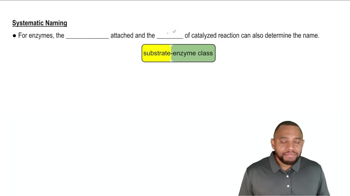
Systematic Naming in Chemistry

Systematic naming in chemistry refers to the IUPAC (International Union of Pure and Applied Chemistry) rules used to create unique and descriptive names for chemical compounds. This method ensures that each compound has a specific name that reflects its structure and composition, allowing for clear communication among chemists. For example, the name 'N-Phenylacetamide' indicates the presence of a phenyl group attached to the nitrogen of an acetamide.
Recommended video:
Guided course
0:38
Systematic Naming Concept 2

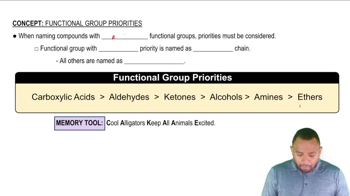
Functional Groups

Functional groups are specific groups of atoms within molecules that are responsible for the characteristic chemical reactions of those molecules. In the case of N-Phenylacetamide, the acetamide functional group (-CONH2) is crucial as it defines the compound's properties and reactivity. Recognizing functional groups is essential for understanding the behavior of organic compounds.
Recommended video:
Guided course
1:11
Functional Group Priorities Concept 1

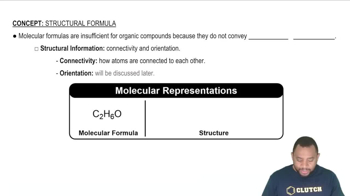
Structural Representation

Structural representation involves depicting the arrangement of atoms within a molecule, which can be illustrated through various formats such as Lewis structures, condensed formulas, or skeletal structures. For N-Phenylacetamide, a structural representation would show the acetamide backbone with the phenyl group attached to the nitrogen atom, providing insight into the compound's geometry and bonding.
Recommended video:
Guided course
2:08
Molecular Representations Concept 1