Pearson+ LogoPearson+ Logo
Ch.17 Carboxylic Acids and Their Derivatives
McMurry - Fundamentals of GOB 8th Edition
McMurry8th EditionFundamentals of GOBISBN: 9780134015187Not the one you use?Change textbook
Chapter 17, Problem 62

Procaine, a local anesthetic whose hydrochloride is Novocain, has the following structure. Identify the functional groups present, and show the structures of the alcohol and carboxylic acids you would use to prepare procaine.

Verified step by step guidance
1
Examine the structure of procaine carefully to identify the functional groups. Look for characteristic features such as hydroxyl (-OH), carboxyl (-COOH), amine (-NH2), ester (-COOR), or aromatic rings.
Identify the ester functional group in procaine. An ester is characterized by the general structure R-COOR', where R and R' are hydrocarbon groups. This indicates that procaine is formed from a reaction between an alcohol and a carboxylic acid.
Determine the alcohol used to form the ester. To do this, break the ester bond (C-O bond) and assign the -OH group to one of the fragments. This fragment represents the alcohol used in the synthesis.
Determine the carboxylic acid used to form the ester. The remaining fragment after breaking the ester bond will contain the -COOH group, which represents the carboxylic acid used in the synthesis.
Draw the structures of the identified alcohol and carboxylic acid. Ensure that the structures are consistent with the original procaine molecule and verify that combining them through an esterification reaction would recreate the ester group in procaine.

Key Concepts

Here are the essential concepts you must grasp in order to answer the question correctly.

Functional Groups

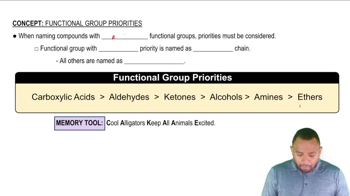
Functional groups are specific groups of atoms within molecules that are responsible for the characteristic chemical reactions of those molecules. In organic chemistry, common functional groups include alcohols, carboxylic acids, amines, and esters. Identifying these groups in a compound like procaine is essential for understanding its chemical behavior and reactivity.
Recommended video:
Guided course
1:11
Functional Group Priorities Concept 1

Alcohols

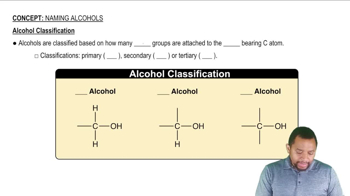
Alcohols are organic compounds characterized by the presence of one or more hydroxyl (-OH) groups attached to a carbon atom. They can be classified as primary, secondary, or tertiary based on the carbon to which the hydroxyl group is attached. In the synthesis of procaine, the alcohol used will contribute to the formation of the ester linkage that is crucial for its structure.
Recommended video:
Guided course
1:10
Alcohol Classification Concept 2

Carboxylic Acids

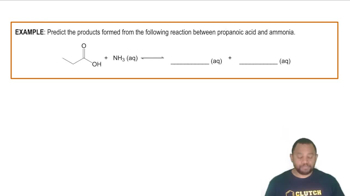
Carboxylic acids are organic acids that contain a carboxyl group (-COOH), which consists of a carbonyl (C=O) and a hydroxyl (-OH) group. These acids are important in organic synthesis, as they can react with alcohols to form esters through a process called esterification. Identifying the appropriate carboxylic acid is vital for preparing procaine, as it will determine the properties of the final compound.
Recommended video:
Guided course
1:09
Carboxylic Acid Reactions Example 1