Pearson+ LogoPearson+ Logo
Ch.4 Introduction to Organic Compounds
Frost - General, Organic and Biological Chemistry 4th Edition
Frost4th EditionGeneral, Organic and Biological ChemistryISBN: 9780134988696Not the one you use?Change textbook
Chapter 1, Problem 24c

Give the correct name for each of the following substituents:
(c) I―

Verified step by step guidance
1
Step 1: Recognize that the substituent 'I' represents the iodine atom, which is a halogen element in the periodic table.
Step 2: Understand that halogen substituents are named by using the root of the element's name followed by the suffix '-o'. For iodine, the root is 'iod'.
Step 3: Combine the root 'iod' with the suffix '-o' to form the name of the substituent, which is 'iodo'.
Step 4: Note that the substituent name 'iodo' is used when iodine is attached to a parent chain or ring in an organic compound.
Step 5: Ensure that the substituent name 'iodo' is correctly applied in the context of the compound's overall nomenclature.

Verified video answer for a similar problem:

This video solution was recommended by our tutors as helpful for the problem above.
Video duration:
1m
Was this helpful?

Key Concepts

Here are the essential concepts you must grasp in order to answer the question correctly.

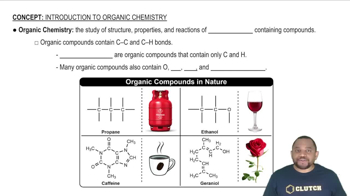
Substituents in Organic Chemistry

Substituents are atoms or groups of atoms that replace hydrogen atoms in a hydrocarbon chain. They can significantly influence the chemical properties and reactivity of the molecule. Understanding the nature of substituents is crucial for naming organic compounds and predicting their behavior in chemical reactions.
Recommended video:
Guided course
2:26
Introduction to Organic Chemistry Concept 1

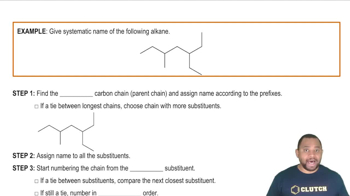
Iodine as a Substituent

In organic chemistry, iodine (I) is commonly recognized as a halogen substituent. When iodine replaces a hydrogen atom in a hydrocarbon, it is referred to as an 'iodo' group. This nomenclature is essential for accurately naming compounds and understanding their structural characteristics.
Recommended video:
Guided course
5:07
Naming Alkanes with Substituents Example 1

Nomenclature Rules

The IUPAC nomenclature rules provide a systematic method for naming organic compounds. These rules dictate how to identify and name substituents based on their structure and position in the molecule. Familiarity with these rules is necessary for correctly naming compounds and communicating chemical information effectively.
Recommended video:
Guided course
00:28
Solubility Rules