Pearson+ LogoPearson+ Logo
Ch.4 Introduction to Organic Compounds
Frost - General, Organic and Biological Chemistry 4th Edition
Frost4th EditionGeneral, Organic and Biological ChemistryISBN: 9780134988696Not the one you use?Change textbook
Chapter 1, Problem 26a

Draw the skeletal structure for each of the following compounds:
(a) 3-ethylhexane

Verified step by step guidance
1
Identify the parent chain: The name '3-ethylhexane' indicates that the parent chain is 'hexane,' which consists of six carbon atoms arranged in a straight chain.
Number the parent chain: Assign numbers to the carbon atoms in the hexane chain starting from the end closest to the substituent group (ethyl group). This ensures the substituent gets the lowest possible number.
Locate the substituent: The '3-ethyl' part of the name indicates that an ethyl group (-CH₂CH₃) is attached to the third carbon atom of the hexane chain.
Draw the skeletal structure: Represent the hexane chain as a zigzag line (each vertex represents a carbon atom). Attach the ethyl group to the third carbon atom as a branch extending from the main chain.
Verify the structure: Ensure the structure matches the name '3-ethylhexane,' with six carbons in the main chain and an ethyl group correctly positioned on the third carbon atom.

Verified video answer for a similar problem:

This video solution was recommended by our tutors as helpful for the problem above.
Video duration:
2m
Was this helpful?

Key Concepts

Here are the essential concepts you must grasp in order to answer the question correctly.

Skeletal Structures

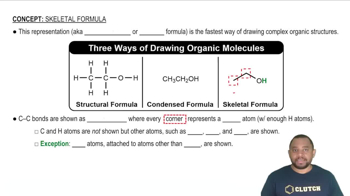
Skeletal structures, also known as line-angle formulas, are simplified representations of organic molecules. In these diagrams, carbon atoms are represented by the ends and intersections of lines, while hydrogen atoms are typically omitted for clarity. This method allows chemists to visualize the connectivity and branching of carbon chains efficiently.
Recommended video:
Guided course
2:26
Skeletal Formula Concept 1

IUPAC Nomenclature

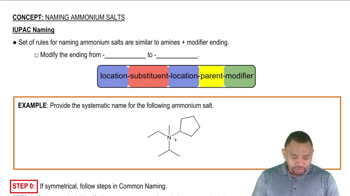
IUPAC nomenclature is a systematic method for naming organic chemical compounds. It provides a set of rules to derive the name of a compound based on its structure, including the identification of the longest carbon chain and the position of substituents. Understanding these rules is essential for accurately interpreting and drawing the structures of compounds like 3-ethylhexane.
Recommended video:
Guided course
3:18
IUPAC Naming Concept 3

Alkane Structure

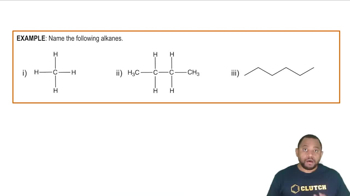
Alkanes are saturated hydrocarbons characterized by single bonds between carbon atoms. They follow the general formula CnH2n+2, where 'n' is the number of carbon atoms. Recognizing the structure of alkanes is crucial for drawing their skeletal representations, as it helps in identifying the branching and substituents present in compounds like 3-ethylhexane.
Recommended video:
Guided course
1:20
Naming Alkanes Example 1