Pearson+ LogoPearson+ Logo
Ch.4 Introduction to Organic Compounds
Frost - General, Organic and Biological Chemistry 4th Edition
Frost4th EditionGeneral, Organic and Biological ChemistryISBN: 9780134988696Not the one you use?Change textbook
Chapter 1, Problem 25a

Draw the skeletal structure for each of the following compounds:
(a) 2,3-dimethylpentane

Verified step by step guidance
1
Step 1: Understand the name of the compound '2,3-dimethylpentane'. The base name 'pentane' indicates that the main chain contains 5 carbon atoms, and the prefix 'dimethyl' indicates two methyl groups attached to the main chain.
Step 2: Draw the main chain of 5 carbon atoms in a straight line. This represents the pentane backbone. Use single bonds to connect the carbon atoms.
Step 3: Identify the positions for the methyl groups. The numbers '2' and '3' indicate that the methyl groups are attached to the second and third carbon atoms of the main chain.
Step 4: Add the methyl groups (CH₃) to the second and third carbon atoms of the pentane chain. Ensure that each carbon atom in the chain has a total of four bonds (following the octet rule).
Step 5: Verify the skeletal structure by checking that all carbon atoms have the correct number of bonds and that the structure matches the name '2,3-dimethylpentane'.

Verified video answer for a similar problem:

This video solution was recommended by our tutors as helpful for the problem above.
Video duration:
2m
Was this helpful?

Key Concepts

Here are the essential concepts you must grasp in order to answer the question correctly.

Skeletal Structures

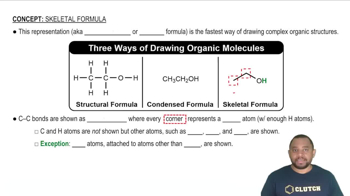
Skeletal structures are simplified representations of organic molecules that depict the arrangement of carbon atoms and their bonds. In these diagrams, carbon atoms are represented by vertices or ends of lines, while hydrogen atoms are typically omitted for clarity. This method allows chemists to visualize complex molecules more easily and focus on functional groups and connectivity.
Recommended video:
Guided course
2:26
Skeletal Formula Concept 1

IUPAC Nomenclature

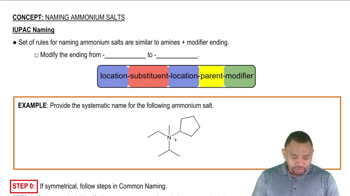
IUPAC nomenclature is a systematic method for naming organic chemical compounds based on their structure. It provides a unique name that conveys information about the number of carbon atoms, the presence of functional groups, and the arrangement of substituents. Understanding IUPAC rules is essential for interpreting compound names and translating them into accurate skeletal structures.
Recommended video:
Guided course
3:18
IUPAC Naming Concept 3

Isomerism

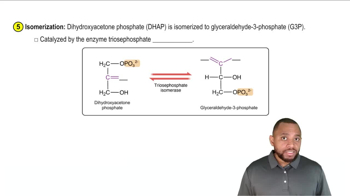
Isomerism refers to the phenomenon where compounds with the same molecular formula have different structural arrangements or spatial orientations. In the case of 2,3-dimethylpentane, isomerism is significant as it can exist in various forms depending on the positioning of the methyl groups on the pentane backbone. Recognizing isomers is crucial for accurately drawing skeletal structures and understanding the properties of the compounds.
Recommended video:
Guided course
1:26
Glycolysis Concept 5