Pearson+ LogoPearson+ Logo
Ch.15 Aldehydes and Ketones
McMurry - Fundamentals of GOB 8th Edition
McMurry8th EditionFundamentals of GOBISBN: 9780134015187Not the one you use?Change textbook
Chapter 15, Problem 4

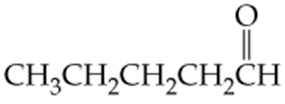
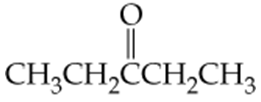
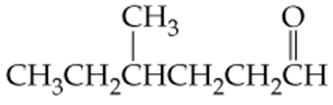
Give systematic, IUPAC names for the following compounds. Redraw each in line structure format.
a.
b.
c.
d. Dipropyl ketone

Verified step by step guidance
1
Step 1: Understand the problem. The task is to provide systematic IUPAC names for the given compounds and redraw them in line structure format. The compounds include functional groups such as ketones (C=O) and alkanes. We will name each compound systematically following IUPAC rules.
Step 2: Analyze compound (a): CH₃CH₂CH₂CH₂C=O. This is a straight-chain molecule with a ketone functional group at the end. Identify the longest carbon chain (5 carbons) and number the chain such that the ketone group gets the lowest possible number. The suffix for ketones is '-one'.
Step 3: Analyze compound (b): CH₃CH₂C=OCH₂CH₃. This is a ketone with a total of 5 carbons. Identify the longest carbon chain (5 carbons) and number it such that the ketone group gets the lowest number. The suffix '-one' is used for ketones, and the position of the ketone group is indicated by a number.
Step 4: Analyze compound (c): CH₃CH₂CH(CH₃)CH₂C=O. This is a ketone with a total of 6 carbons. Identify the longest carbon chain (6 carbons) and number it such that the ketone group gets the lowest number. Note the methyl group (-CH₃) branching off the main chain. Use the prefix 'methyl-' to indicate the branch and specify its position.
Step 5: Analyze compound (d): Dipropyl ketone. This is a common name for a ketone with two propyl groups attached to the carbonyl carbon. Convert this to its systematic IUPAC name by identifying the longest carbon chain and numbering it such that the ketone group gets the lowest number. Use the suffix '-one' for the ketone group.

Verified video answer for a similar problem:

This video solution was recommended by our tutors as helpful for the problem above.
Was this helpful?

Key Concepts

Here are the essential concepts you must grasp in order to answer the question correctly.

IUPAC Nomenclature

IUPAC nomenclature is a systematic method for naming chemical compounds, ensuring that each name conveys specific information about the structure of the compound. It involves identifying the longest carbon chain, determining functional groups, and applying rules for naming based on the type of compound, such as alkanes, alkenes, or ketones. Understanding these rules is essential for accurately naming organic compounds.
Recommended video:
Guided course
3:18
IUPAC Naming Concept 3

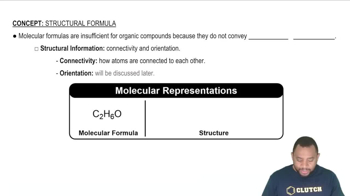
Line Structure Representation

Line structure representation is a simplified way of drawing organic molecules where carbon atoms are represented by the ends and intersections of lines, while hydrogen atoms are often omitted for clarity. This method allows chemists to visualize the connectivity of atoms in a compound without cluttering the diagram with hydrogen atoms. Mastery of this representation is crucial for interpreting and communicating molecular structures effectively.
Recommended video:
Guided course
2:08
Molecular Representations Concept 1

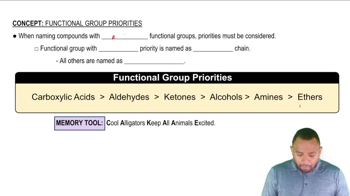
Functional Groups

Functional groups are specific groups of atoms within molecules that are responsible for the characteristic chemical reactions of those molecules. Common functional groups include hydroxyl (-OH), carbonyl (C=O), and alkyl groups (R-). Recognizing functional groups is vital for understanding the properties and reactivity of organic compounds, as they dictate how the compound behaves in chemical reactions.
Recommended video:
Guided course
1:11
Functional Group Priorities Concept 1