Pearson+ LogoPearson+ Logo
Ch.15 Aldehydes and Ketones
McMurry - Fundamentals of GOB 8th Edition
McMurry8th EditionFundamentals of GOBISBN: 9780134015187Not the one you use?Change textbook
Chapter 15, Problem 12

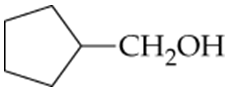
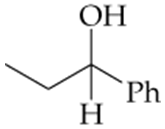
What ketones or aldehydes might be reduced to yield the following alcohols?
a.
b.
c. HOCH2–CH2–CH2OH

Verified step by step guidance
1
Step 1: Understand the reduction process. Ketones and aldehydes can be reduced to alcohols using reducing agents like NaBH4 (sodium borohydride) or LiAlH4 (lithium aluminum hydride). The carbonyl group (C=O) is converted into a hydroxyl group (OH) during this process.
Step 2: Analyze the structure of the alcohol provided in part c: HOCH₂―CH₂―CH₂OH. This is a diol, meaning it has two hydroxyl groups (-OH). Determine the possible precursor molecule by identifying where the hydroxyl groups could have originated from a carbonyl group.
Step 3: Consider the possible ketone or aldehyde precursors. For HOCH₂―CH₂―CH₂OH, the precursor could be an aldehyde with a single carbonyl group at one end of the chain, such as CHO―CH₂―CH₂OH. Alternatively, it could be a ketone with the carbonyl group in the middle of the chain, such as CH₂=O (formaldehyde) reacting with another molecule to form the diol.
Step 4: Write the general reduction reaction for aldehydes and ketones. For aldehydes: \( RCHO + [H] \rightarrow RCH₂OH \). For ketones: \( RCOR' + [H] \rightarrow RCH(OH)R' \). Apply this concept to the alcohol structure provided.
Step 5: For parts a and b, analyze the provided images (if available) to identify the alcohol structures and reverse-engineer the possible ketone or aldehyde precursors using the same reduction principles. Match the carbon skeletons and functional groups to deduce the precursors.

Verified video answer for a similar problem:

This video solution was recommended by our tutors as helpful for the problem above.
Was this helpful?

Key Concepts

Here are the essential concepts you must grasp in order to answer the question correctly.

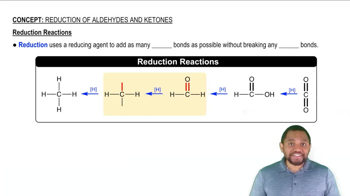
Reduction Reactions

Reduction reactions involve the gain of electrons or the decrease in oxidation state by a molecule. In organic chemistry, this often refers to the conversion of carbonyl compounds, such as ketones and aldehydes, into alcohols. Understanding the mechanisms of these reactions, including the role of reducing agents like lithium aluminum hydride or sodium borohydride, is essential for predicting the products formed.
Recommended video:
Guided course
2:38
Reduction Reactions Concept 1

Functional Groups

Functional groups are specific groups of atoms within molecules that are responsible for the characteristic chemical reactions of those molecules. In the context of the question, ketones (with a carbonyl group, C=O) and aldehydes (with a carbonyl group at the end of a carbon chain) are key functional groups that can be reduced to form alcohols, which contain hydroxyl groups (-OH). Recognizing these functional groups is crucial for identifying potential reactants.
Recommended video:
Guided course
1:11
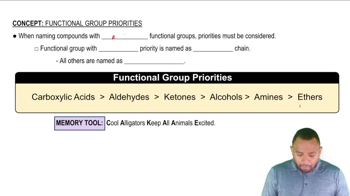
Functional Group Priorities Concept 1

Stereochemistry

Stereochemistry refers to the study of the spatial arrangement of atoms in molecules and how this affects their chemical behavior. When reducing ketones or aldehydes, the stereochemistry of the resulting alcohols can vary, leading to different isomers. Understanding stereochemistry is important for predicting the specific alcohols that can be formed from the reduction of given carbonyl compounds, especially when chiral centers are involved.
Recommended video:
Guided course
1:30
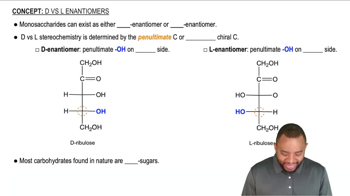
D vs L Enantiomers Concept 1