Pearson+ LogoPearson+ Logo
Ch.4 Introduction to Organic Compounds
Frost - General, Organic and Biological Chemistry 4th Edition
Frost4th EditionGeneral, Organic and Biological ChemistryISBN: 9780134988696Not the one you use?Change textbook
Chapter 1, Problem 43c

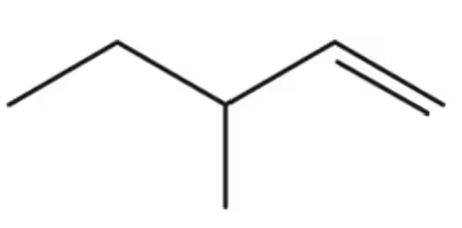
Lewis structures, condensed structural formulas, and skeletal structures are used to represent the structure of an organic compound. Each of the following compounds is shown in one of these representations. Convert each compound into the other two structural representations not shown.
(c) Skeletal formula of an organic compound showing carbon backbone and bonds.

Verified step by step guidance
1
Identify the given structure type in the problem (Lewis structure, condensed structural formula, or skeletal structure). Analyze the connectivity of atoms and the placement of bonds in the given representation.
If the given structure is a Lewis structure, convert it to a condensed structural formula by grouping atoms together based on their connectivity. For example, write CH3 for a methyl group, CH2 for a methylene group, and so on.
If the given structure is a Lewis structure, convert it to a skeletal structure by representing carbon atoms as vertices and omitting hydrogen atoms bonded to carbons. Use lines to represent bonds between carbons and other atoms.
If the given structure is a condensed structural formula, convert it to a Lewis structure by expanding the formula to show all atoms, bonds, and lone pairs explicitly. Ensure that each atom satisfies its valency (e.g., carbon forms 4 bonds, oxygen forms 2 bonds, etc.).
If the given structure is a condensed structural formula, convert it to a skeletal structure by simplifying the representation. Represent carbon atoms as vertices, omit hydrogen atoms bonded to carbons, and use lines for bonds. Include heteroatoms (e.g., O, N) explicitly and show any hydrogens attached to them.

Verified video answer for a similar problem:

This video solution was recommended by our tutors as helpful for the problem above.
Video duration:
6m
Was this helpful?

Key Concepts

Here are the essential concepts you must grasp in order to answer the question correctly.

Lewis Structures

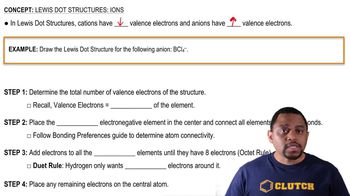
Lewis structures are diagrams that represent the bonding between atoms in a molecule and the lone pairs of electrons that may exist. They use dots to depict valence electrons and lines to indicate covalent bonds. This representation helps in visualizing the arrangement of atoms and understanding molecular geometry, reactivity, and polarity.
Recommended video:
Guided course
03:11
Lewis Dot Structures: Ions (Simplified) Concept 1

Condensed Structural Formulas

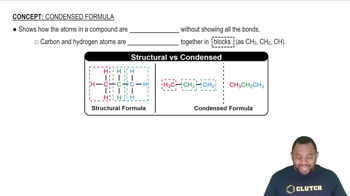
Condensed structural formulas provide a simplified way to represent the structure of a molecule by showing the connectivity of atoms without depicting all the bonds explicitly. In this format, groups of atoms are often grouped together, making it easier to read and understand the overall structure, especially for larger organic compounds.
Recommended video:
Guided course
1:53
Condensed Formula Concept 1

Skeletal Structures

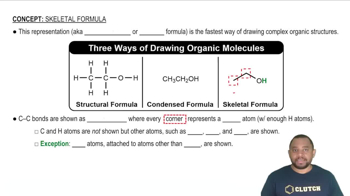
Skeletal structures, also known as line-angle formulas, are a shorthand representation of organic molecules where carbon atoms are represented by vertices and hydrogen atoms are implied. This method emphasizes the connectivity of the carbon backbone and is particularly useful for illustrating complex organic compounds in a clear and concise manner.
Recommended video:
Guided course
2:26
Skeletal Formula Concept 1