Pearson+ LogoPearson+ Logo
Ch.6 Carbohydrates Life's Sweet Molecules
Frost - General, Organic and Biological Chemistry 4th Edition
Frost4th EditionGeneral, Organic and Biological ChemistryISBN: 9780134988696Not the one you use?Change textbook
Chapter 3, Problem 15

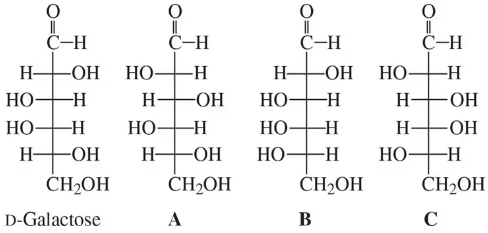
Classify structures A, B, and C in the figure as being either an enantiomer or a diastereomer of D-galactose.
Structures A, B, and C are compared to d-galactose for classification as enantiomers or diastereomers.

Verified step by step guidance
1
Examine the structure of d-galactose and identify its stereocenters. A stereocenter is a carbon atom bonded to four different groups.
Compare the stereocenters of structure A with those of d-galactose. Determine if all stereocenters are inverted (enantiomer) or if only some are inverted (diastereomer).
Repeat the comparison for structure B, analyzing its stereocenters relative to d-galactose to classify it as an enantiomer or diastereomer.
Perform the same stereocenter comparison for structure C, checking whether all or some stereocenters are inverted compared to d-galactose.
Summarize the classifications for structures A, B, and C based on the stereocenter analysis, ensuring clarity in distinguishing enantiomers (complete inversion) from diastereomers (partial inversion).

Verified video answer for a similar problem:

This video solution was recommended by our tutors as helpful for the problem above.
Video duration:
3m
Was this helpful?

Key Concepts

Here are the essential concepts you must grasp in order to answer the question correctly.

Enantiomers

Enantiomers are a type of stereoisomer that are non-superimposable mirror images of each other. They have identical physical properties except for their interaction with plane-polarized light and reactions in chiral environments. Understanding enantiomers is crucial for classifying molecules like d-galactose and its derivatives.
Recommended video:
Guided course
3:33
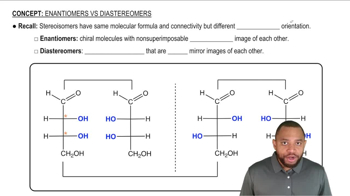
Enantiomers vs Diastereomers Concept 1

Diastereomers

Diastereomers are stereoisomers that are not mirror images of each other. They have different physical and chemical properties, which can be used to distinguish them from one another. In the context of d-galactose, identifying diastereomers involves recognizing differences in configuration at one or more but not all stereocenters.
Recommended video:
Guided course
3:33
Enantiomers vs Diastereomers Concept 1

Stereochemistry

Stereochemistry is the study of the spatial arrangement of atoms in molecules and how this affects their chemical behavior. It is essential for understanding the relationships between different forms of sugars like d-galactose, as the three-dimensional orientation of atoms determines whether a structure is an enantiomer or a diastereomer.
Recommended video:
Guided course
1:30
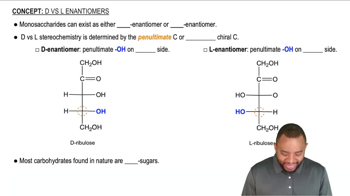
D vs L Enantiomers Concept 1